



Korea’s post 1997 recovery is often praised for its speed, but the deeper lesson lies in the structural trade offs behind that recovery. The crisis forced reform across three core areas at once: financial supervision, corporate balance sheets, and social protection. Institutions were strengthened, firms were pushed to deleverage, and welfare protections were expanded under crisis conditions. Yet because labor market flexibility moved faster than welfare coverage, the adjustment process also entrenched a lasting divide between regular and non-regular workers. Ultimately, this report argues that the most transferable lesson is not simply to move fast in crisis, but to combine rapid stabilization with social protection that matches labor market change, so that short term recovery does not harden into long term inequality and dualism.
#1997 financial crisis #institutional reform #social protection #labor market dualism
Figure 1. GDP growth (1995–2005)
Korea’s GDP growth around the Asian Financial Crisis. The chart highlights the speed of the rebound, helping explain why the recovery is often remembered as a macroeconomic success even as distributional effects persisted.
When the old rulebook broke, Korea rebuilt its economic operating system.
The post 1997 recovery was not only a rebound in output. It was a reset in how the economy was governed under global finance. The crisis exposed a system that could grow fast but became fragile once international capital moved at full speed.
Across the sources, one explanation stands out: Korea’s crisis was less about classic “macro mismanagement” and more about weaknesses inside the corporate and financial system, reinforced by governance failures. Short term external borrowing, weak supervision, and opaque chaebol structures made growth appear sustainable until confidence turned. When the regional shock arrived, it triggered these underlying vulnerabilities and pushed the system into crisis.
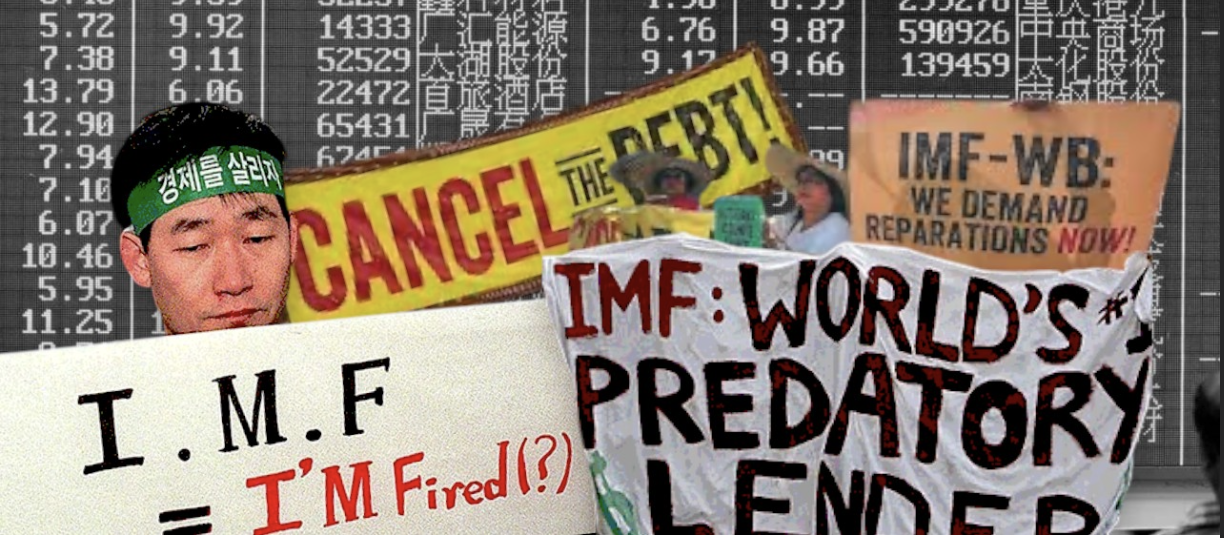
What followed was reform at crisis speed because the existing rules no longer worked. This reset did not take place in a purely domestic vacuum. In December 1997, Korea accepted a 58 billion dollar IMF led bailout, and the package went beyond emergency financing to require broad reforms across banking, corporate governance, and labor markets. Because the rescue was tied to restoring international credibility during a wider regional crisis, Korea’s reform path was shaped not only by internal weaknesses but also by the external constraints imposed through IMF conditionality.
The reset centered on three lasting changes:
Korea’s financial vulnerability was driven by short term lending incentives and weak monitoring. Many short term loans were treated as routine trade financing and were not closely supervised, encouraging borrowing while quietly increasing rollover risk.
When confidence collapsed, refinancing became impossible. This is how liquidity crises become systemic: the problem is not only the existence of debt, but the inability to roll it over when lenders panic.
By the end of 1997, usable reserves had fallen to about 9.1 billion dollars, while short term external debt stood at 63.8 billion dollars. By late November, total external debt had reached 157 billion dollars, with about 40 percent in short term liabilities and over 70 percent held by financial institutions. The risk lay not only in the size of the debt, but in its maturity structure: a system dependent on short term borrowing could unravel quickly once rollover stopped.
The reform response aimed to reduce this vulnerability. The IMF linked program went beyond standard stabilization and pushed broad institutional reform across banking and corporate sectors. In practice, this meant tighter supervision, improved transparency, and stronger regulatory oversight so that liquidity risk would become more visible and more manageable.
Figure 2. Liquidity vulnerability ratio (1994–2000)
The key takeaway is that Korea’s liquidity problem did not emerge suddenly in late 1997. Vulnerability had been building for several years as short term external debt rose faster than usable reserves. The reversal after the crisis shows how reserve accumulation and financial reform helped reduce dependence on short term external financing.
The crisis also forced a corporate reckoning. Korea confronted a reality it could no longer postpone: big-business balance sheets were not transparent enough, and conglomerate structures made risk hard to see.
Risks were embedded in cross-shareholdings and internal debt guarantees across affiliates. This mattered because risk was not only high; it was hard to locate. Fragility could move across affiliated firms without being fully visible to creditors, regulators, or even markets until funding conditions tightened.
By end-1996, the average debt–equity ratio of the top chaebol reached 400%—roughly twice the international banking norm of 200%. This mattered not simply because leverage was high, but because it reflected a financing model built on continued confidence, cheap refinancing, and limited transparency.
Reforms pushed toward corporate transparency under the Kim Dae-jung government, including stronger external audits and a requirement that chaebol provide combined financial statements. Restructuring also targeted the internal channels that spread risk:
Together, these measures were meant to do more than reduce debt. They were meant to make risk visible, so that firms could be disciplined earlier instead of being protected until fragility spread across the whole group. Governance changes also aimed at accountability and monitoring, including requiring outside directors and increasing accountability for management failures.
Table 1. Corporate governance reset
The table shows that post crisis corporate reform was designed not only to reduce leverage, but also to make risk easier to see. By requiring combined financial statements, limiting internal guarantees, and strengthening outside oversight, the reforms made it harder for chaebol to hide group wide fragility and easier for creditors and regulators to impose discipline earlier.
One of the most important institutional changes after 1997 was a shift in the purpose of bankruptcy and restructuring.
Korea’s cumulative external debt rose sharply from 42 billion dollars in 1992 to 157 billion dollars in November 1997, much of it linked to private financial institutions. That buildup helps explain why a policy of simply preserving large firms became harder to sustain.
Bankruptcy reform marked a turning point. Post crisis changes in the court administered system made economic efficiency criteria more important than social or political considerations in deciding which firms entered rehabilitation. In effect, exit became part of recovery policy: not simply a way to close firms, but a means of redirecting capital and credit away from weak or protected actors toward more viable uses.
Table 2 illustrates this shift from firm preservation toward selection and resource reallocation.
Table 2. Why “exit” reform matters
The table shows that post crisis restructuring reform changed not only procedures, but the purpose of intervention itself. Rather than preserving weak firms by default, the new framework increasingly used bankruptcy and rehabilitation to distinguish viable firms from nonviable ones and to reallocate resources accordingly.
Key takeaway: Post-crisis exit reform made failure more governable, helping shift restructuring from protection toward reallocation.
Who carried the risk after 1997, and what legacies remained?
The crisis did not only force Korea to restructure firms and banks. It forced the country to renegotiate something more basic: what counted as a normal working life, and what the state should do when the labor market stopped being stable.
After 1997, the risks of unemployment and downward movement into non-regular work became widespread, and the pain was amplified because the social safety net was still thin. The old bargain of growth plus stability, with lifetime employment as a norm, gave way to insecurity at scale.
Korea had lived with sustained growth for so long that the country was not prepared for mass unemployment, and lifelong job security had symbolized the employment system. Once that norm cracked, insecurity was no longer only temporary. It became a new baseline expectation.
This is also where the crisis stopped being only economic. Before the crisis, many people shared expectations around lifetime employment and social stability. After the crisis, those expectations weakened, and broader trust in social relations also began to erode.
That shift appeared not only in jobs, but also in how people saw their place in society. Survey self-identification moved sharply: the share calling themselves middle class fell from 61.1% to 45.1%, while the share identifying as low classrose from 34.3% to 54%; the upper class share fell from 4.3% to 0.6%.
Many households hit by unemployment were not effectively protected by social programs and relied heavily on private coping strategies, including savings, family income, and borrowing.
The state responded quickly on three fronts:
Over time, the long tail became clearer. Even after macroeconomic stabilization, labor-market cleavages sharpened between regular and non-regular work. By 1999, 92% of newly employed workers entered non-regular jobs, showing how adjustment had shifted risk onto more insecure forms of work.
Figure 3. Unemployment shock (1995–2002)
The figure shows how abruptly unemployment rose after the crisis, climbing from about 2.5 percent in 1996 to nearly 7 percent in 1998 to 1999. The key point is that job loss became widespread in a very short period, exposing how unprepared the pre-crisis safety net was for mass unemployment.
The unemployment shock was only the first visible sign of a broader social shift. More fundamentally, the crisis changed how risk was distributed, who was protected, and what role the state was expected to play in cushioning labor market instability.
Table 3. Social contract shift: before vs after 1997
The table highlights how the social contract changed after 1997. Protection expanded, but labor market risk also became more visible and more unevenly distributed. In this sense, the crisis produced not only a larger safety net, but also a more segmented pattern of security.
Key takeaway: Protection expanded after 1997, but uneven reach helped lock in a more segmented labor market.
The case for “speed with protection”
Korea’s experience supports a clear position: fast stabilization is necessary, but if social protection lags behind labor adjustment, the long tail is dualism, inequality pressure, and politicized reform.
The institutional reforms in Section 1 were designed to restore financial credibility. But credibility alone does not prevent social fracture if workers bear adjustment costs without matching protection.
After the crisis, labor reforms increased flexibility, but they also strengthened segmentation between core regular workers and peripheral contingent workers. Reforms aimed to broaden coverage, but many low-income families still remained outside effective protection, partly because compliance was weaker among insecure workers and the self-employed.
In a globalized economy, money can leave fast. When it does, you need a backstop. After 1997, Korea strengthened its ability to handle liquidity shocks, building buffers and crisis-time tools that reduced the odds that panic would become collapse.
The parallel is straightforward:
The distributional side deteriorated quickly: the Gini coefficient rose from 0.3005 to 0.3222 between Q3 1997 and Q3 1998, showing how fast adjustment pressures translated into inequality.
The external side moved just as abruptly: net private capital outflows in late 1997 reached $26.1 billion, about 6% of annual GDP, showing how quickly confidence can disappear in an open economy.
Taken together, these patterns point to a broader lesson. Crisis management in an open economy requires backstops on both sides: financial tools to contain panic and social tools to prevent adjustment from hardening into long term inequality.
Table 4. “Speed with protection”: what to copy, what to avoid
A practical summary of sequencing choices that strengthened credibility while managing social risk. The key point is that stabilization and protection work best as one reform package, not as two separate agendas.
Korea also mobilized large scale public resources to support restructuring, including 160.5 trillion won in public funds.
Watch-out: Speed can restore market confidence while quietly weakening the social settlement. If protection does not reach the workers most exposed to adjustment, insecurity can become entrenched as dualism. When that happens, the next crisis is more likely to be political than financial.
This was the mixed longer run legacy of Korea’s post crisis adjustment.
Table 5. Legacy
The table shows that Korea’s post crisis legacy was double sided. Financial, corporate, and restructuring reforms left behind stronger institutional capacity, but the social legacy was more uneven: labor market dualism persisted even as social protection expanded. The key point is that reform success and long run segmentation can coexist.
Korea’s post 1997 recovery deserves its reputation for speed. But the deeper story is not only one of renewed growth. It is also a story of institutional reset: stronger supervision, greater transparency, and a more credible approach to restructuring and exit.
At the same time, the crisis rewrote the social contract. Employment risk became more individualized, while protection expanded through broader insurance coverage, public works, and the rights based logic embodied in the National Basic Livelihood Security system. Yet that protection did not reach all households equally, especially as the labor market shifted toward non regular work.
For that reason, the most transferable lesson is neither “reform quickly” nor “expand welfare” as separate agendas. It is a single principle: move fast with protection that matches labor market reality. Stabilization can succeed on paper while society fragments in practice, and the long tail of that fragmentation can outlast the headline recovery.