


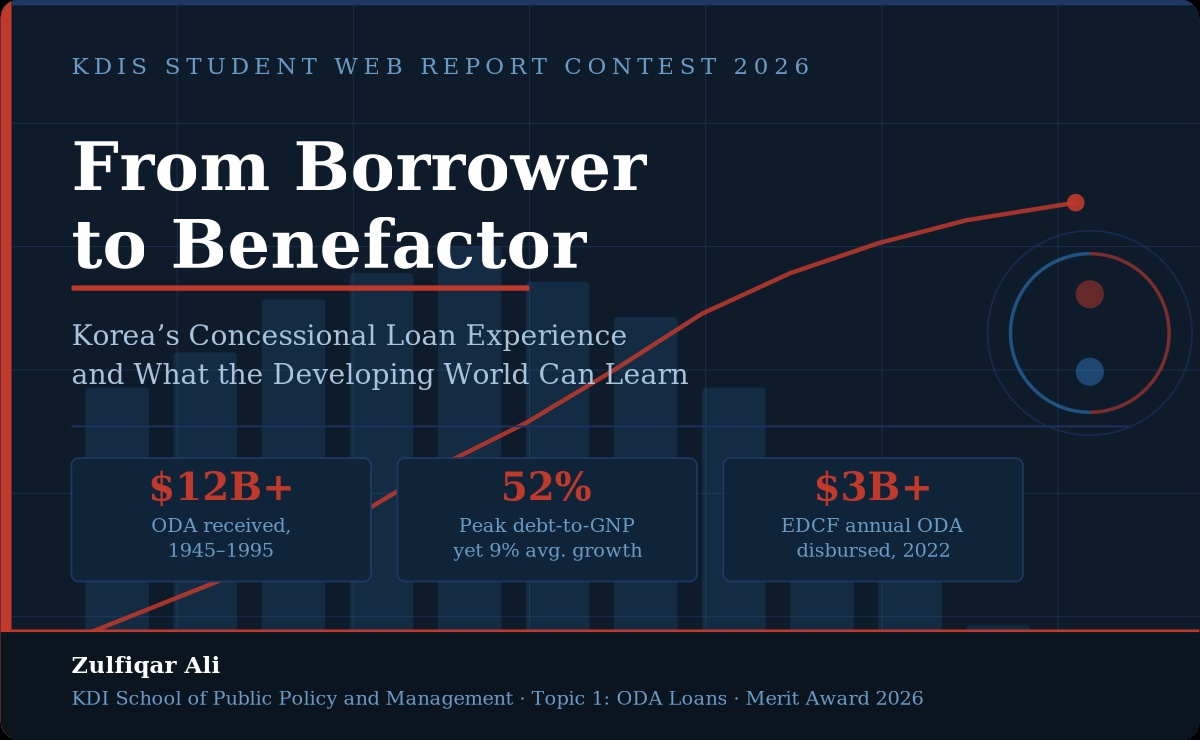

Between 1945 and the mid-1990s, Korea received over $12 billion in foreign aid and concessional loans ; more per capita than almost any peer. Today it disburses over $3 billion in development assistance annually and holds full membership in the OECD’s Development Assistance Committee. This report traces how Korea transformed borrowed capital into industrial growth, what institutional conditions made that transformation possible, and what today’s developing nations, particularly in South Asia can learn from this story. The central argument is that it was not the loans themselves that drove Korea’s rise, but the policy architecture within which they were purposively deployed
#ODALoans #DevelopmentFinance #KoreaDevelopment #EDCF #ConcessionalCredit
The Republic of Korea’s transformation over the past half-century is one of the most remarkable stories of economic development in modern history. In the 1950s, Korea was one of the poorest countries on earth, its infrastructure shattered by war and its government budget kept alive almost entirely by American aid. By the late 1990s, it had become a high-income OECD member, a global leader in semiconductors, steel, and shipbuilding.
Yet this transformation did not happen in isolation from the international financial system. It happened through it. Korea was, for four decades, one of the world’s most prolific borrowers of concessional and semi-concessional capital. And it repaid everything, on time, while using the borrowed funds to build the very industries that generated the export earnings to service its debts. This circular logic borrow to export, export to repay, repay to borrow again on better terms is the model that makes Korea’s loan story worth examining in detail.
The paradox is this: many developing countries have borrowed at similar scales and remained mired in debt. What Korea did differently is the question that gives this report its purpose.
Korea’s ODA receipts vs. selected comparators, 1960–1995
Total net ODA received (USD million, constant 2021 prices) — Korea, India, Pakistan, Nigeria
Source: OECD DAC Statistics, 2023
What to look for in this chart
▶ Korea’s bars shrink continuously from left to right, reaching near-zero by 1995. No other country in this comparison replicated this exit trajectory establishing that Korea’s graduation from aid was not accidental but the result of a deliberate financing strategy.
▶ Pakistan’s sharp peak in 1985 (~$2.15B) reflects geopolitically driven US transfers during the Soviet–Afghan War capital without the export-discipline conditions Korea imposed on itself. Compare this to Korea’s own peak of $465M in 1970: smaller in absolute terms, but purposively deployed into export-oriented factories.
▶ India and Nigeria maintain large, stable bars throughout. Their aid trajectories reflect sustained recipient-country dependence the structural contrast to Korea’s diminishing bar is the visual argument of this entire section
Korea’s GNP per capita stood at approximately $67 in 1953 below that of Ghana, Egypt, or Pakistan in the same year. The physical infrastructure of the peninsula had been largely destroyed during the Korean War. In the decade that followed, American aid financed roughly 70 percent of total South Korean imports and covered a substantial share of the government budget.
This dependence was not seen as a permanent condition, but as raw material. The decisive shift came in the 1960s under President Park Chung-hee, who reoriented Korea’s relationship with foreign capital from dependence to instrumentality. The normalization treaty with Japan in 1965, deeply controversial at home, unlocked $300 million in grants and $200 million in commercial loans that were immediately directed into infrastructure with industrial logic: the POSCO steel complex in Pohang, the Seoul-Busan expressway, and the expansion of Busan port.
$67 Korea’s GNP per capita in 1953 below Pakistan, Ghana, and Egypt
70% of total Korean imports financed by US aid in the 1950s
$14 billion borrowed from the World Bank across 120 projects, 1945–2001
2001 Year Korea’s last World Bank loan was fully repaid
Korea’s External Debt vs. GDP Growth, 1965–1995
Debt-to-GNP ratio (%) and annual GDP growth rate (%) overlaid by decade
Source: World Bank World Development Indicators, 2023
What to look for in this chart
▶ Notice the direction of movement between 1973 and 1983: as the shaded debt area climbs from 31% to its peak of 52% of GNP, the red growth line does not fall ; it averages above 9%. This co-movement is the anomaly. In most heavily-indebted developing economies debt rises and growth falls. Korea decoupled them by ensuring borrowed capital financed productive export factories rather than government consumption.
▶ The reference line at 52% GNP marks Korea’s 1983 debt peak the same year Mexico defaulted. Korea at this level of debt was simultaneously running export growth above 15% annually, because the factories that generated the debt were generating the foreign exchange to service it. The chart makes visible why debt level alone is the wrong metric for assessing development finance risk.
▶ Follow the rightward convergence from 1984 onward: debt declines steadily toward 10% while growth stays firmly positive through 1995. This is the self-liquidating logic in action — loans planted export factories; factories earned the dollars that repaid the loans; declining debt improved creditworthiness and allowed progressively better borrowing terms.
What distinguished Korea from many peers was that its borrowing was always calibrated to export-generating capacity. Foreign loans did not finance consumption subsidies or recurrent government expenditure. Every major borrowing decision passed through the Economic Planning Board (EPB) Korea’s powerful central planning agency, established in 1961 which attached loan projects to Five Year Plan industrial targets. Borrowed capital went where the plan directed it.
Even as it borrowed abroad, Korea maintained one of the highest domestic savings rates in the world averaging over 20 percent of household income through the 1970s and 1980s. Foreign loans complemented domestic capital formation; they did not substitute for it. This distinction matters enormously: Korea’s investment-to-GDP ratio routinely exceeded 30 percent, sustaining growth even as debt servicing pressures mounted during the 1979 oil shock and the global recession of 1980–81.
Korea’s relationship with concessional capital evolved through five distinct phases, each responding to a different stage of national development and a different set of financing needs.
Korea’s rural development parallel is instructive here. Just as the 1970s Saemaul Undong mobilised village-level effort toward national industrial goals, Korea’s concessional loan strategy mobilised foreign capital toward nationally defined export targets. In both cases, the central government set the direction; the resources whether loans or village labour were instruments, not ends in themselves.
“The most successful development strategies share a common denominator: they treat external finance as a catalyst, not a crutch. Korea understood this from the beginning.” — Amsden, A. H., Asia’s Next Giant (1989)
In the decade following the Korean War, South Korea’s economic survival depended almost entirely on US concessional transfers. Under the PL-480 programme, the United States provided food commodities that Korean authorities monetised domestically, using the generated counterpart funds to finance government spending. UNKRA (the United Nations Korean Reconstruction Agency) contributed reconstruction grants for schools, health facilities, and basic infrastructure.
This period established an important cultural baseline: Korean policymakers observed, at first hand, what aid without strategic direction looked like. The lesson drawn was not ingratitude — the grants were lifesaving but resolve: future foreign capital would be borrowed, not given, and borrowed for a purpose.
The 1970s were Korea’s highest-borrowing decade. President Park’s Heavy and Chemical Industrialisation (HCI) drive launched in 1973 required massive capital inputs that domestic savings alone could not supply. World Bank and Asian Development Bank loans financed power generation, petrochemicals, shipbuilding yards, and the expansion of the electronics sector. Commercial bank borrowing from international markets supplemented multilateral lending.
By 1982, Korea’s external debt had risen to over $37 billion, representing roughly 50 percent of GNP levels that triggered debt crises in Latin American economies in the same period. Yet Korea did not reschedule or default. The difference was the destination of the borrowed funds: Korean debt financed factories and infrastructure that were generating export revenue. Debt servicing came from export earnings; the model was internally consistent.
As Korea entered the 1990s, its development finance relationship was reversing. Having graduated from World Bank concessional lending in 1995 and joined the OECD in 1996, Korea was no longer a borrower in the traditional sense. Yet it had already begun lending. The Economic Development Cooperation Fund established in 1987, while Korea was still itself a significant borrower is the clearest institutional expression of what Korea had learned about development finance from the inside.
Managed by the Export-Import Bank of Korea (Korea Eximbank), EDCF provides low-interest concessional loans to developing countries for infrastructure, health systems, and education. The design reflects the Korean experience directly: EDCF loans are tied to infrastructure projects with demonstrable economic return potential, disbursed through a planning framework, and paired with technical assistance to build the absorptive capacity that Korea’s own EPB once provided domestically.
The Smart Farm Innovation Valley, discussed in the sample report on rural decline, represents Korea’s most ambitious attempt to reshape rural policy through technology. EDCF plays a structurally analogous role in the development finance story: it is the clearest institutional evidence that Korea has internalised, institutionalised, and exported the logic of its own borrowing experience.
Each EDCF loan cycle integrates:
Korea’s EDCF Cumulative Disbursements by Region, 2000–2022
USD million — Asia-Pacific, South & Southeast Asia, Africa, Other
Source: Korea Eximbank EDCF Annual Report, 2023
What to look for in this chart
▶ The area chart’s steepest acceleration occurs after 2010 marked by the DAC accession reference line. DAC membership formalised Korea’s commitment to systematic ODA scaling. From $380M in 2000 to over $3B in 2022 represents an eightfold expansion in 22 years, driven by institutional commitment, not ad hoc generosity.
▶ The donut chart’s concentration in Southeast Asia (Vietnam, Indonesia, Cambodia $6.84B combined) reflects deliberate strategic logic. These are countries where Korean firms are active investors, where infrastructure returns are high, and where Korea’s development model is most directly applicable mirroring the purposiveness that characterised Korea’s own borrowing four decades earlier.
▶ South Asia’s $3.21B share (Bangladesh, Sri Lanka, Nepal, Pakistan) deserves particular attention. These loans follow the EDCF framework: infrastructure first, technical cooperation alongside, performance-linked tranches. The question for recipient governments is whether they have built the institutional equivalent of Korea’s EPB
Despite its logic, the EDCF model faces a challenge that mirrors the limits of Korea’s own borrowing success: it requires a recipient government with sufficient institutional capacity to absorb, direct, and account for concessional finance in a disciplined way. Korea’s EPB was exceptional by the standards of developing-country governance in 1961. Many EDCF recipients today lack an equivalent.
This is not an argument against EDCF it is an argument for integrating governance capacity-building into the front end of every loan cycle, rather than appending it as an afterthought. The most productive EDCF programmes in Vietnam and Bangladesh have been those where Korean technical cooperation preceded, not followed, infrastructure investment.
“Korea is unique in being the only country to have graduated from being a major ODA recipient to becoming a full member of the OECD Development Assistance Committee and to have done so within living memory of the officials who shaped its aid architecture.” OECD DAC Peer Review: Korea (2018)
Despite the variety of scholarship on Korea’s development finance experience, several structural features of that experience are not transferable without significant qualification — and several borrowing nations have discovered this the hard way.
Korea’s Economic Planning Board was extraordinary not because planning agencies are inherently effective, but because this one had cross-governmental authority, technocratic insulation from political interference, and a clear mandate tied to measurable export targets. Most developing country planning ministries lack one or more of these attributes. When external donors including Korea’s own EDCF transfer the hardware of development finance (loan agreements, infrastructure contracts, disbursement schedules) without the institutional software (absorptive capacity, project selection discipline, evaluation frameworks), borrowed funds flow into lower-return uses.
I write this as a Pakistani national. Pakistan has received substantial concessional lending for over seven decades from the World Bank, the ADB, the IMF, and more recently China through CPEC. Yet Pakistan’s export-to-GDP ratio has remained stubbornly below 10 percent, compared to Korea’s trajectory from near-zero to over 35 percent. CPEC energy projects have generated electricity that the transmission grid cannot reliably distribute, and created dollar-denominated obligations that strain foreign exchange reserves. The loans arrived. The EPB equivalent did not.
8–10% Pakistan’s export-to-GDP ratio broadly stable for four decades
35%+ Korea’s export-to-GDP ratio by the mid-1990s, up from near-zero in 1960
1.7% Pakistan’s public spending on education as share of GDP (among Asia’s lowest)
KRW 25 trillion cumulative EDCF commitments by 2022 — but absorptive capacity varies widely
Korea’s most powerful development finance tool was not a loan instrument it was the requirement that loan-financed firms demonstrate international export competitiveness within defined timelines. Alice Amsden called these ‘reciprocal control mechanisms.’ A steel mill financed with World Bank loans had to sell steel at internationally competitive prices; if it could not, state credit was withdrawn. This kept borrowed capital perpetually being tested against a standard the firms did not control.
This discipline is extraordinarily difficult to replicate in political economies where industrial incumbents accumulate enough influence to protect their rents indefinitely which is to say, most political economies. The export market was the external disciplinarian that Korea’s state wielded against its own industrialists. Without that external standard, concessional loans risk financing protected industries that generate employment but not the foreign exchange needed to service the debt.
Perhaps the least appreciated dimension of Korea’s loan strategy is that a significant share of foreign finance was directed toward education and skills. World Bank and ADB loans in the 1970s and 1980s financed the expansion of vocational training institutes, technical universities, and science and engineering curricula. By 1990, Korea had achieved near-universal secondary enrolment. This was not a social service add-on: it was the mechanism through which borrowed capital became productive capital. Factories are only as productive as the workers who operate them.
The compounding effect is the insight most missed in development finance discussions. Human capital investment generates returns that make all subsequent investments including in loan-financed infrastructure more productive. Countries that borrow for roads but not for schools find their roads underutilised.
It would be intellectually dishonest to omit the geopolitical dimension. Korea’s heterodox state capitalism in which the government directed credit to favoured industries, maintained an undervalued currency, and protected domestic markets while demanding export performance — would not have been tolerated by Western donors under the Washington Consensus conditions applied to Africa and Latin America in the 1980s. Korea received this latitude because it sat on the Cold War’s front line, and its survival mattered to Washington as a matter of strategic priority.
This is not replicable. Today’s developing nations operate in an international finance architecture that is, for better or worse, more ideologically constrained. Korea’s path is a model of logic, not of prescription.
Korea’s development finance story underscores a central insight: the same volume of concessional borrowing can produce transformative industrialisation or chronic debt dependency, depending almost entirely on the institutional and policy architecture within which it operates. Korea borrowed more than almost any country of comparable size in the postwar era. It repaid every cent and built the export industries that made repayment possible with the borrowed funds themselves.
The erosion of that lesson in today’s development finance discourse where loan volume, interest rates, and debt sustainability ratios dominate the conversation reflects how rarely the deeper institutional conditions are examined. Korea’s Economic Planning Board, its export discipline mechanisms, its parallel investment in human capital, and its insulation of technocratic decision-making from short-term political pressures: these are the real variables that explain the outcome. They are harder to measure than loan terms and harder to transfer than infrastructure contracts.
For today’s borrowing nations, the takeaway is not to wait for better donors or more concessional terms. It is to build better borrowing institutions ones capable of directing foreign capital toward export-generating, productivity-enhancing investments, and enforcing the discipline that turns debt into development. Korea did not borrow its way to prosperity. It borrowed strategically, invested purposively, and built the institutional capacity to make the logic work. That is the model worth emulating.
“Korea’s development demonstrates that external finance is neither sufficient nor necessary for growth but that, in the right institutional hands, it can accelerate a trajectory that domestic capital alone could not.”