

Back to List
K-Dev Original

Evolution of Teacher Policy in Korea: From Quantity Expansion to Professionalization

Summary

Since the establishment of the Korean government, teacher policy has remained a central pillar of educational development, continuously evolving in response to social and economic transformation. This paper traces the historical evolution of Korea’s teacher policy through three phases: Adoption (1945–1960s), Development (1970s–1980s), and Transition (after the 1990s). Across these periods, the consistent goal has been to build and sustain a high-quality teaching workforce, with major policy shifts focusing on teacher recruitment, retention, and professional development.

Key Questions

  • How did Korea address severe teacher shortages after liberation?
  • How did Korea balance teacher supply expansion with quality assurance across different periods?
  • Why has teacher self-efficacy declined despite stable employment conditions and competitive compensation?

#Teacher policy #Pre-service Education #Professional Development

Overview

Teaching has long been highly respected in traditional Korean society, yet securing talented and devoted teachers has remained a persistent challenge. Since the establishment of the Korean government, teacher policy has been prioritized among educational issues and has been continuously adjusted in response to socio-economic development.

To understand this evolution, this article explores how Korea’s teacher policy has developed across three major historical phases—Adoption, Development, and Transition—and within three key dimensions: pre-service education and recruitment, retention and remuneration, and teacher quality and capacity building.

The Adoption Period (1945-1960s): Building a Foundation from Scratch

1) Pre-service Education and Recruitment: Teacher Shortage and Responses

Emergency Training of Elementary Teachers
Right after liberation from Japanese colonial rule, Korea faced a serious shortage of teachers who could teach in Korean. The United States Military Government (USMG) during 1945 to 1948 established teacher-training schools (“Normal Schools”) as secondary education and Temporary Teacher Training Centers to supply elementary and secondary schools with more teachers. The Rhee government also established a number of Normal Schools at the secondary level, and teacher training centers (according to the enactment of “establishment of temporary centers of teacher training and re-training” in 1953). Graduates of normal schools were granted teaching certificates upon completion of upper secondary school. So were graduates of high schools who completed an 18-week course at a training center. In 1961, all normal schools were upgraded to two-year teachers colleges; which were later upgraded to four-year institutions, National Universities of Education between 1981 and 1984; 92.7 percent of elementary school teachers had a below normal school academic background as of 1966.

Graduation day of college of teacher education (Source: Jeju Domin Ilbo)

Expansion of Secondary and Specialized Teacher Training
Seoul National University (SNU) was newly established in 1946 with 11 constituent colleges including that of education and a graduate school. SNU worked as one of the key institutions to retraining of in-service teachers, and of vocational education. Educational administration training center for principals and educational supervisors, and “reorientation” center for teachers were also set up in teachers’ college of SNU to improve the quality of teachers.

In addition, to train secondary school teachers, colleges of education were established in Seoul National University and Kyungbuk National University and one independent teachers’ college, or Kongju Teachers’ College in 1962 and there were many departments in universities teaching pedagogies and specialized subjects. From 1963, those who completed teacher training courses in general universities, and who finished graduate schools of education could acquire the certificate. The university graduates whose majors were related with industries were also entitled to teacher certificates from 1963, and many private universities were authorized to operate teachers’ colleges in 1965, to prepare students for teaching in secondary schools.

2) Retaining and Remuneration: Teacher Status and Working Conditions

The Basic Education Law enacted in 1949 stated special socio-economic treatment for teachers, and thePublic Educational Official Act in 1953defined status, qualification, service, salaries, and pension. These legal institutions materialized a salary table for teachers independent from that of other public officials. They were also guaranteed their personnel status as public officials, could enjoy job security before retirement, and were to be protected from unfair enforcement of law. The status of teachers as public officials contributed to job security, and also helped the government dispatch them even to remote areas. Owing to this system, the students in islands or other isolated areas could also benefit from mandatory schooling. In addition, with the enactment of pension for public officials in 1962, school teachers in public schools could benefit from the system, which was followed by the adoption of pension for private school teachers in 1973.

However, teachers had to endure overcrowded classroom and other unfavorable working conditions. They had to manage two or three shifts of class every day. Even worse, the salary was not competitive either. According to a survey done by the Korean Federation of Teacher's Associations (KFTA), in the early 1960s, the salary of elementary school teachers (KRW 6,220, about US$ 22) was only a half of their required monthly expenditure in Seoul about KRW 12,270. The salaries for middle school teachers, KRW 7,690 and for high school ones, KRW 8,860 also forced them run into debt every month. This matter was a cause for concern not only to teachers but also policy-makers.
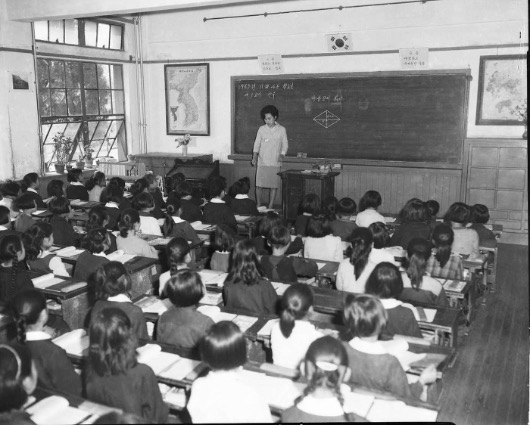
Class at Borae Elementary School, 1963 (Source: Seoul Metropolitan Archives)

3) Teacher Quality and Capacity Building: International Cooperation

At the early stage of the development, the international development cooperation did play important roles in building capacity of teachers and teacher training. George Peabody Project was one of the well-known programs. From 1956 to 1962, George Peabody College for Teachers provided Korea's Ministry of Education and schools with the technical assistance in cooperation with the International Cooperation Administration, the United States Mission to Korea. The college sent American educators to Korea to work on programs to improve teacher education including pre- and in-service training, curriculum and textbook development, educational research, library science etc. 39 advisors or consultants stayed in Korea about two years in Seoul National University, Yonsei University, several other teachers’ colleges, attached schools and other normal schools as well. The program also sent 82 Korean teachers, school principals, supervisors, and researchers to the college for training or scholarship courses. This program nurtured many national and local educational leaders, who actively transformed and modernized its educational system.

The Development Period (1970s-1980s): Managing Growth and Quality

1) Pre-Service Education and Recruitment: Forecasting Efforts and Persistent Imbalances

Supply and Demand Plan of Teachers
To effectively manage the teacher policy, the government started to forecast supply and demand of teachers in a more systematic way. It is comparatively easier for elementary schools in Korea, but the open certificate system, altering advancement rates, and a variety of subjects make the case of secondary schools very difficult. However, in spite of these difficulties, basic studies on the supply and demand of teachers by provinces, by school levels, and by subjects, have been yearly implemented. The report titled Long-term Plan for the Supply of and Demand for Teachers in 1972, and in 1985, prepared by Korean Educational Development Institute (KE) were representative studies on this issue. The estimation have given key information to provincial governments and students who preparing teacher recruitment examination.

Actual Supply and Demand
The increase of certificate granting universities solved the teacher shortage by the late 1960s, but it simultaneously produced the problem of oversupply of teacher candidates. Many graduates from teacher colleges did not find teaching jobs; therefore five such colleges were merged with others.

In case of elementary schools, the new recruitment hit the peak at the end of 1960s, which was supplied by teacher training centers and teachers’ colleges. After the abolishment of training centers and restructuring of teachers’ college in 1970s, the supply and demand of teachers were coordinated in a more stable manner, and the ratio stayed around 1.2 in 1980s and 1990s.

The number of secondary school teachers increased rapidly in the 1970s and 1980s as a consequence of the expansion of elementary schools in the 1960s. With the oversupply of prospective teachers for secondary schools, graduates from national universities were given priority over those from private universities by the decree in 1973. Later the requirements for teacher certification were strengthened from 1982, which made some of the graduates unable to take the examination for teachers after their graduations. However, the sharp increase in certificate granting institutions from 1980s could not be controlled by the government or the colleges, either, and made the competition fiercer. The ratio went up to as high as 5.7 in 1986 and 7.6 in 1998. Many of certificate holders failed to be employed as a teacher, which evoked disputes about teacher training system.
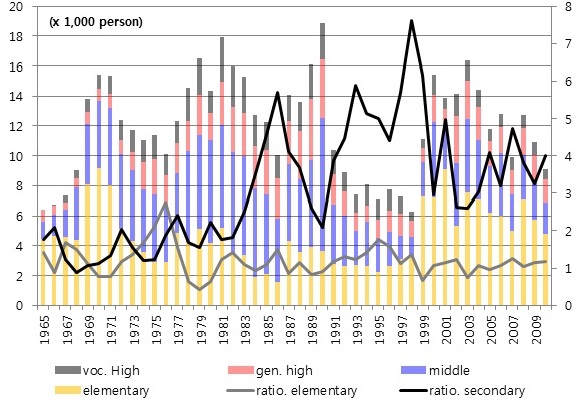
New Recruitment of Teachers

Source: MOE, Statistical Yearbook, Various Years

2) Retaining and Remuneration: Addressing High Turnover and Improving Teacher Status

The rapid economic growth created more well-paid jobs in private sectors, and many teachers left the profession for other jobs, notwithstanding the increase of the certificate-holders. The turnover rate was as high as 7.0 percent for elementary schools, 10.8 percent for middle schools, and 10.3 percent for vocational high schools in 1970, and these trends lasted till the late 1970s. The government still had to design better incentives to retain talented teachers. The government continuously raised the salary for public officials as well as teachers to balance rising price levels. In addition, the equalization policy of middle school from 1968 and high school from 1974 helped improve the status of private school teachers by subsidization of their salary from the government. From 1985 the salary of elementary school teachers was raised and paid on level with secondary ones. The KFEA proposed various measures to improve the treatment for teachers, which resulted in the legislation of Special Act on the Improvement of Teachers’ Status in 1991.

3) Teacher Quality and Capacity Building: Foreign Assistance and Institutional Development

As the economy grew more industrialized from the 1960s, the quantitative expansion of manpower itself was not enough to meet the demands from industries. Especially vocational and technical education in secondary schools was found too academic and remote from actual demands of business. To upgrade the quality teachers of vocational schools, the government requested assistance and loans from international communities. For example, the credit agreement between Korea and International Development Association in 1969 included the construction and equipment for technical, agricultural, commercial, and comprehensive high schools, four university teacher training departments, technical assistance and fellowship for trainers.

The Transition Period (After 1990s): An Era of Competition and Professionalism

1) Pre-Service Education and Recruitment: Structured Pathways and Quality Assurance

Structured Pathways for Pre-Service Teacher Education
As results of continuous adjustments, there are several types of pre-service teacher education programs in Korea. In case of elementary schools, most of the teachers are educated in the ten National Universities of Education, which are dedicated for training of elementary school teachers in each province, and constitute about 93 percent of new candidates. In addition, the Korea National University of Education, Jeju National University, and Ewha Women University have departments for elementary school education.

For secondary school teachers, there are more paths to achieve the certificates. For undergraduates, one can enroll in colleges of education or departments of education opened in general universities, or take teacher preparation courses in the universities where those courses are offered. By finishing graduate schools of education, one can also receive the certificates. As of 2015, pre-service secondary teachers were trained through diverse institutions, as illustrated  below.

The undergraduate teacher education programs all offer four-year coursework comprised of a curriculum of subject-area content and pedagogical theory and student who completed the program with bachelor’s degree are eligible to apply for a teacher certificate. However, some of those who completed teacher education programs fail to achieve it. It is awarded to those whose average score of teaching subjects is 80 or above out of 100, and to those who pass the aptitude and personal character test at least twice before their graduation. They are issued a certificate of Grade II, which can be upgraded to Grade I after three years of teaching practice and additional 15 credit hours of in-service training. There is no age restriction for certificate acquisition.

Open Competition for Teacher Recruitment
All those who want to be a teacher should take the employment examination. Graduates of national teacher training institutions had to compete with those from private universities to be employed as a teacher in national and public schools from 1994. Private schools have the authority to employ their employees, but they have been encouraged to balance their autonomy and public accountability by following the standards of public schools.

Accreditation of Teacher Education Institutions
As the number of teacher certificate-granting institutions increased and the competition for teacher recruitment has become fiercer, consequently, more certificate holders failed to become teachers. In response, from 1998 the ministry addressed the evaluation system on teacher training colleges, and those which failed to meet certain standards had to reduce their quota of certificate numbers. Managed by KEDI, the evaluation evolved into the accreditation system, which reviews all teacher education institutions every three or five year and grades them with five ratings. The evaluation covers the areas of teaching environment, curriculum, outcome, and specialization of each institution. More specifically, the key criteria include: ratio of the number of students per faculty, composition of faculties majoring in subject-specific pedagogy to strengthen professional education; curriculum to meet the national standards; and percentage of graduates employed as regular teachers. The results of the evaluation are sent to the individual institutes and are open to the public, with the intention of improving quality. The institutions which are granted with grade of failure have to cut down their student population or are banned from conferring the certificates on their graduates. The institutions with excellent results are entitled to more autonomy, research grant, and other financial and administrative incentives.

2) Retaining and Remuneration: Competitive Teacher Salaries and Working Conditions

The comparison of relative salary of teachers with other workers in same conditions shows that in most of other countries, teachers are paid less than other professions, except some countries such as Spain and New Zealand. But in Korea teachers are paid 1.36 times more than workers with same career, ages, and gender in other professions, which partially explains why the teaching profession is still attractive.

However, the numbers of students per class in Korea are still higher than those in other advanced countries. The crowded classroom hinders enhancing the quality of education and working conditions of teachers.

3) Teacher Quality and Capacity Building: Promotion and Professional Development

Seniority-Based Promotion and Performance Evaluation System
After the first establishment of regulation on promotion of educational public officials in 1964, Korean Teacher Promotion System became a certificate system based on a hierarchical organization structure, composed of Grade II and I regular teachers, vice principals, and principals. Regular teachers with Grade II certificates could be promoted to Grade I after their three-year teaching and completion of qualification training. To become either a school vice principal or principal, regular teachers had to be listed on the candidates for the qualification training, based upon the scores of service year, performance appraisal, in-service training, and additional credits. It usually took around 20 years for Grade II teachers to get a vice principal certificate and approximately 25 years to obtain a principal certificate.

Among them, Teacher Appraisal for Performance is critical factor. In order to be on the top of the list, a teacher must acquire a minimum of 70 points on teaching experience, 100 points on work performance evaluation, and 30 points on training outcomes. Additional points may be gained through other means. Because work-performance evaluation takes up the biggest part in the promotion scores, teachers are very eager to achieve good results on performance appraisal. But the decrease of students and schools in 2000s has resulted in tough competition for the promotion. And this promotion practice by seniority has been questioned seriously, but it turned out to be very difficult to change the rule.

Evaluation System for Continuous Professional Growth
The Teacher Appraisal for Professional Development was firstly adopted as a pilot project in 2005, and implemented as a full-fledged national level policy since 2010. Enactment Decree of Teacher Training of February 2011, states that the Minster and Superintendents of education should appraise school teachers to examine their capabilities for the purpose of selecting persons who need reeducation or training. The appraisal needs to be done by means of peer review by their colleagues and satisfaction surveys from students and parents. Teachers are to be evaluated by their student guidance capabilities in learning and school life. For principals and vice principals, their school management ability is to be evaluated, and for master teachers, their supporting capability of teaching and research for other teachers is to be evaluated.

Their leadership and capabilities are rated from one to five by peer teachers, students of the third grade above, and their parents. The Minister or Superintendents are supposed to notify the results to individual teachers, and to select some of under-performing teachers for their reeducation and training. The teachers with excellent performance reviews are entitled to extra credits for sabbaticals. Most of teachers make use of the results for professional development. In addition, the average scores of the evaluation should be made available at schools through school information disclosure system.

Institutionalized In-Service Training
The Offices of Education
have managed professional development programs or in-service education for teachers, including training for qualifications, in-service training, and special training in areas such as information digitalization or curriculum formation. In-service programs take place over at least 180 hours (30 days); teacher performance is assessed on a 100-point scale and teachers who complete a program earn a certificate, which can enhance their promotion and wage prospects. In order to encourage teachers to take advantage of professional development opportunities, credit hours completed can help enhance a teacher’s promotion prospects. However, teachers are not required to complete the programs, and can still be promoted without having done so. Principals can provide teachers with professional development support by recommending particular programs and using school funding to subsidize a portion of the training expense.

Challenges and Reform: Teacher Motivation and Systemic Renewal

However, the social prestige that school teachers earned during the industrialization periods has been withering because of many reasons. Various social demands of rapidly changing societies ask more from teachers and schools, which cannot address all the changes with its rigid outdated systems. The system established during the industrialization period has not been suitable for teachers to showcase their talents and professionalism. The result of an international survey showing that Korea teachers were at an average level of job satisfaction but ranked the lowest in terms of Self-efficacy can be understood in this context.

The government has addressed many new policies to revitalize the passion of teachers. Master teacher, Sabbatical Year for Enhancing Teacher Competence (SYETC), and Open Recruitment of Principal are recent efforts to motivate teachers.

Implications for Other Countries

The critical factor of Korean teacher policy lies in the personnel status of teachers as public officials, of whom the government must control the numbers, remuneration, discipline, and promotion. In addition, the purpose-oriented closed training system of prospective teachers has consolidated a unique culture of the teaching profession in Korea. With the acknowledgment of these characteristics, one can find some implications from Korean experience as follows.

1) Controls on Quantitative Expansion of Teachers

The government strategically controlled the quantitative increase of teachers. At the initial stage, the government focused on the elementary schools by recruiting more teachers for them, and later recruited more teachers for middle school, and high schools.The increase of teachers by school levels was closely related with the sequential expansion of education in Korea. It was also interwoven with the personnel status of teachers as public official of the central government. Their numbers and salaries must be controlled by the related ministries of finance and civil services as well for the soundness of public finance. The government has chosen to keep the salary of teachers a certain level above, at the expense of having more teachers, especially for secondary schools. The strategic approach of ‘larger class size but high pay’ contributed to the development of teaching profession to some extent. It also can be interpreted that the government attempted to achieve two competing goals - expansion and improvement - in phases. In addition, teachers as public officials had to follow personnel order of being dispatched to remote regions, which contributed to the effective delivery of compulsory education and to the expansion of enrollment all over the nation.

2) Closed and Purpose-Oriented Pre-Service System

To economically produce more teachers within limited time in the early days, the Korean government operated closed and purposed-oriented training system which has been still working and formulated a unique culture and strong solidarity among the teaching profession. Most of elementary school teachers are still trained without any exchanges with peers who want to have other professions. Even prospective secondary school teachers are detached from other students of liberal arts and science in teachers’ colleges or departments. This separation could hinder the diversity or creativity of prospective teachers who should prepare students to live in diverse societies with various viewpoints.

3) Institutionalization of Policies by Legislation

All the major systems dealing with teacher policy have been institutionalized by laws, decrees, and regulations, guaranteeing the continuity and stability of the policies. This institutionalization could be buttressed by coordination and support from other ministries and the congress. Public Educational Officials Act is the exemplary legislation which was first enacted in 1953, and the last version is available in English (amended in July 2011). But the legal system has controlled basic quality of teachers and protected their rights as custodians of the teaching profession.

4) Comprehensive Package to Attract Talents

The government provided comprehensive incentive package to invite and retain talented persons in the teaching profession. In addition to the permanent personnel status as public officials, they were granted the license and the job upon their graduation from the pre-service education by 1990. Moreover, students in the National University of Education still benefit from cheap tuition fees, and male students in those institutions were exempted from three-year mandatory military services from 1969 to 1990. Without these inclusive benefits, the teaching profession would not have attracted so many capable young minds.

Further Readings

  • Kim, E.-G., & Han, Y.-K. (2002). Attracting, developing and retaining effective teachers. Korean Educational Development Institute.
  • Kim, K., Kim, G., Kim, S., et al. (2010). OECD review on evaluation and assessment frameworks for improving school outcomes. Korean Educational Development Institute.
  • Yeom, M.-H. (2005). Professionalization and the reform of teaching, teachers, and teacher education in the United States and the Republic of Korea (Doctoral dissertation, University of Pittsburgh).

Author
Song-chan Hong
Korea Development Institute
Ik Hyun Shim
Policy Planning Bureau Ministry of Education
Seyeoung Chun
Chungnam National University
cite this work

Evolution of Teacher Policy in Korea: From Quantity Expansion to Professionalization

K-Dev Original
February 1, 2026
This is some text inside of a div block.

Summary

Since the establishment of the Korean government, teacher policy has remained a central pillar of educational development, continuously evolving in response to social and economic transformation. This paper traces the historical evolution of Korea’s teacher policy through three phases: Adoption (1945–1960s), Development (1970s–1980s), and Transition (after the 1990s). Across these periods, the consistent goal has been to build and sustain a high-quality teaching workforce, with major policy shifts focusing on teacher recruitment, retention, and professional development.

Key Questions

  • How did Korea address severe teacher shortages after liberation?
  • How did Korea balance teacher supply expansion with quality assurance across different periods?
  • Why has teacher self-efficacy declined despite stable employment conditions and competitive compensation?

#Teacher policy #Pre-service Education #Professional Development

Overview

Teaching has long been highly respected in traditional Korean society, yet securing talented and devoted teachers has remained a persistent challenge. Since the establishment of the Korean government, teacher policy has been prioritized among educational issues and has been continuously adjusted in response to socio-economic development.

To understand this evolution, this article explores how Korea’s teacher policy has developed across three major historical phases—Adoption, Development, and Transition—and within three key dimensions: pre-service education and recruitment, retention and remuneration, and teacher quality and capacity building.

The Adoption Period (1945-1960s): Building a Foundation from Scratch

1) Pre-service Education and Recruitment: Teacher Shortage and Responses

Emergency Training of Elementary Teachers
Right after liberation from Japanese colonial rule, Korea faced a serious shortage of teachers who could teach in Korean. The United States Military Government (USMG) during 1945 to 1948 established teacher-training schools (“Normal Schools”) as secondary education and Temporary Teacher Training Centers to supply elementary and secondary schools with more teachers. The Rhee government also established a number of Normal Schools at the secondary level, and teacher training centers (according to the enactment of “establishment of temporary centers of teacher training and re-training” in 1953). Graduates of normal schools were granted teaching certificates upon completion of upper secondary school. So were graduates of high schools who completed an 18-week course at a training center. In 1961, all normal schools were upgraded to two-year teachers colleges; which were later upgraded to four-year institutions, National Universities of Education between 1981 and 1984; 92.7 percent of elementary school teachers had a below normal school academic background as of 1966.

Graduation day of college of teacher education (Source: Jeju Domin Ilbo)

Expansion of Secondary and Specialized Teacher Training
Seoul National University (SNU) was newly established in 1946 with 11 constituent colleges including that of education and a graduate school. SNU worked as one of the key institutions to retraining of in-service teachers, and of vocational education. Educational administration training center for principals and educational supervisors, and “reorientation” center for teachers were also set up in teachers’ college of SNU to improve the quality of teachers.

In addition, to train secondary school teachers, colleges of education were established in Seoul National University and Kyungbuk National University and one independent teachers’ college, or Kongju Teachers’ College in 1962 and there were many departments in universities teaching pedagogies and specialized subjects. From 1963, those who completed teacher training courses in general universities, and who finished graduate schools of education could acquire the certificate. The university graduates whose majors were related with industries were also entitled to teacher certificates from 1963, and many private universities were authorized to operate teachers’ colleges in 1965, to prepare students for teaching in secondary schools.

2) Retaining and Remuneration: Teacher Status and Working Conditions

The Basic Education Law enacted in 1949 stated special socio-economic treatment for teachers, and thePublic Educational Official Act in 1953defined status, qualification, service, salaries, and pension. These legal institutions materialized a salary table for teachers independent from that of other public officials. They were also guaranteed their personnel status as public officials, could enjoy job security before retirement, and were to be protected from unfair enforcement of law. The status of teachers as public officials contributed to job security, and also helped the government dispatch them even to remote areas. Owing to this system, the students in islands or other isolated areas could also benefit from mandatory schooling. In addition, with the enactment of pension for public officials in 1962, school teachers in public schools could benefit from the system, which was followed by the adoption of pension for private school teachers in 1973.

However, teachers had to endure overcrowded classroom and other unfavorable working conditions. They had to manage two or three shifts of class every day. Even worse, the salary was not competitive either. According to a survey done by the Korean Federation of Teacher's Associations (KFTA), in the early 1960s, the salary of elementary school teachers (KRW 6,220, about US$ 22) was only a half of their required monthly expenditure in Seoul about KRW 12,270. The salaries for middle school teachers, KRW 7,690 and for high school ones, KRW 8,860 also forced them run into debt every month. This matter was a cause for concern not only to teachers but also policy-makers.

Class at Borae Elementary School, 1963 (Source: Seoul Metropolitan Archives)

3) Teacher Quality and Capacity Building: International Cooperation

At the early stage of the development, the international development cooperation did play important roles in building capacity of teachers and teacher training. George Peabody Project was one of the well-known programs. From 1956 to 1962, George Peabody College for Teachers provided Korea's Ministry of Education and schools with the technical assistance in cooperation with the International Cooperation Administration, the United States Mission to Korea. The college sent American educators to Korea to work on programs to improve teacher education including pre- and in-service training, curriculum and textbook development, educational research, library science etc. 39 advisors or consultants stayed in Korea about two years in Seoul National University, Yonsei University, several other teachers’ colleges, attached schools and other normal schools as well. The program also sent 82 Korean teachers, school principals, supervisors, and researchers to the college for training or scholarship courses. This program nurtured many national and local educational leaders, who actively transformed and modernized its educational system.

The Development Period (1970s-1980s): Managing Growth and Quality

1) Pre-Service Education and Recruitment: Forecasting Efforts and Persistent Imbalances

Supply and Demand Plan of Teachers
To effectively manage the teacher policy, the government started to forecast supply and demand of teachers in a more systematic way. It is comparatively easier for elementary schools in Korea, but the open certificate system, altering advancement rates, and a variety of subjects make the case of secondary schools very difficult. However, in spite of these difficulties, basic studies on the supply and demand of teachers by provinces, by school levels, and by subjects, have been yearly implemented. The report titled Long-term Plan for the Supply of and Demand for Teachers in 1972, and in 1985, prepared by Korean Educational Development Institute (KE) were representative studies on this issue. The estimation have given key information to provincial governments and students who preparing teacher recruitment examination.

Actual Supply and Demand
The increase of certificate granting universities solved the teacher shortage by the late 1960s, but it simultaneously produced the problem of oversupply of teacher candidates. Many graduates from teacher colleges did not find teaching jobs; therefore five such colleges were merged with others.

In case of elementary schools, the new recruitment hit the peak at the end of 1960s, which was supplied by teacher training centers and teachers’ colleges. After the abolishment of training centers and restructuring of teachers’ college in 1970s, the supply and demand of teachers were coordinated in a more stable manner, and the ratio stayed around 1.2 in 1980s and 1990s.

The number of secondary school teachers increased rapidly in the 1970s and 1980s as a consequence of the expansion of elementary schools in the 1960s. With the oversupply of prospective teachers for secondary schools, graduates from national universities were given priority over those from private universities by the decree in 1973. Later the requirements for teacher certification were strengthened from 1982, which made some of the graduates unable to take the examination for teachers after their graduations. However, the sharp increase in certificate granting institutions from 1980s could not be controlled by the government or the colleges, either, and made the competition fiercer. The ratio went up to as high as 5.7 in 1986 and 7.6 in 1998. Many of certificate holders failed to be employed as a teacher, which evoked disputes about teacher training system.

New Recruitment of Teachers

Source: MOE, Statistical Yearbook, Various Years

2) Retaining and Remuneration: Addressing High Turnover and Improving Teacher Status

The rapid economic growth created more well-paid jobs in private sectors, and many teachers left the profession for other jobs, notwithstanding the increase of the certificate-holders. The turnover rate was as high as 7.0 percent for elementary schools, 10.8 percent for middle schools, and 10.3 percent for vocational high schools in 1970, and these trends lasted till the late 1970s. The government still had to design better incentives to retain talented teachers. The government continuously raised the salary for public officials as well as teachers to balance rising price levels. In addition, the equalization policy of middle school from 1968 and high school from 1974 helped improve the status of private school teachers by subsidization of their salary from the government. From 1985 the salary of elementary school teachers was raised and paid on level with secondary ones. The KFEA proposed various measures to improve the treatment for teachers, which resulted in the legislation of Special Act on the Improvement of Teachers’ Status in 1991.

3) Teacher Quality and Capacity Building: Foreign Assistance and Institutional Development

As the economy grew more industrialized from the 1960s, the quantitative expansion of manpower itself was not enough to meet the demands from industries. Especially vocational and technical education in secondary schools was found too academic and remote from actual demands of business. To upgrade the quality teachers of vocational schools, the government requested assistance and loans from international communities. For example, the credit agreement between Korea and International Development Association in 1969 included the construction and equipment for technical, agricultural, commercial, and comprehensive high schools, four university teacher training departments, technical assistance and fellowship for trainers.

The Transition Period (After 1990s): An Era of Competition and Professionalism

1) Pre-Service Education and Recruitment: Structured Pathways and Quality Assurance

Structured Pathways for Pre-Service Teacher Education
As results of continuous adjustments, there are several types of pre-service teacher education programs in Korea. In case of elementary schools, most of the teachers are educated in the ten National Universities of Education, which are dedicated for training of elementary school teachers in each province, and constitute about 93 percent of new candidates. In addition, the Korea National University of Education, Jeju National University, and Ewha Women University have departments for elementary school education.

For secondary school teachers, there are more paths to achieve the certificates. For undergraduates, one can enroll in colleges of education or departments of education opened in general universities, or take teacher preparation courses in the universities where those courses are offered. By finishing graduate schools of education, one can also receive the certificates. As of 2015, pre-service secondary teachers were trained through diverse institutions, as illustrated  below.

The undergraduate teacher education programs all offer four-year coursework comprised of a curriculum of subject-area content and pedagogical theory and student who completed the program with bachelor’s degree are eligible to apply for a teacher certificate. However, some of those who completed teacher education programs fail to achieve it. It is awarded to those whose average score of teaching subjects is 80 or above out of 100, and to those who pass the aptitude and personal character test at least twice before their graduation. They are issued a certificate of Grade II, which can be upgraded to Grade I after three years of teaching practice and additional 15 credit hours of in-service training. There is no age restriction for certificate acquisition.

Open Competition for Teacher Recruitment
All those who want to be a teacher should take the employment examination. Graduates of national teacher training institutions had to compete with those from private universities to be employed as a teacher in national and public schools from 1994. Private schools have the authority to employ their employees, but they have been encouraged to balance their autonomy and public accountability by following the standards of public schools.

Accreditation of Teacher Education Institutions
As the number of teacher certificate-granting institutions increased and the competition for teacher recruitment has become fiercer, consequently, more certificate holders failed to become teachers. In response, from 1998 the ministry addressed the evaluation system on teacher training colleges, and those which failed to meet certain standards had to reduce their quota of certificate numbers. Managed by KEDI, the evaluation evolved into the accreditation system, which reviews all teacher education institutions every three or five year and grades them with five ratings. The evaluation covers the areas of teaching environment, curriculum, outcome, and specialization of each institution. More specifically, the key criteria include: ratio of the number of students per faculty, composition of faculties majoring in subject-specific pedagogy to strengthen professional education; curriculum to meet the national standards; and percentage of graduates employed as regular teachers. The results of the evaluation are sent to the individual institutes and are open to the public, with the intention of improving quality. The institutions which are granted with grade of failure have to cut down their student population or are banned from conferring the certificates on their graduates. The institutions with excellent results are entitled to more autonomy, research grant, and other financial and administrative incentives.

2) Retaining and Remuneration: Competitive Teacher Salaries and Working Conditions

The comparison of relative salary of teachers with other workers in same conditions shows that in most of other countries, teachers are paid less than other professions, except some countries such as Spain and New Zealand. But in Korea teachers are paid 1.36 times more than workers with same career, ages, and gender in other professions, which partially explains why the teaching profession is still attractive.

However, the numbers of students per class in Korea are still higher than those in other advanced countries. The crowded classroom hinders enhancing the quality of education and working conditions of teachers.

3) Teacher Quality and Capacity Building: Promotion and Professional Development

Seniority-Based Promotion and Performance Evaluation System
After the first establishment of regulation on promotion of educational public officials in 1964, Korean Teacher Promotion System became a certificate system based on a hierarchical organization structure, composed of Grade II and I regular teachers, vice principals, and principals. Regular teachers with Grade II certificates could be promoted to Grade I after their three-year teaching and completion of qualification training. To become either a school vice principal or principal, regular teachers had to be listed on the candidates for the qualification training, based upon the scores of service year, performance appraisal, in-service training, and additional credits. It usually took around 20 years for Grade II teachers to get a vice principal certificate and approximately 25 years to obtain a principal certificate.

Among them, Teacher Appraisal for Performance is critical factor. In order to be on the top of the list, a teacher must acquire a minimum of 70 points on teaching experience, 100 points on work performance evaluation, and 30 points on training outcomes. Additional points may be gained through other means. Because work-performance evaluation takes up the biggest part in the promotion scores, teachers are very eager to achieve good results on performance appraisal. But the decrease of students and schools in 2000s has resulted in tough competition for the promotion. And this promotion practice by seniority has been questioned seriously, but it turned out to be very difficult to change the rule.

Evaluation System for Continuous Professional Growth
The Teacher Appraisal for Professional Development was firstly adopted as a pilot project in 2005, and implemented as a full-fledged national level policy since 2010. Enactment Decree of Teacher Training of February 2011, states that the Minster and Superintendents of education should appraise school teachers to examine their capabilities for the purpose of selecting persons who need reeducation or training. The appraisal needs to be done by means of peer review by their colleagues and satisfaction surveys from students and parents. Teachers are to be evaluated by their student guidance capabilities in learning and school life. For principals and vice principals, their school management ability is to be evaluated, and for master teachers, their supporting capability of teaching and research for other teachers is to be evaluated.

Their leadership and capabilities are rated from one to five by peer teachers, students of the third grade above, and their parents. The Minister or Superintendents are supposed to notify the results to individual teachers, and to select some of under-performing teachers for their reeducation and training. The teachers with excellent performance reviews are entitled to extra credits for sabbaticals. Most of teachers make use of the results for professional development. In addition, the average scores of the evaluation should be made available at schools through school information disclosure system.

Institutionalized In-Service Training
The Offices of Education
have managed professional development programs or in-service education for teachers, including training for qualifications, in-service training, and special training in areas such as information digitalization or curriculum formation. In-service programs take place over at least 180 hours (30 days); teacher performance is assessed on a 100-point scale and teachers who complete a program earn a certificate, which can enhance their promotion and wage prospects. In order to encourage teachers to take advantage of professional development opportunities, credit hours completed can help enhance a teacher’s promotion prospects. However, teachers are not required to complete the programs, and can still be promoted without having done so. Principals can provide teachers with professional development support by recommending particular programs and using school funding to subsidize a portion of the training expense.

Challenges and Reform: Teacher Motivation and Systemic Renewal

However, the social prestige that school teachers earned during the industrialization periods has been withering because of many reasons. Various social demands of rapidly changing societies ask more from teachers and schools, which cannot address all the changes with its rigid outdated systems. The system established during the industrialization period has not been suitable for teachers to showcase their talents and professionalism. The result of an international survey showing that Korea teachers were at an average level of job satisfaction but ranked the lowest in terms of Self-efficacy can be understood in this context.

The government has addressed many new policies to revitalize the passion of teachers. Master teacher, Sabbatical Year for Enhancing Teacher Competence (SYETC), and Open Recruitment of Principal are recent efforts to motivate teachers.

Implications for Other Countries

The critical factor of Korean teacher policy lies in the personnel status of teachers as public officials, of whom the government must control the numbers, remuneration, discipline, and promotion. In addition, the purpose-oriented closed training system of prospective teachers has consolidated a unique culture of the teaching profession in Korea. With the acknowledgment of these characteristics, one can find some implications from Korean experience as follows.

1) Controls on Quantitative Expansion of Teachers

The government strategically controlled the quantitative increase of teachers. At the initial stage, the government focused on the elementary schools by recruiting more teachers for them, and later recruited more teachers for middle school, and high schools.The increase of teachers by school levels was closely related with the sequential expansion of education in Korea. It was also interwoven with the personnel status of teachers as public official of the central government. Their numbers and salaries must be controlled by the related ministries of finance and civil services as well for the soundness of public finance. The government has chosen to keep the salary of teachers a certain level above, at the expense of having more teachers, especially for secondary schools. The strategic approach of ‘larger class size but high pay’ contributed to the development of teaching profession to some extent. It also can be interpreted that the government attempted to achieve two competing goals - expansion and improvement - in phases. In addition, teachers as public officials had to follow personnel order of being dispatched to remote regions, which contributed to the effective delivery of compulsory education and to the expansion of enrollment all over the nation.

2) Closed and Purpose-Oriented Pre-Service System

To economically produce more teachers within limited time in the early days, the Korean government operated closed and purposed-oriented training system which has been still working and formulated a unique culture and strong solidarity among the teaching profession. Most of elementary school teachers are still trained without any exchanges with peers who want to have other professions. Even prospective secondary school teachers are detached from other students of liberal arts and science in teachers’ colleges or departments. This separation could hinder the diversity or creativity of prospective teachers who should prepare students to live in diverse societies with various viewpoints.

3) Institutionalization of Policies by Legislation

All the major systems dealing with teacher policy have been institutionalized by laws, decrees, and regulations, guaranteeing the continuity and stability of the policies. This institutionalization could be buttressed by coordination and support from other ministries and the congress. Public Educational Officials Act is the exemplary legislation which was first enacted in 1953, and the last version is available in English (amended in July 2011). But the legal system has controlled basic quality of teachers and protected their rights as custodians of the teaching profession.

4) Comprehensive Package to Attract Talents

The government provided comprehensive incentive package to invite and retain talented persons in the teaching profession. In addition to the permanent personnel status as public officials, they were granted the license and the job upon their graduation from the pre-service education by 1990. Moreover, students in the National University of Education still benefit from cheap tuition fees, and male students in those institutions were exempted from three-year mandatory military services from 1969 to 1990. Without these inclusive benefits, the teaching profession would not have attracted so many capable young minds.

Further Readings

  • Kim, E.-G., & Han, Y.-K. (2002). Attracting, developing and retaining effective teachers. Korean Educational Development Institute.
  • Kim, K., Kim, G., Kim, S., et al. (2010). OECD review on evaluation and assessment frameworks for improving school outcomes. Korean Educational Development Institute.
  • Yeom, M.-H. (2005). Professionalization and the reform of teaching, teachers, and teacher education in the United States and the Republic of Korea (Doctoral dissertation, University of Pittsburgh).

References
Cite this work
.

More to explore from
In Perspective

No items found.

Evolution of Teacher Policy in Korea: From Quantity Expansion to Professionalization

K-Dev Original
February 1, 2026

I am the text that will be copied.

Overview

Teaching has long been highly respected in traditional Korean society, yet securing talented and devoted teachers has remained a persistent challenge. Since the establishment of the Korean government, teacher policy has been prioritized among educational issues and has been continuously adjusted in response to socio-economic development.

To understand this evolution, this article explores how Korea’s teacher policy has developed across three major historical phases—Adoption, Development, and Transition—and within three key dimensions: pre-service education and recruitment, retention and remuneration, and teacher quality and capacity building.

The Adoption Period (1945-1960s): Building a Foundation from Scratch

1) Pre-service Education and Recruitment: Teacher Shortage and Responses

Emergency Training of Elementary Teachers
Right after liberation from Japanese colonial rule, Korea faced a serious shortage of teachers who could teach in Korean. The United States Military Government (USMG) during 1945 to 1948 established teacher-training schools (“Normal Schools”) as secondary education and Temporary Teacher Training Centers to supply elementary and secondary schools with more teachers. The Rhee government also established a number of Normal Schools at the secondary level, and teacher training centers (according to the enactment of “establishment of temporary centers of teacher training and re-training” in 1953). Graduates of normal schools were granted teaching certificates upon completion of upper secondary school. So were graduates of high schools who completed an 18-week course at a training center. In 1961, all normal schools were upgraded to two-year teachers colleges; which were later upgraded to four-year institutions, National Universities of Education between 1981 and 1984; 92.7 percent of elementary school teachers had a below normal school academic background as of 1966.

Graduation day of college of teacher education (Source: Jeju Domin Ilbo)

Expansion of Secondary and Specialized Teacher Training
Seoul National University (SNU) was newly established in 1946 with 11 constituent colleges including that of education and a graduate school. SNU worked as one of the key institutions to retraining of in-service teachers, and of vocational education. Educational administration training center for principals and educational supervisors, and “reorientation” center for teachers were also set up in teachers’ college of SNU to improve the quality of teachers.

In addition, to train secondary school teachers, colleges of education were established in Seoul National University and Kyungbuk National University and one independent teachers’ college, or Kongju Teachers’ College in 1962 and there were many departments in universities teaching pedagogies and specialized subjects. From 1963, those who completed teacher training courses in general universities, and who finished graduate schools of education could acquire the certificate. The university graduates whose majors were related with industries were also entitled to teacher certificates from 1963, and many private universities were authorized to operate teachers’ colleges in 1965, to prepare students for teaching in secondary schools.

2) Retaining and Remuneration: Teacher Status and Working Conditions

The Basic Education Law enacted in 1949 stated special socio-economic treatment for teachers, and thePublic Educational Official Act in 1953defined status, qualification, service, salaries, and pension. These legal institutions materialized a salary table for teachers independent from that of other public officials. They were also guaranteed their personnel status as public officials, could enjoy job security before retirement, and were to be protected from unfair enforcement of law. The status of teachers as public officials contributed to job security, and also helped the government dispatch them even to remote areas. Owing to this system, the students in islands or other isolated areas could also benefit from mandatory schooling. In addition, with the enactment of pension for public officials in 1962, school teachers in public schools could benefit from the system, which was followed by the adoption of pension for private school teachers in 1973.

However, teachers had to endure overcrowded classroom and other unfavorable working conditions. They had to manage two or three shifts of class every day. Even worse, the salary was not competitive either. According to a survey done by the Korean Federation of Teacher's Associations (KFTA), in the early 1960s, the salary of elementary school teachers (KRW 6,220, about US$ 22) was only a half of their required monthly expenditure in Seoul about KRW 12,270. The salaries for middle school teachers, KRW 7,690 and for high school ones, KRW 8,860 also forced them run into debt every month. This matter was a cause for concern not only to teachers but also policy-makers.

Class at Borae Elementary School, 1963 (Source: Seoul Metropolitan Archives)

3) Teacher Quality and Capacity Building: International Cooperation

At the early stage of the development, the international development cooperation did play important roles in building capacity of teachers and teacher training. George Peabody Project was one of the well-known programs. From 1956 to 1962, George Peabody College for Teachers provided Korea's Ministry of Education and schools with the technical assistance in cooperation with the International Cooperation Administration, the United States Mission to Korea. The college sent American educators to Korea to work on programs to improve teacher education including pre- and in-service training, curriculum and textbook development, educational research, library science etc. 39 advisors or consultants stayed in Korea about two years in Seoul National University, Yonsei University, several other teachers’ colleges, attached schools and other normal schools as well. The program also sent 82 Korean teachers, school principals, supervisors, and researchers to the college for training or scholarship courses. This program nurtured many national and local educational leaders, who actively transformed and modernized its educational system.

The Development Period (1970s-1980s): Managing Growth and Quality

1) Pre-Service Education and Recruitment: Forecasting Efforts and Persistent Imbalances

Supply and Demand Plan of Teachers
To effectively manage the teacher policy, the government started to forecast supply and demand of teachers in a more systematic way. It is comparatively easier for elementary schools in Korea, but the open certificate system, altering advancement rates, and a variety of subjects make the case of secondary schools very difficult. However, in spite of these difficulties, basic studies on the supply and demand of teachers by provinces, by school levels, and by subjects, have been yearly implemented. The report titled Long-term Plan for the Supply of and Demand for Teachers in 1972, and in 1985, prepared by Korean Educational Development Institute (KE) were representative studies on this issue. The estimation have given key information to provincial governments and students who preparing teacher recruitment examination.

Actual Supply and Demand
The increase of certificate granting universities solved the teacher shortage by the late 1960s, but it simultaneously produced the problem of oversupply of teacher candidates. Many graduates from teacher colleges did not find teaching jobs; therefore five such colleges were merged with others.

In case of elementary schools, the new recruitment hit the peak at the end of 1960s, which was supplied by teacher training centers and teachers’ colleges. After the abolishment of training centers and restructuring of teachers’ college in 1970s, the supply and demand of teachers were coordinated in a more stable manner, and the ratio stayed around 1.2 in 1980s and 1990s.

The number of secondary school teachers increased rapidly in the 1970s and 1980s as a consequence of the expansion of elementary schools in the 1960s. With the oversupply of prospective teachers for secondary schools, graduates from national universities were given priority over those from private universities by the decree in 1973. Later the requirements for teacher certification were strengthened from 1982, which made some of the graduates unable to take the examination for teachers after their graduations. However, the sharp increase in certificate granting institutions from 1980s could not be controlled by the government or the colleges, either, and made the competition fiercer. The ratio went up to as high as 5.7 in 1986 and 7.6 in 1998. Many of certificate holders failed to be employed as a teacher, which evoked disputes about teacher training system.

New Recruitment of Teachers

Source: MOE, Statistical Yearbook, Various Years

2) Retaining and Remuneration: Addressing High Turnover and Improving Teacher Status

The rapid economic growth created more well-paid jobs in private sectors, and many teachers left the profession for other jobs, notwithstanding the increase of the certificate-holders. The turnover rate was as high as 7.0 percent for elementary schools, 10.8 percent for middle schools, and 10.3 percent for vocational high schools in 1970, and these trends lasted till the late 1970s. The government still had to design better incentives to retain talented teachers. The government continuously raised the salary for public officials as well as teachers to balance rising price levels. In addition, the equalization policy of middle school from 1968 and high school from 1974 helped improve the status of private school teachers by subsidization of their salary from the government. From 1985 the salary of elementary school teachers was raised and paid on level with secondary ones. The KFEA proposed various measures to improve the treatment for teachers, which resulted in the legislation of Special Act on the Improvement of Teachers’ Status in 1991.

3) Teacher Quality and Capacity Building: Foreign Assistance and Institutional Development

As the economy grew more industrialized from the 1960s, the quantitative expansion of manpower itself was not enough to meet the demands from industries. Especially vocational and technical education in secondary schools was found too academic and remote from actual demands of business. To upgrade the quality teachers of vocational schools, the government requested assistance and loans from international communities. For example, the credit agreement between Korea and International Development Association in 1969 included the construction and equipment for technical, agricultural, commercial, and comprehensive high schools, four university teacher training departments, technical assistance and fellowship for trainers.

The Transition Period (After 1990s): An Era of Competition and Professionalism

1) Pre-Service Education and Recruitment: Structured Pathways and Quality Assurance

Structured Pathways for Pre-Service Teacher Education
As results of continuous adjustments, there are several types of pre-service teacher education programs in Korea. In case of elementary schools, most of the teachers are educated in the ten National Universities of Education, which are dedicated for training of elementary school teachers in each province, and constitute about 93 percent of new candidates. In addition, the Korea National University of Education, Jeju National University, and Ewha Women University have departments for elementary school education.

For secondary school teachers, there are more paths to achieve the certificates. For undergraduates, one can enroll in colleges of education or departments of education opened in general universities, or take teacher preparation courses in the universities where those courses are offered. By finishing graduate schools of education, one can also receive the certificates. As of 2015, pre-service secondary teachers were trained through diverse institutions, as illustrated  below.

The undergraduate teacher education programs all offer four-year coursework comprised of a curriculum of subject-area content and pedagogical theory and student who completed the program with bachelor’s degree are eligible to apply for a teacher certificate. However, some of those who completed teacher education programs fail to achieve it. It is awarded to those whose average score of teaching subjects is 80 or above out of 100, and to those who pass the aptitude and personal character test at least twice before their graduation. They are issued a certificate of Grade II, which can be upgraded to Grade I after three years of teaching practice and additional 15 credit hours of in-service training. There is no age restriction for certificate acquisition.

Open Competition for Teacher Recruitment
All those who want to be a teacher should take the employment examination. Graduates of national teacher training institutions had to compete with those from private universities to be employed as a teacher in national and public schools from 1994. Private schools have the authority to employ their employees, but they have been encouraged to balance their autonomy and public accountability by following the standards of public schools.

Accreditation of Teacher Education Institutions
As the number of teacher certificate-granting institutions increased and the competition for teacher recruitment has become fiercer, consequently, more certificate holders failed to become teachers. In response, from 1998 the ministry addressed the evaluation system on teacher training colleges, and those which failed to meet certain standards had to reduce their quota of certificate numbers. Managed by KEDI, the evaluation evolved into the accreditation system, which reviews all teacher education institutions every three or five year and grades them with five ratings. The evaluation covers the areas of teaching environment, curriculum, outcome, and specialization of each institution. More specifically, the key criteria include: ratio of the number of students per faculty, composition of faculties majoring in subject-specific pedagogy to strengthen professional education; curriculum to meet the national standards; and percentage of graduates employed as regular teachers. The results of the evaluation are sent to the individual institutes and are open to the public, with the intention of improving quality. The institutions which are granted with grade of failure have to cut down their student population or are banned from conferring the certificates on their graduates. The institutions with excellent results are entitled to more autonomy, research grant, and other financial and administrative incentives.

2) Retaining and Remuneration: Competitive Teacher Salaries and Working Conditions

The comparison of relative salary of teachers with other workers in same conditions shows that in most of other countries, teachers are paid less than other professions, except some countries such as Spain and New Zealand. But in Korea teachers are paid 1.36 times more than workers with same career, ages, and gender in other professions, which partially explains why the teaching profession is still attractive.

However, the numbers of students per class in Korea are still higher than those in other advanced countries. The crowded classroom hinders enhancing the quality of education and working conditions of teachers.

3) Teacher Quality and Capacity Building: Promotion and Professional Development

Seniority-Based Promotion and Performance Evaluation System
After the first establishment of regulation on promotion of educational public officials in 1964, Korean Teacher Promotion System became a certificate system based on a hierarchical organization structure, composed of Grade II and I regular teachers, vice principals, and principals. Regular teachers with Grade II certificates could be promoted to Grade I after their three-year teaching and completion of qualification training. To become either a school vice principal or principal, regular teachers had to be listed on the candidates for the qualification training, based upon the scores of service year, performance appraisal, in-service training, and additional credits. It usually took around 20 years for Grade II teachers to get a vice principal certificate and approximately 25 years to obtain a principal certificate.

Among them, Teacher Appraisal for Performance is critical factor. In order to be on the top of the list, a teacher must acquire a minimum of 70 points on teaching experience, 100 points on work performance evaluation, and 30 points on training outcomes. Additional points may be gained through other means. Because work-performance evaluation takes up the biggest part in the promotion scores, teachers are very eager to achieve good results on performance appraisal. But the decrease of students and schools in 2000s has resulted in tough competition for the promotion. And this promotion practice by seniority has been questioned seriously, but it turned out to be very difficult to change the rule.

Evaluation System for Continuous Professional Growth
The Teacher Appraisal for Professional Development was firstly adopted as a pilot project in 2005, and implemented as a full-fledged national level policy since 2010. Enactment Decree of Teacher Training of February 2011, states that the Minster and Superintendents of education should appraise school teachers to examine their capabilities for the purpose of selecting persons who need reeducation or training. The appraisal needs to be done by means of peer review by their colleagues and satisfaction surveys from students and parents. Teachers are to be evaluated by their student guidance capabilities in learning and school life. For principals and vice principals, their school management ability is to be evaluated, and for master teachers, their supporting capability of teaching and research for other teachers is to be evaluated.

Their leadership and capabilities are rated from one to five by peer teachers, students of the third grade above, and their parents. The Minister or Superintendents are supposed to notify the results to individual teachers, and to select some of under-performing teachers for their reeducation and training. The teachers with excellent performance reviews are entitled to extra credits for sabbaticals. Most of teachers make use of the results for professional development. In addition, the average scores of the evaluation should be made available at schools through school information disclosure system.

Institutionalized In-Service Training
The Offices of Education
have managed professional development programs or in-service education for teachers, including training for qualifications, in-service training, and special training in areas such as information digitalization or curriculum formation. In-service programs take place over at least 180 hours (30 days); teacher performance is assessed on a 100-point scale and teachers who complete a program earn a certificate, which can enhance their promotion and wage prospects. In order to encourage teachers to take advantage of professional development opportunities, credit hours completed can help enhance a teacher’s promotion prospects. However, teachers are not required to complete the programs, and can still be promoted without having done so. Principals can provide teachers with professional development support by recommending particular programs and using school funding to subsidize a portion of the training expense.

Challenges and Reform: Teacher Motivation and Systemic Renewal

However, the social prestige that school teachers earned during the industrialization periods has been withering because of many reasons. Various social demands of rapidly changing societies ask more from teachers and schools, which cannot address all the changes with its rigid outdated systems. The system established during the industrialization period has not been suitable for teachers to showcase their talents and professionalism. The result of an international survey showing that Korea teachers were at an average level of job satisfaction but ranked the lowest in terms of Self-efficacy can be understood in this context.

The government has addressed many new policies to revitalize the passion of teachers. Master teacher, Sabbatical Year for Enhancing Teacher Competence (SYETC), and Open Recruitment of Principal are recent efforts to motivate teachers.

Implications for Other Countries

The critical factor of Korean teacher policy lies in the personnel status of teachers as public officials, of whom the government must control the numbers, remuneration, discipline, and promotion. In addition, the purpose-oriented closed training system of prospective teachers has consolidated a unique culture of the teaching profession in Korea. With the acknowledgment of these characteristics, one can find some implications from Korean experience as follows.

1) Controls on Quantitative Expansion of Teachers

The government strategically controlled the quantitative increase of teachers. At the initial stage, the government focused on the elementary schools by recruiting more teachers for them, and later recruited more teachers for middle school, and high schools.The increase of teachers by school levels was closely related with the sequential expansion of education in Korea. It was also interwoven with the personnel status of teachers as public official of the central government. Their numbers and salaries must be controlled by the related ministries of finance and civil services as well for the soundness of public finance. The government has chosen to keep the salary of teachers a certain level above, at the expense of having more teachers, especially for secondary schools. The strategic approach of ‘larger class size but high pay’ contributed to the development of teaching profession to some extent. It also can be interpreted that the government attempted to achieve two competing goals - expansion and improvement - in phases. In addition, teachers as public officials had to follow personnel order of being dispatched to remote regions, which contributed to the effective delivery of compulsory education and to the expansion of enrollment all over the nation.

2) Closed and Purpose-Oriented Pre-Service System

To economically produce more teachers within limited time in the early days, the Korean government operated closed and purposed-oriented training system which has been still working and formulated a unique culture and strong solidarity among the teaching profession. Most of elementary school teachers are still trained without any exchanges with peers who want to have other professions. Even prospective secondary school teachers are detached from other students of liberal arts and science in teachers’ colleges or departments. This separation could hinder the diversity or creativity of prospective teachers who should prepare students to live in diverse societies with various viewpoints.

3) Institutionalization of Policies by Legislation

All the major systems dealing with teacher policy have been institutionalized by laws, decrees, and regulations, guaranteeing the continuity and stability of the policies. This institutionalization could be buttressed by coordination and support from other ministries and the congress. Public Educational Officials Act is the exemplary legislation which was first enacted in 1953, and the last version is available in English (amended in July 2011). But the legal system has controlled basic quality of teachers and protected their rights as custodians of the teaching profession.

4) Comprehensive Package to Attract Talents

The government provided comprehensive incentive package to invite and retain talented persons in the teaching profession. In addition to the permanent personnel status as public officials, they were granted the license and the job upon their graduation from the pre-service education by 1990. Moreover, students in the National University of Education still benefit from cheap tuition fees, and male students in those institutions were exempted from three-year mandatory military services from 1969 to 1990. Without these inclusive benefits, the teaching profession would not have attracted so many capable young minds.

Further Readings

  • Kim, E.-G., & Han, Y.-K. (2002). Attracting, developing and retaining effective teachers. Korean Educational Development Institute.
  • Kim, K., Kim, G., Kim, S., et al. (2010). OECD review on evaluation and assessment frameworks for improving school outcomes. Korean Educational Development Institute.
  • Yeom, M.-H. (2005). Professionalization and the reform of teaching, teachers, and teacher education in the United States and the Republic of Korea (Doctoral dissertation, University of Pittsburgh).

References
Cite this work
.

More to explore from
In Perspective

No items found.