

Back to List
K-Dev Original

From Postwar Relief to Social Protection: How Growth and Crisis Shaped South Korea’s Welfare System

Summary

Social welfare in Korea evolved through successive responses to war, rapid growth, and economic crisis, gradually shifting from residual relief to a more institutionalized social protection system. In the postwar period, welfare policy centered on emergency assistance for displaced and vulnerable groups, with limited fiscal capacity and heavy reliance on foreign aid and non-state actors. During the era of state-led industrialization, social protection remained subordinate to economic growth, although basic legal frameworks and selective social insurance programs were introduced. As industrialization progressed, rising inequality and social risks increased public demand for welfare, leading to a notable expansion of social spending and the strengthening of core programs. A major milestone was the achievement of universal health insurance through the integration and extension of fragmented schemes, alongside the consolidation of pension and employment insurance systems. The late-1990s economic crisis further accelerated welfare expansion and broadened coverage, redefining the state’s role in guaranteeing minimum living standards. Despite these advances, persistent challenges remained in coverage gaps, work incentives, fiscal sustainability, and the appropriate division of responsibility between the state and the market.

Key Questions

  • How did rapid industrialization and social inequality change public demand for social protection?
  • How did the crisis redefine the state’s responsibility for minimum living standards?
  • What structural challenges persist despite the expansion of social protection programs?

#social protection #health insurance #employment insurance #pension #expenditure

1953–1961: Emergency Relief, Limited State Capacity, Heavy Reliance on External Providers

During the period of Japanese colonial rule, the Chosun Relief Order provided the first modern public relief program in Korea. But it has been criticized for serving political ends rather than being a genuine social welfare program (Yong-hwan Lee et al., 2006; Seop-joong Shin et al., 1999; Chan-young Yoon et al., 1998).

Welfare programs between the signing of the Korean War armistice in 1953 and the launch of the first economic development plan in 1961 comprised mainly of offering emergency relief assistance to refugees and orphans displaced by the war. Little more could be done since the government lacked funding to support welfare programs. Article 19 of the Constitution spoke of giving public assistance to the most vulnerable, namely the old, the disabled or the unemployed.
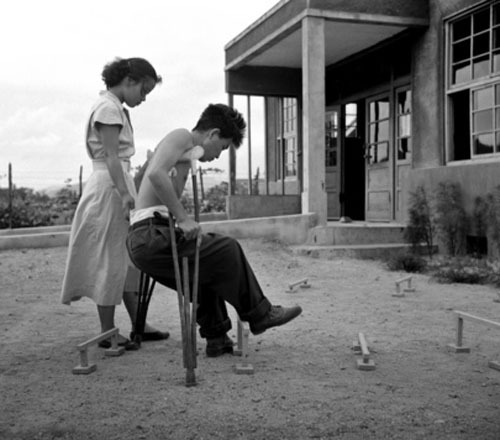
A war-wounded veteran undertakes rehabilitative therapy at the Dongnae Rehabilitation Center for Disabled Veterans, established in Busan under the United Nations Korean Reconstruction Agency (UNKRA) on 1 September 1954 (Source: UN Archives)

Limited access to welfare services was offered to the poor, women and children, and the disabled. The government did not provide much assistance, which instead was mainly the responsibility of civil organizations, overseas aid institutions and religious bodies. The government’s role was mostly confined to setting up welfare institutions for injured soldiers and policemen and their families, which provided public assistance, jobs and housing. [1] Other early steps toward creating a social security system included the Labor Standards Act in May 1953 and the Charter for Children in 1956. The former did not have much real meaning given the dearth of profitable businesses and the lack of the government’s administrative capacity. Much the same applied to the latter.

1950s Reconstruction: Foreign Aid, War Widows, and Early Women’s Rights in Law

Korean society was marked by chaos and poverty during the Korean War and the post-war reconstruction period. Primary industries dominated the economy, with the agriculture, forestry and fishing accounting for 47 percent of GDP in 1953 and employing an estimated 70 percent of the workforce. Women’s labor participation was mostly in these sectors. According to a 1948 survey conducted by the government, the number of women working in companies with more than five employees was 40,268, which was 18 percent of the total female working-age population of 223,030.

The main welfare policy for women was the provision of public assistance for war widows, who numbered as many as 700,000. The government also focused on providing primary education for women to improve literacy rates and conducted campaigns to encourage the participation of women in the post-war reconstruction of society. Women were granted the right to vote under the 1948 Constitution. The Labor Standards Law included provisions for maternity protection and banned discrimination against women.
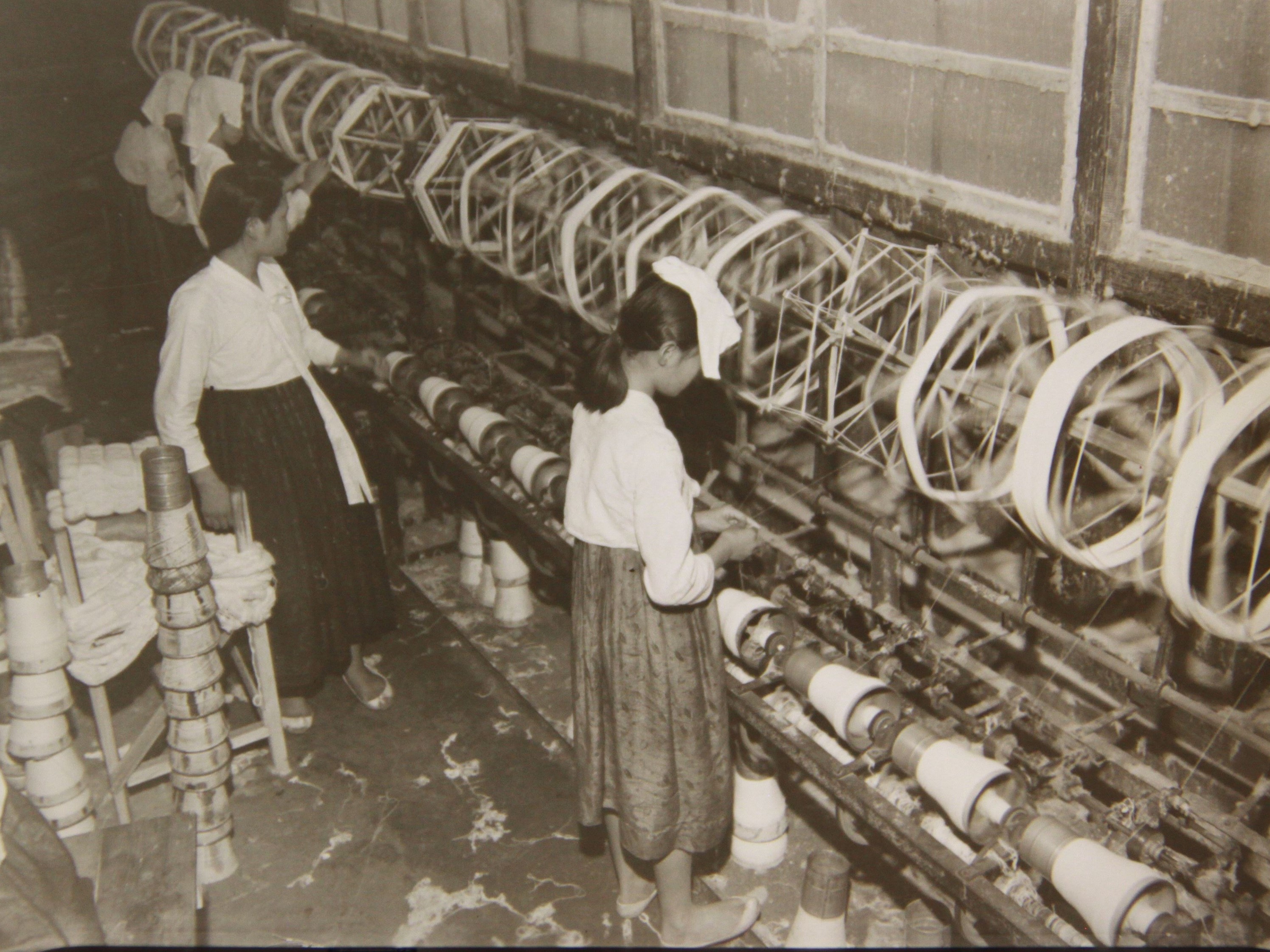
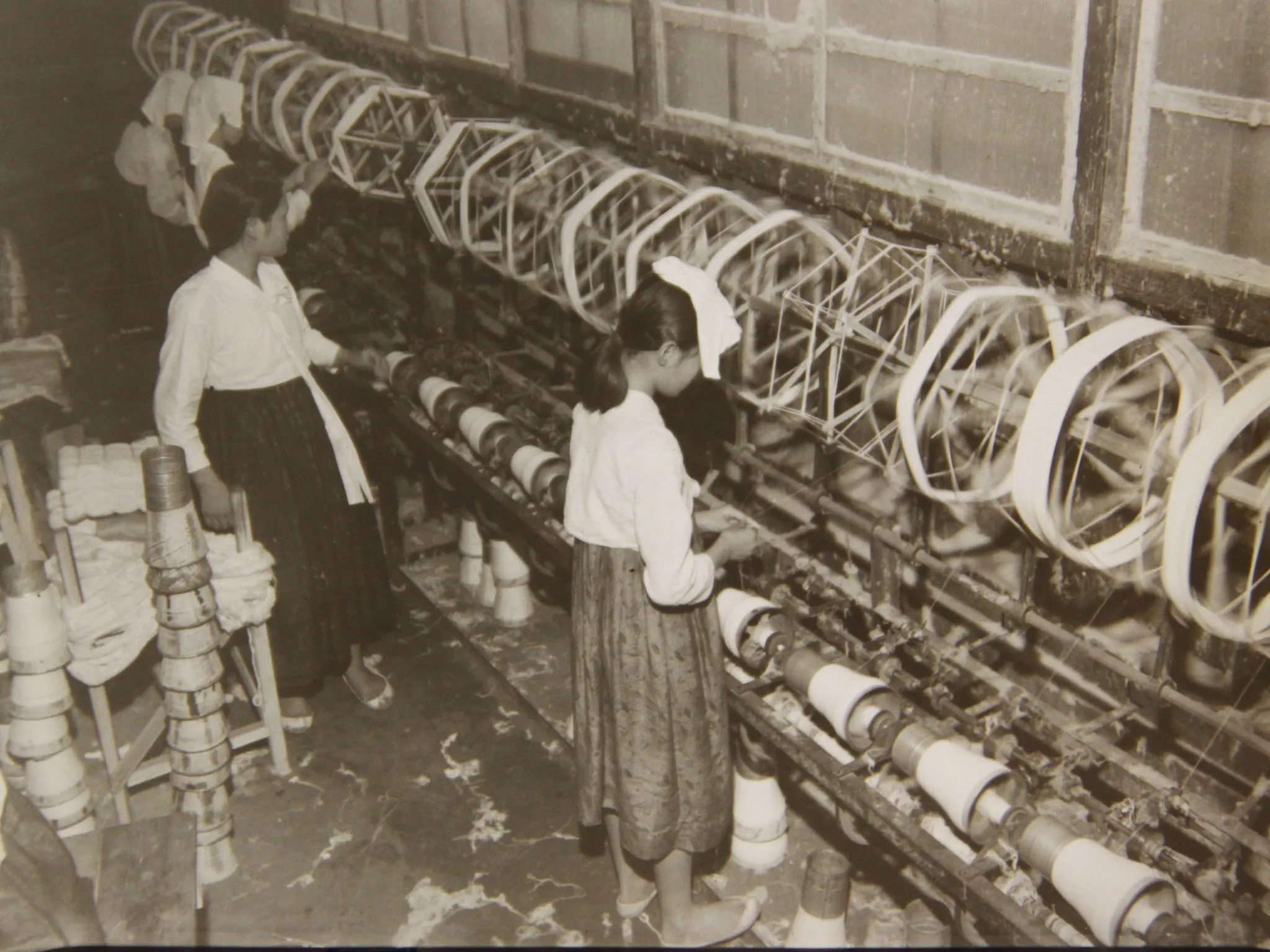
Girls draw thread from raw cotton to produce T-shirts at a textile factory in Busan, 9 September 1951 (Source: U.S. National Archives and Records Administration)

These provisions had been adopted from advanced countries, but had little impact on the actual working conditions of women in Korea. Vocational training focused on low-skill jobs for war widows. The government built state-run homes for single-parent families to provide shelter and encourage economic self-reliance by providing simple vocational training. These institutions were financially supported by foreign aid, including the supply of basic items as well as sewing machines.

There were 62 homes for single-parent families in operation by 1956, but there were still too few of them to meet rising demand for their services. In 1957, the Labor Guidance Institution for Girls was established to provide vocational skills for knitting, sewing, hairdressing and embroidering to older girls who had to leave the orphanages or girls who could not attend primary and middle schools.

Rhee Syngman, the first president of the young republic, strived to rebuild the economy with a series of reconstruction plans. These plans aimed to expand the economic infrastructure, build key industries (cement, steel, etc.) and increase the productive capacity of manufacturing (Sang-oh Choi, 2005, pp.358-359).

Rhee’s desire to construct a self-sufficient Korean economy with these plans was in direct conflict with the American government’s intention to rebuild an East Asian economic block with an industrialized Japan at its center. America urged Korea to liberalize its market, stabilize the value of the Korean currency, and expand cooperation with Japan. To Rhee, however, this implied nothing but the revival of the Greater East Asian Co-Prosperity Sphere and the re-colonialization of the Korean economy. Rhee made full use of Korea’s geopolitical value to frustrate America’s effort while promoting import-substitution industries through reconstruction plans.

The Korean government also differed with the Americans on what kind of foreign aid it would receive. There were two types, one being project assistance and the other non-project assistance. The former was to be used for reconstruction, while the latter was to be distributed to private enterprises for civilian use. Korea received a large amount of foreign aid from the United Nations and the U.S. in the 1950s and 1960s. The Korean government preferred project assistance, while the American government preferred non-project assistance. In the end, the American preference prevailed; under ICA (International Cooperation Administration) aid, for example, project assistance made up 27 percent of the total and non-project assistance 73 percent. In any event, various reconstruction plans prepared by Rhee’s administration failed to spark economic growth in Korea.

1960s–1970s: Social Security Built at the Margins of Growth

Korea’s top priority during this period was economic growth as reflected in the Five-Year Economic Development Plans that dominated the government policy. Despite the low priority on welfare programs, however, several steps were taken in this period toward building a proper social security system in Korea.

The Livelihood Protection Act was introduced in 1962 to provide public assistance to the poor. It was criticized for stigmatizing its recipients because of its implicit suggestion that they were to be blamed for their poverty, but it was still an important step. In addition, the Social Security Act was enacted in 1963 to serve as a framework for welfare programs. In the same year, the Military Personnel Pension was introduced in addition to the Government Employees Pension that had been introduced in 1960. The Health Insurance Act was established but it did not stipulate compulsory participation for any group in Korean society.

In 1964, the Industrial Accident Compensation Insurance Act was introduced in line with the Economic Development Plans to provide support for workers suffering disabilities as a result of industrial accidents. It was the first social insurance program implemented in Korea. In addition, an industrial rehabilitation center was established under the auspices of the National Labor Office in 1971 to provide occupational training.

There was also a growing recognition of the need for welfare programs to take care of the elderly. The submission of the Basic Plan for Social Development in 1968 by the Social Security Review Committee led to several follow-up proposals, including the establishment of the Act on the Welfare of the Elderly, the development of pension programs, the expansion of medical facilities, the provision of employment opportunities for the elderly, an increase in the legal retirement age and the designation of the Day for the Elderly. The suggestions, however, failed to draw much attention from the government, which was preoccupied with economic growth.

In 1973, the National Assembly passed the National Welfare and Pension Act, but it was not implemented due to adverse social and economic conditions, including the two global oil shocks of the 1970s. Only the Teachers Pension was added to the public pension system in 1975.

In 1976, the Health Insurance Act was revised to stipulate compulsory participation of workers at firms with 500 or more employees beginning in 1977. The coverage was extended in 1979 to include those at firms with 300 or more employees. The year 1979 also witnessed the establishment of a compulsory health insurance program for government employees and teachers. It is significant since the introduction of compulsory health insurance was done at the behest of government rather than in response to public demands. As for low-income households, the Health Care Protection Act was introduced in 1977 to provide them with medical services.

A welfare program for the disabled was also introduced in the 1970s. The Ministry of Health and Social Affairs announced in 1978 the Comprehensive Welfare Program for Mentally and Physically Disabled Persons. Although the program was largely limited to public assistance measures, it did introduce rehabilitation treatment policies as well.

To summarize, basic social insurance programs were introduced in the 1960s and 1970s, including the Industrial Accident Compensation Insurance (1964); pensions for government employees (1960), military personnel (1963) and teachers (1975); and health insurances for private sector workers in large firms (1977) and government employees and teachers (1979). In addition, basic programs of public assistance and social services were introduced for the poor and the disabled. These programs were quite limited in their scope but Korea could improve income distribution due to the rapid growth of labor-intensive industries and the rapid increase of job opportunities.

1980–Mid-1990s: Welfare Expansion and System-Building

Toward the end of the 1970s, the government-led, growth-first strategy that had been pursued since the 1960s began to produce various social problems. The improvement in income distribution stopped or was partially reversed as the government actively promoted capital-intensive industries at the cost of macroeconomic stability (Il SaKong, 1993, p.18).

The poor, in particular, were affected by rising inflation. With the improvement in general living conditions, public attention was drawn to the income gaps between rich and poor and between different regions of the country. These developments highlighted the need for larger and more effective welfare programs.

The Chun Doo-hwan administration that came into office in 1980 announced a radical departure from past economic and social policies. It placed priority on promoting private initiatives and stabilizing inflation. It also set out as a goal “the establishment of a welfare society.”[2] The revised 1980 constitution made firm commitments on the state’s responsibility to provide a social safety net and this was followed by the enactment of major laws on welfare programs. Welfare spending jumped in the early 1980s.

In 1981, a pilot project was started to provide a community-based health insurance program to residents in rural areas, while the company-based health insurance program was extended to firms with 100 or more employees. Coverage was then extended to companies with 16 or more employees in 1982 and 5 or more employees in 1988.

Meanwhile, the community-based program was extended to all rural residents in 1988 and to all urban residents in 1989. This resulted in the creation of a universal health insurance system, a feat that was accomplished in only 12 years, the shortest time it has taken anywhere in the world (Deutsche Gesellschaft für Technische Zusammenarbeit, 2005; Ensor, 1999). [3]

The Livelihood Protection Act, which provided public assistance, was revised in 1982 to expand the types of assistance that could be offered to the destitute, with the aim of providing better access to education and jobs.

The introduction of the Act on the Welfare of the Elderly in June 1981 created the legal basis to offer welfare benefits to the older population. Starting from 1982, people aged 65 or older received discounts on the use of mass transit, museum admissions and visits to public baths and barber facilities. A free medical diagnosis program for the elderly was introduced in 1983.

In 1987, a pilot project was launched to provide welfare services to older persons forced to stay at home. Two years later, the government began an allowance payment program for the elderly. This involved paying 10,000 won a month to 76,000 heads of households who were aged 70 or older and who were receiving some form of assistance. Regulations on nursing homes for the elderly were introduced in 1988 and those governing senior citizens’ community centers in 1989.

The National Pension Scheme (NPS), covering workers in firms with 10 or more employees, was implemented in 1988. In 1992, the compulsory coverage was expanded to firms with 5 or more employees. It was expanded further in 1995 to farmers, fishermen and the self-employed in rural areas, and finally in 1999 to the self-employed in urban areas. This completed the move toward a universal public pension scheme.

Welfare services for the disabled were expanded as well. Between 1985 and 1987, a program was implemented to modernize welfare facilities for the disabled. A Comprehensive Welfare Program for the Disabled Persons was launched in 1986, and a pilot program to register the disabled for services was carried out the following year. [4]

In 1989, the government launched a program to increase the housing stock and supply rental housing to low-income households in response to the sharp rise in housing prices and rental costs. The program continued until 1992 and the housing supply ratio [5] jumped from 70.9 to 79.1 percent between 1989 and 1993. [6]

The Act on the Employment Promotion of the Handicapped was passed in 1990 and implemented the following year with the goal of providing jobs for the disabled and encouraging their social integration. The law required that public enterprises and private-sector firms with 300 or more employees employ the disabled until they accounted for 2 percent of the total workforce. This was an important step in providing economic support to the handicapped.

The Pre-school Age Children Care Act was enacted in January 1991 to expand childcare facilities, improve the protection and education for children, and support children in families in need of assistance. In 1998, the government stopped requiring that childcare facilities be certified before going into operation, but instead only be registered with the authorities. This was to encourage the expansion of childcare facilities. The system was, however, changed back to the certification system in 2004.

Another important development in this period was the introduction of the Employment Insurance System (EIS) in 1995. With this, Korea came to have all four types of major social insurance programs.

The EIS is comprised of two programs, one being the traditional unemployment benefit program and the other a group of ALMPs such as wage subsidies, vocational training and employment services. The idea was that preventing unemployment through ALMPs was as important as providing relief measures to the unemployed. Initially, the unemployment benefit program covered firms with 30 or more employees and the ALMPs those with 70 or more employees. The coverage was expanded rapidly in 1998.

To summarize, the period from 1980 to the mid-1990s witnessed an important change in the stance toward welfare policies, with the introduction of two social insurance programs -the NPS (1988) and the EIS (1995)-and the creation of universal health insurance (1989). The Livelihood Protection Program and welfare services for the disabled, children and other vulnerable groups were expanded. These changes accelerated the growth of welfare spending.

Nonetheless, welfare spending amounted to only 3.3 percent of GDP in 1997. Only those workers at firms with 30 or more employees were covered by the unemployment benefit program of the EIS. The old-age pension of the NPS was not available to retirees because it required at least 15 years of prior contribution while the NPS had been introduced less than 10 years earlier. [7] The public assistance and welfare services provided limited benefits and the delivery system was not well organized. The economic crisis of 1997 exposed the weaknesses of the Korean social security system and played a catalytic role in its subsequent enlargement.

Post-1997 Crisis: Rapid Safety Net Scaling and Major Program Reforms

The economic crisis produced extreme hardships. The unemployment rate skyrocketed to 7 percent in 1998 from less than 3 percent in preceding years. Due to the limited coverage of the EIS, only 10 percent of the unemployed could receive unemployment benefits. The Gini coefficient rose by 13 percent from 0.27 in 1997 to 0.31 in 1998.

The increasing unemployment and poverty raised public awareness about the need for a well-functioning social safety net and helped forge a national consensus on the issue. This coincided with the election of Kim Dae-jung as the new president, which represented the first peaceful transfer of power to the opposition in Korea’s postwar history.

In response to the crisis, the government increased wage subsidies to firms that retained redundant workers and expanded vocational training for the unemployed within the framework of the EIS. In March 1998, a public works program was introduced to create jobs directly with public money. This program played a major role during the crisis in providing emergency support to the poor. Unemployed college graduates could also benefit from government-paid internships at private companies.

At the same time, the government made important changes to the EIS and the public assistance program. First, the coverage of the unemployment benefit program of the EIS was extended rapidly in 1998 to firms with at least 10 employees (January), to those with at least 5 employees (March), and eventually to those with one or more employees (October). [8] Since then, the beneficiaries of the EIS have increased in number.

Second, a new revised public assistance program, the National Basic Livelihood Security Program (NBLSP), was introduced in 2000. The NBLSP stipulated the state’s responsibility to guarantee minimum living standards for the whole population by providing benefits to households below the poverty line. It has been, however, criticized for discouraging participants from seeking employment because their benefits decline by the same amount as their earnings increase. All types of benefits (health, housing, education, etc.) are given to those below the poverty line, but none at all to those above it. These features impart to the beneficiaries a strong incentive not to work and escape from poverty.

Other important changes under the Kim administration were the consolidation of the various national health insurance schemes into the National Health Insurance (NHI) in 1999 and the revision of the National Pension Act the same year. The latter finally completed the process of bringing all workers under the compulsory system and at the same time adjusted the contribution and benefit scheme to make the program more financially sustainable in the long term. Specifically, the replacement rate [9] was reduced from 70 to 60 percent for participants who had contributed to the NPS for 40 years and earned a wage equivalent to the average among the NPS participants. It also required the government to make a forecast estimate on the long-term financial conditions of the NPS every five years and submit a report to the National Assembly. [10]

While the first NPS reform embodied in the revised Act failed to eliminate the financial instability of the NPS, it was still a remarkable achievement given the difficulties other countries have experienced in their pension reform. Success factors included the very small number of NPS beneficiaries at the time, the public’s concern about the tax burden of future generations, the advocacy role of research institutions such as KDI, and the economic crisis of 1997 that weakened resistance to reforms of any sort.

The Roh Moo-hyun administration (2003-2008) that followed the Kim’s administration (1998-2003) placed an even greater emphasis on welfare policies. [11] Various new programs were added in this period. Among them, the Emergency Relief Program (2006) offers temporary assistance to the households suffering a sudden loss of income. The Long-Term Care Insurance (2008) provides in-kind benefits to the severely disabled older persons. It is funded by a surtax on the contribution to the NHI. The Earned Income Tax Credit (2008) supplements the earnings of low-income workers with cash benefits to encourage their participation in the labor market and support their living conditions. The first benefits were offered in 2009 for earnings made in 2008. The Basic Old-Age Pension (2008) is a public assistance program for the elderly with low incomes. In 2008, 60 percent of those aged 65 or more were to benefit from the program. The target was raised to 70 percent in 2009. Given the small amount of benefit per recipient, [12] the program invited criticism for spreading scare resources thinly over a large segment of the older population.

Another notable development was the rapid increase in spending for the care and education of pre-school age children starting with the Roh’s administration. Spending grew by 43 percent per year in 2002-2010. It had multiple purposes, including securing equal opportunities for children’s educational development, investing in human resources, encouraging child-bearing, and promoting the labor market participation of mothers.

In the meantime, the NPS underwent a second round of reforms in 2007. Based on the result of the long-term financial projection published in 2003 that predicted that the accumulated savings in the NPS would be depleted by 2047, the government began an intense consensus-building process to arrive at a reform formula. The business community preferred a drastic cut in benefits to minimize the growth in contributions, whereas labor unions and civic groups opposed benefit cuts (National Pension Service, 2008). In the end, most parties agreed to the necessity of reform, and a middle ground was found by reducing the replacement rate by 10 percentage point from 60 percent in 2007 to 50 percent in 2008, and then by 0.5 percentage point each year over the next 20 years to arrive finally at 40 percent in 2028. Despite the reform of the NPS, total welfare spending kept increasing rapidly in this period. In the mid-2000s, it became the largest spending category, surpassing economic affairs, education and defense.

It is of interest that all administrations in this period advocated some form of “workfare.” For example, the Kim’s administration adopted “productive welfare” as its slogan and emphasized that while welfare programs should be expanded, they also needed to be structured in away that would allow recipients to develop their own capabilities and eventually become self-sufficient and no longer dependent on state support. However, such rhetoric was not evident in actual policies such as the National Basic Livelihood Security Program, which contained strong disincentives for seeking work.

Persistent Challenges: Effectiveness, Incentives, Sustainability, and System Governance

Despite its relatively short history, the social security system in Korea has expanded and matured to the point where it is deeply embedded in society. But there are a number of difficult challenges that still must be tackled in order that it can reach full fruition.

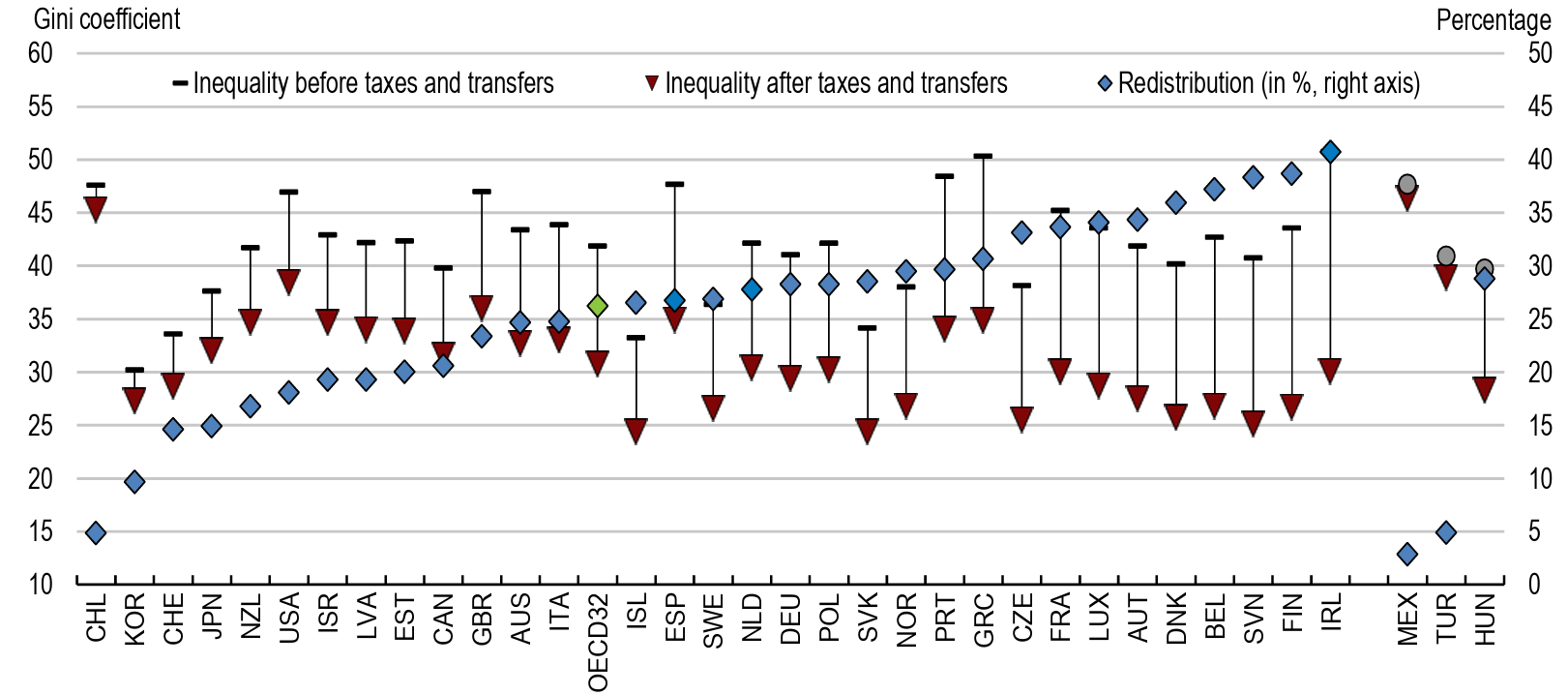
The first issue concerns the effectiveness of the system, that is, whether it is serving its purpose of reducing poverty and inequality. For now, the relative poverty in Korea is rather high among OECD countries and the role of the tax and transfer system extremely limited.

The Equalising Effect of Taxes and Transfers Across OECD Countries
Source: OECD (2019)

But care is needed in interpreting these data. As explained at the beginning, income distribution is influenced not only by the social welfare system but also by economic conditions and many other institutions and policies. In particular, the apparently meager role of the tax and transfer system in Korea appears mostly attributable to the under development of the NPS. [13] The problem, however, is that even when the NPS is fully developed, many retirees would not be able to benefit from it because about 40 percent of workers are not currently covered by public pension programs.

The low coverage ratio is also observed in the Industrial Accident Compensation Insurance and the EIS. This comes primarily from the prevalence of self-employment and temporary employment in Korea’s labor market, with many working at small businesses or in the service sector. [14] Such employment patterns severely limit the government’s ability to include all workers in social insurance programs.

To enhance the effectiveness of the social security system, efforts should be made to encourage the workers on the margins of labor market to participate in social insurance programs by, for example, reducing their contribution rates. Other important tasks include streamlining the complex programs of public assistance and social services, strengthening the delivery system, and focusing the resources on the most needy.

The second issue is to minimize the adverse impact of the tax and transfer system on work incentives. As explained earlier, the National Basic Livelihood Security Program (NBLSP) has a serious defect in this regard. Of course, it is quite possible that many beneficiaries of the NBLSP are already working in the informal labor market as self-employed or temporary workers, and not disclosing their income to the authorities in order to keep NBLSP benefits. But encouraging people to cheat on the system is in itself undesirable. To reduce the disincentive to work, discussion is underway on reforming the NBLSP by making its in-kind benefits (health care, education, housing, etc.) available to those over the poverty line or by limiting its coverage to those unable to work.

This issue is not, however, restricted to the case of NBLSP. Other programs such as childcare support often bases the amount of benefits offered on the level of household income. The dilemma is unavoidable as long as the government wants to target resources on people in need. Still, attention should be paid to the aggregate impact of various programs on the work incentives of households, which has never been identified to date.

Fortunately, the disincentive to work resulting from the tax system is rather weak, not only because of the large informal labor market but also the low statutory rates of taxation and social security contributions as can be inferred from the tax wedge. But given the rapid increase in social security contributions, it is important to minimize the growth of welfare spending and increase its cost-effectiveness.

This leads us to the third issue of assuring the long-term financial sustainability of the social security system. Of particular concern are the NPS and the NHI. As mentioned before, the NPS is expected to run out of its savings by 2060 and turn into a pure pay-as-you-go system, imposing a heavy burden on future generations. The NHI spending has been increasing over the years, and is set to increase further due to the rise in income levels, the development of more expensive technologies and equipment, and population aging. It is already costing the government about 4 trillion won (0.4 percent of GDP) each year.

Because there is a limit to increasing the tax revenues and social security contributions, serious efforts are required to constrain the spending growth of the NPS and the NHI, while fulfilling their fundamental roles of securing old-age income and access to affordable health care for the public. [15]

The final issue is about redefining the respective responsibilities of individuals and the state in social security system. With ever rising income levels, individuals are better positioned than before to prepare themselves for various risks that used to be the sole responsibility of the state. Private pensions and private health care in particular should be encouraged to play a larger role in this regard.

At the same time, private service providers should be allowed to enter the market for social services such as childcare, education, employment services, job training and health care. Their increased participation, while carrying some risks, can help promote innovation, customer orientation and cost-savings in the delivery of services (Shleifer, 1998;Pearson and Martin, 2005). This does not imply that the state should play a less important role; rather, it should keep financing these services and make sure that service quality and distributional equity is not compromised. [16]

In summary, greater efforts are needed in the future to enhance the effectiveness of the social security system; to minimize its adverse impact on the incentives to work; to assure long-term financial sustainability; and to redefine the respective responsibilities of individuals and the state and make greater use of private service providers. Korea’s social security system has achieved a lot of progress, and will continue to if these efforts bear fruit.

Notes

[1] These specialized welfare programs were the result of the Military Relief Act of 1950, the Police Relief Act of 1951, and the Act on Pensions for Deceased or Injured Military and Police Personnel of 1952.

[2] The government policy objectives laid out by the Chun administration included establishing a welfare state; developing democracy; building a society based on justice; reforming the education system; and promoting culture.

[3] It took 127 years for Germany, the first country to introduce a national health insurance program in 1854, to expand coverage to all German citizens. In the case of Japan which introduced health insurance much later with a more advanced economy, it took 36 years.

[4] These programs were undertaken with the view that Seoul would host the Paralympics Games as part of the 1988 Summer Olympic Games. Korea recognized the importance of this event in light of the growing international movement to support the human rights of the disabled.

[5] Housing supply ratio = number of houses÷number of households.

[6] See Table 2-13 in Chapter 2 for a long-term trend of the housing supply ratio.

[7] In 1997, there existed about 150,000 beneficiaries of the disability pension, the survivors’ pension, or the special pension for the elderly. The last type of pension benefit is granted to those who were aged between 45 and 60 in 1988 when the NPS was introduced and have contributed for at least five years before retiring at the age of 60 or older. Since then, pension beneficiaries have increased in number and totaled 2.8 million in 2009

[8] Still, only 10 percent of the unemployed could receive unemployment benefits in 1998 because the eligibility depends on aminimum period of contribution to the EIS. The minimum size of firms subject to the ALMPs of the EIS was lowered to 50 employees (January), 5 employees (July) and one employee (October).

[9] The replacement rate is the amount of pension benefit as a percentage of the retiree’s average wage during his working years

[10] In addition, the minimum pensionable age was scheduled to rise from 60 to 65 years between 2013 and 2033 (by 1 year every 5years). The contribution rate which had been raised from 3 percent in 1988 to 6 percent in 1993 and 9 percent in 1998 was to stay at that level in following years. The minimum contribution period was reduced from 15 to 10 years for the old-age pension.

[11] Another important policy agenda of the Roh’s administration was correcting regional imbalances across the country, which was viewed by many as another form of income transfer policy.

[12] In 2010, the maximum benefit was about 80 dollars a month for a single person and 130 dollars for a couple in a country with per capita income of about 1,600 dollars a month.

[13] Workers in countries with mature public pension systems tend to save less and their capital income from savings after retirement tends to be smaller. See Kyung-Mook Lim and Hyungpyo Moon (2003) for empirical evidence on this issue. In these countries, most retirees would be counted as being poor in terms of market income, and public pensions by themselves would play an important role in reducing poverty.

[14] The coverage ratio rises when the workers legally excluded from participation are subtracted from the denominator. For example, the coverage ratio of the EIS was 39 percent of total workers, 57 percent of wage and salary earners, and 82 percent of eligible workers in 2007 (OECD, 2008, p.126).

[15] One option for the NPS is to adopt a notional defined contribution system as in Sweden that is immune to macroeconomic and demographic shocks (Palmer, 2008).

[16] An example can be found again in Sweden (Blomqvist, 2004).

Author
Il SaKong
Korea Development Institute
Youngsun Koh
Korea Development Institute
cite this work

From Postwar Relief to Social Protection: How Growth and Crisis Shaped South Korea’s Welfare System

K-Dev Original
February 4, 2026
This is some text inside of a div block.

Summary

Social welfare in Korea evolved through successive responses to war, rapid growth, and economic crisis, gradually shifting from residual relief to a more institutionalized social protection system. In the postwar period, welfare policy centered on emergency assistance for displaced and vulnerable groups, with limited fiscal capacity and heavy reliance on foreign aid and non-state actors. During the era of state-led industrialization, social protection remained subordinate to economic growth, although basic legal frameworks and selective social insurance programs were introduced. As industrialization progressed, rising inequality and social risks increased public demand for welfare, leading to a notable expansion of social spending and the strengthening of core programs. A major milestone was the achievement of universal health insurance through the integration and extension of fragmented schemes, alongside the consolidation of pension and employment insurance systems. The late-1990s economic crisis further accelerated welfare expansion and broadened coverage, redefining the state’s role in guaranteeing minimum living standards. Despite these advances, persistent challenges remained in coverage gaps, work incentives, fiscal sustainability, and the appropriate division of responsibility between the state and the market.

Key Questions

  • How did rapid industrialization and social inequality change public demand for social protection?
  • How did the crisis redefine the state’s responsibility for minimum living standards?
  • What structural challenges persist despite the expansion of social protection programs?

#social protection #health insurance #employment insurance #pension #expenditure

1953–1961: Emergency Relief, Limited State Capacity, Heavy Reliance on External Providers

During the period of Japanese colonial rule, the Chosun Relief Order provided the first modern public relief program in Korea. But it has been criticized for serving political ends rather than being a genuine social welfare program (Yong-hwan Lee et al., 2006; Seop-joong Shin et al., 1999; Chan-young Yoon et al., 1998).

Welfare programs between the signing of the Korean War armistice in 1953 and the launch of the first economic development plan in 1961 comprised mainly of offering emergency relief assistance to refugees and orphans displaced by the war. Little more could be done since the government lacked funding to support welfare programs. Article 19 of the Constitution spoke of giving public assistance to the most vulnerable, namely the old, the disabled or the unemployed.

A war-wounded veteran undertakes rehabilitative therapy at the Dongnae Rehabilitation Center for Disabled Veterans, established in Busan under the United Nations Korean Reconstruction Agency (UNKRA) on 1 September 1954 (Source: UN Archives)

Limited access to welfare services was offered to the poor, women and children, and the disabled. The government did not provide much assistance, which instead was mainly the responsibility of civil organizations, overseas aid institutions and religious bodies. The government’s role was mostly confined to setting up welfare institutions for injured soldiers and policemen and their families, which provided public assistance, jobs and housing. [1] Other early steps toward creating a social security system included the Labor Standards Act in May 1953 and the Charter for Children in 1956. The former did not have much real meaning given the dearth of profitable businesses and the lack of the government’s administrative capacity. Much the same applied to the latter.

1950s Reconstruction: Foreign Aid, War Widows, and Early Women’s Rights in Law

Korean society was marked by chaos and poverty during the Korean War and the post-war reconstruction period. Primary industries dominated the economy, with the agriculture, forestry and fishing accounting for 47 percent of GDP in 1953 and employing an estimated 70 percent of the workforce. Women’s labor participation was mostly in these sectors. According to a 1948 survey conducted by the government, the number of women working in companies with more than five employees was 40,268, which was 18 percent of the total female working-age population of 223,030.

The main welfare policy for women was the provision of public assistance for war widows, who numbered as many as 700,000. The government also focused on providing primary education for women to improve literacy rates and conducted campaigns to encourage the participation of women in the post-war reconstruction of society. Women were granted the right to vote under the 1948 Constitution. The Labor Standards Law included provisions for maternity protection and banned discrimination against women.

Girls draw thread from raw cotton to produce T-shirts at a textile factory in Busan, 9 September 1951 (Source: U.S. National Archives and Records Administration)

These provisions had been adopted from advanced countries, but had little impact on the actual working conditions of women in Korea. Vocational training focused on low-skill jobs for war widows. The government built state-run homes for single-parent families to provide shelter and encourage economic self-reliance by providing simple vocational training. These institutions were financially supported by foreign aid, including the supply of basic items as well as sewing machines.

There were 62 homes for single-parent families in operation by 1956, but there were still too few of them to meet rising demand for their services. In 1957, the Labor Guidance Institution for Girls was established to provide vocational skills for knitting, sewing, hairdressing and embroidering to older girls who had to leave the orphanages or girls who could not attend primary and middle schools.

Rhee Syngman, the first president of the young republic, strived to rebuild the economy with a series of reconstruction plans. These plans aimed to expand the economic infrastructure, build key industries (cement, steel, etc.) and increase the productive capacity of manufacturing (Sang-oh Choi, 2005, pp.358-359).

Rhee’s desire to construct a self-sufficient Korean economy with these plans was in direct conflict with the American government’s intention to rebuild an East Asian economic block with an industrialized Japan at its center. America urged Korea to liberalize its market, stabilize the value of the Korean currency, and expand cooperation with Japan. To Rhee, however, this implied nothing but the revival of the Greater East Asian Co-Prosperity Sphere and the re-colonialization of the Korean economy. Rhee made full use of Korea’s geopolitical value to frustrate America’s effort while promoting import-substitution industries through reconstruction plans.

The Korean government also differed with the Americans on what kind of foreign aid it would receive. There were two types, one being project assistance and the other non-project assistance. The former was to be used for reconstruction, while the latter was to be distributed to private enterprises for civilian use. Korea received a large amount of foreign aid from the United Nations and the U.S. in the 1950s and 1960s. The Korean government preferred project assistance, while the American government preferred non-project assistance. In the end, the American preference prevailed; under ICA (International Cooperation Administration) aid, for example, project assistance made up 27 percent of the total and non-project assistance 73 percent. In any event, various reconstruction plans prepared by Rhee’s administration failed to spark economic growth in Korea.

1960s–1970s: Social Security Built at the Margins of Growth

Korea’s top priority during this period was economic growth as reflected in the Five-Year Economic Development Plans that dominated the government policy. Despite the low priority on welfare programs, however, several steps were taken in this period toward building a proper social security system in Korea.

The Livelihood Protection Act was introduced in 1962 to provide public assistance to the poor. It was criticized for stigmatizing its recipients because of its implicit suggestion that they were to be blamed for their poverty, but it was still an important step. In addition, the Social Security Act was enacted in 1963 to serve as a framework for welfare programs. In the same year, the Military Personnel Pension was introduced in addition to the Government Employees Pension that had been introduced in 1960. The Health Insurance Act was established but it did not stipulate compulsory participation for any group in Korean society.

In 1964, the Industrial Accident Compensation Insurance Act was introduced in line with the Economic Development Plans to provide support for workers suffering disabilities as a result of industrial accidents. It was the first social insurance program implemented in Korea. In addition, an industrial rehabilitation center was established under the auspices of the National Labor Office in 1971 to provide occupational training.

There was also a growing recognition of the need for welfare programs to take care of the elderly. The submission of the Basic Plan for Social Development in 1968 by the Social Security Review Committee led to several follow-up proposals, including the establishment of the Act on the Welfare of the Elderly, the development of pension programs, the expansion of medical facilities, the provision of employment opportunities for the elderly, an increase in the legal retirement age and the designation of the Day for the Elderly. The suggestions, however, failed to draw much attention from the government, which was preoccupied with economic growth.

In 1973, the National Assembly passed the National Welfare and Pension Act, but it was not implemented due to adverse social and economic conditions, including the two global oil shocks of the 1970s. Only the Teachers Pension was added to the public pension system in 1975.

In 1976, the Health Insurance Act was revised to stipulate compulsory participation of workers at firms with 500 or more employees beginning in 1977. The coverage was extended in 1979 to include those at firms with 300 or more employees. The year 1979 also witnessed the establishment of a compulsory health insurance program for government employees and teachers. It is significant since the introduction of compulsory health insurance was done at the behest of government rather than in response to public demands. As for low-income households, the Health Care Protection Act was introduced in 1977 to provide them with medical services.

A welfare program for the disabled was also introduced in the 1970s. The Ministry of Health and Social Affairs announced in 1978 the Comprehensive Welfare Program for Mentally and Physically Disabled Persons. Although the program was largely limited to public assistance measures, it did introduce rehabilitation treatment policies as well.

To summarize, basic social insurance programs were introduced in the 1960s and 1970s, including the Industrial Accident Compensation Insurance (1964); pensions for government employees (1960), military personnel (1963) and teachers (1975); and health insurances for private sector workers in large firms (1977) and government employees and teachers (1979). In addition, basic programs of public assistance and social services were introduced for the poor and the disabled. These programs were quite limited in their scope but Korea could improve income distribution due to the rapid growth of labor-intensive industries and the rapid increase of job opportunities.

1980–Mid-1990s: Welfare Expansion and System-Building

Toward the end of the 1970s, the government-led, growth-first strategy that had been pursued since the 1960s began to produce various social problems. The improvement in income distribution stopped or was partially reversed as the government actively promoted capital-intensive industries at the cost of macroeconomic stability (Il SaKong, 1993, p.18).

The poor, in particular, were affected by rising inflation. With the improvement in general living conditions, public attention was drawn to the income gaps between rich and poor and between different regions of the country. These developments highlighted the need for larger and more effective welfare programs.

The Chun Doo-hwan administration that came into office in 1980 announced a radical departure from past economic and social policies. It placed priority on promoting private initiatives and stabilizing inflation. It also set out as a goal “the establishment of a welfare society.”[2] The revised 1980 constitution made firm commitments on the state’s responsibility to provide a social safety net and this was followed by the enactment of major laws on welfare programs. Welfare spending jumped in the early 1980s.

In 1981, a pilot project was started to provide a community-based health insurance program to residents in rural areas, while the company-based health insurance program was extended to firms with 100 or more employees. Coverage was then extended to companies with 16 or more employees in 1982 and 5 or more employees in 1988.

Meanwhile, the community-based program was extended to all rural residents in 1988 and to all urban residents in 1989. This resulted in the creation of a universal health insurance system, a feat that was accomplished in only 12 years, the shortest time it has taken anywhere in the world (Deutsche Gesellschaft für Technische Zusammenarbeit, 2005; Ensor, 1999). [3]

The Livelihood Protection Act, which provided public assistance, was revised in 1982 to expand the types of assistance that could be offered to the destitute, with the aim of providing better access to education and jobs.

The introduction of the Act on the Welfare of the Elderly in June 1981 created the legal basis to offer welfare benefits to the older population. Starting from 1982, people aged 65 or older received discounts on the use of mass transit, museum admissions and visits to public baths and barber facilities. A free medical diagnosis program for the elderly was introduced in 1983.

In 1987, a pilot project was launched to provide welfare services to older persons forced to stay at home. Two years later, the government began an allowance payment program for the elderly. This involved paying 10,000 won a month to 76,000 heads of households who were aged 70 or older and who were receiving some form of assistance. Regulations on nursing homes for the elderly were introduced in 1988 and those governing senior citizens’ community centers in 1989.

The National Pension Scheme (NPS), covering workers in firms with 10 or more employees, was implemented in 1988. In 1992, the compulsory coverage was expanded to firms with 5 or more employees. It was expanded further in 1995 to farmers, fishermen and the self-employed in rural areas, and finally in 1999 to the self-employed in urban areas. This completed the move toward a universal public pension scheme.

Welfare services for the disabled were expanded as well. Between 1985 and 1987, a program was implemented to modernize welfare facilities for the disabled. A Comprehensive Welfare Program for the Disabled Persons was launched in 1986, and a pilot program to register the disabled for services was carried out the following year. [4]

In 1989, the government launched a program to increase the housing stock and supply rental housing to low-income households in response to the sharp rise in housing prices and rental costs. The program continued until 1992 and the housing supply ratio [5] jumped from 70.9 to 79.1 percent between 1989 and 1993. [6]

The Act on the Employment Promotion of the Handicapped was passed in 1990 and implemented the following year with the goal of providing jobs for the disabled and encouraging their social integration. The law required that public enterprises and private-sector firms with 300 or more employees employ the disabled until they accounted for 2 percent of the total workforce. This was an important step in providing economic support to the handicapped.

The Pre-school Age Children Care Act was enacted in January 1991 to expand childcare facilities, improve the protection and education for children, and support children in families in need of assistance. In 1998, the government stopped requiring that childcare facilities be certified before going into operation, but instead only be registered with the authorities. This was to encourage the expansion of childcare facilities. The system was, however, changed back to the certification system in 2004.

Another important development in this period was the introduction of the Employment Insurance System (EIS) in 1995. With this, Korea came to have all four types of major social insurance programs.

The EIS is comprised of two programs, one being the traditional unemployment benefit program and the other a group of ALMPs such as wage subsidies, vocational training and employment services. The idea was that preventing unemployment through ALMPs was as important as providing relief measures to the unemployed. Initially, the unemployment benefit program covered firms with 30 or more employees and the ALMPs those with 70 or more employees. The coverage was expanded rapidly in 1998.

To summarize, the period from 1980 to the mid-1990s witnessed an important change in the stance toward welfare policies, with the introduction of two social insurance programs -the NPS (1988) and the EIS (1995)-and the creation of universal health insurance (1989). The Livelihood Protection Program and welfare services for the disabled, children and other vulnerable groups were expanded. These changes accelerated the growth of welfare spending.

Nonetheless, welfare spending amounted to only 3.3 percent of GDP in 1997. Only those workers at firms with 30 or more employees were covered by the unemployment benefit program of the EIS. The old-age pension of the NPS was not available to retirees because it required at least 15 years of prior contribution while the NPS had been introduced less than 10 years earlier. [7] The public assistance and welfare services provided limited benefits and the delivery system was not well organized. The economic crisis of 1997 exposed the weaknesses of the Korean social security system and played a catalytic role in its subsequent enlargement.

Post-1997 Crisis: Rapid Safety Net Scaling and Major Program Reforms

The economic crisis produced extreme hardships. The unemployment rate skyrocketed to 7 percent in 1998 from less than 3 percent in preceding years. Due to the limited coverage of the EIS, only 10 percent of the unemployed could receive unemployment benefits. The Gini coefficient rose by 13 percent from 0.27 in 1997 to 0.31 in 1998.

The increasing unemployment and poverty raised public awareness about the need for a well-functioning social safety net and helped forge a national consensus on the issue. This coincided with the election of Kim Dae-jung as the new president, which represented the first peaceful transfer of power to the opposition in Korea’s postwar history.

In response to the crisis, the government increased wage subsidies to firms that retained redundant workers and expanded vocational training for the unemployed within the framework of the EIS. In March 1998, a public works program was introduced to create jobs directly with public money. This program played a major role during the crisis in providing emergency support to the poor. Unemployed college graduates could also benefit from government-paid internships at private companies.

At the same time, the government made important changes to the EIS and the public assistance program. First, the coverage of the unemployment benefit program of the EIS was extended rapidly in 1998 to firms with at least 10 employees (January), to those with at least 5 employees (March), and eventually to those with one or more employees (October). [8] Since then, the beneficiaries of the EIS have increased in number.

Second, a new revised public assistance program, the National Basic Livelihood Security Program (NBLSP), was introduced in 2000. The NBLSP stipulated the state’s responsibility to guarantee minimum living standards for the whole population by providing benefits to households below the poverty line. It has been, however, criticized for discouraging participants from seeking employment because their benefits decline by the same amount as their earnings increase. All types of benefits (health, housing, education, etc.) are given to those below the poverty line, but none at all to those above it. These features impart to the beneficiaries a strong incentive not to work and escape from poverty.

Other important changes under the Kim administration were the consolidation of the various national health insurance schemes into the National Health Insurance (NHI) in 1999 and the revision of the National Pension Act the same year. The latter finally completed the process of bringing all workers under the compulsory system and at the same time adjusted the contribution and benefit scheme to make the program more financially sustainable in the long term. Specifically, the replacement rate [9] was reduced from 70 to 60 percent for participants who had contributed to the NPS for 40 years and earned a wage equivalent to the average among the NPS participants. It also required the government to make a forecast estimate on the long-term financial conditions of the NPS every five years and submit a report to the National Assembly. [10]

While the first NPS reform embodied in the revised Act failed to eliminate the financial instability of the NPS, it was still a remarkable achievement given the difficulties other countries have experienced in their pension reform. Success factors included the very small number of NPS beneficiaries at the time, the public’s concern about the tax burden of future generations, the advocacy role of research institutions such as KDI, and the economic crisis of 1997 that weakened resistance to reforms of any sort.

The Roh Moo-hyun administration (2003-2008) that followed the Kim’s administration (1998-2003) placed an even greater emphasis on welfare policies. [11] Various new programs were added in this period. Among them, the Emergency Relief Program (2006) offers temporary assistance to the households suffering a sudden loss of income. The Long-Term Care Insurance (2008) provides in-kind benefits to the severely disabled older persons. It is funded by a surtax on the contribution to the NHI. The Earned Income Tax Credit (2008) supplements the earnings of low-income workers with cash benefits to encourage their participation in the labor market and support their living conditions. The first benefits were offered in 2009 for earnings made in 2008. The Basic Old-Age Pension (2008) is a public assistance program for the elderly with low incomes. In 2008, 60 percent of those aged 65 or more were to benefit from the program. The target was raised to 70 percent in 2009. Given the small amount of benefit per recipient, [12] the program invited criticism for spreading scare resources thinly over a large segment of the older population.

Another notable development was the rapid increase in spending for the care and education of pre-school age children starting with the Roh’s administration. Spending grew by 43 percent per year in 2002-2010. It had multiple purposes, including securing equal opportunities for children’s educational development, investing in human resources, encouraging child-bearing, and promoting the labor market participation of mothers.

In the meantime, the NPS underwent a second round of reforms in 2007. Based on the result of the long-term financial projection published in 2003 that predicted that the accumulated savings in the NPS would be depleted by 2047, the government began an intense consensus-building process to arrive at a reform formula. The business community preferred a drastic cut in benefits to minimize the growth in contributions, whereas labor unions and civic groups opposed benefit cuts (National Pension Service, 2008). In the end, most parties agreed to the necessity of reform, and a middle ground was found by reducing the replacement rate by 10 percentage point from 60 percent in 2007 to 50 percent in 2008, and then by 0.5 percentage point each year over the next 20 years to arrive finally at 40 percent in 2028. Despite the reform of the NPS, total welfare spending kept increasing rapidly in this period. In the mid-2000s, it became the largest spending category, surpassing economic affairs, education and defense.

It is of interest that all administrations in this period advocated some form of “workfare.” For example, the Kim’s administration adopted “productive welfare” as its slogan and emphasized that while welfare programs should be expanded, they also needed to be structured in away that would allow recipients to develop their own capabilities and eventually become self-sufficient and no longer dependent on state support. However, such rhetoric was not evident in actual policies such as the National Basic Livelihood Security Program, which contained strong disincentives for seeking work.

Persistent Challenges: Effectiveness, Incentives, Sustainability, and System Governance

Despite its relatively short history, the social security system in Korea has expanded and matured to the point where it is deeply embedded in society. But there are a number of difficult challenges that still must be tackled in order that it can reach full fruition.

The first issue concerns the effectiveness of the system, that is, whether it is serving its purpose of reducing poverty and inequality. For now, the relative poverty in Korea is rather high among OECD countries and the role of the tax and transfer system extremely limited.

The Equalising Effect of Taxes and Transfers Across OECD Countries

Source: OECD (2019)

But care is needed in interpreting these data. As explained at the beginning, income distribution is influenced not only by the social welfare system but also by economic conditions and many other institutions and policies. In particular, the apparently meager role of the tax and transfer system in Korea appears mostly attributable to the under development of the NPS. [13] The problem, however, is that even when the NPS is fully developed, many retirees would not be able to benefit from it because about 40 percent of workers are not currently covered by public pension programs.

The low coverage ratio is also observed in the Industrial Accident Compensation Insurance and the EIS. This comes primarily from the prevalence of self-employment and temporary employment in Korea’s labor market, with many working at small businesses or in the service sector. [14] Such employment patterns severely limit the government’s ability to include all workers in social insurance programs.

To enhance the effectiveness of the social security system, efforts should be made to encourage the workers on the margins of labor market to participate in social insurance programs by, for example, reducing their contribution rates. Other important tasks include streamlining the complex programs of public assistance and social services, strengthening the delivery system, and focusing the resources on the most needy.

The second issue is to minimize the adverse impact of the tax and transfer system on work incentives. As explained earlier, the National Basic Livelihood Security Program (NBLSP) has a serious defect in this regard. Of course, it is quite possible that many beneficiaries of the NBLSP are already working in the informal labor market as self-employed or temporary workers, and not disclosing their income to the authorities in order to keep NBLSP benefits. But encouraging people to cheat on the system is in itself undesirable. To reduce the disincentive to work, discussion is underway on reforming the NBLSP by making its in-kind benefits (health care, education, housing, etc.) available to those over the poverty line or by limiting its coverage to those unable to work.

This issue is not, however, restricted to the case of NBLSP. Other programs such as childcare support often bases the amount of benefits offered on the level of household income. The dilemma is unavoidable as long as the government wants to target resources on people in need. Still, attention should be paid to the aggregate impact of various programs on the work incentives of households, which has never been identified to date.

Fortunately, the disincentive to work resulting from the tax system is rather weak, not only because of the large informal labor market but also the low statutory rates of taxation and social security contributions as can be inferred from the tax wedge. But given the rapid increase in social security contributions, it is important to minimize the growth of welfare spending and increase its cost-effectiveness.

This leads us to the third issue of assuring the long-term financial sustainability of the social security system. Of particular concern are the NPS and the NHI. As mentioned before, the NPS is expected to run out of its savings by 2060 and turn into a pure pay-as-you-go system, imposing a heavy burden on future generations. The NHI spending has been increasing over the years, and is set to increase further due to the rise in income levels, the development of more expensive technologies and equipment, and population aging. It is already costing the government about 4 trillion won (0.4 percent of GDP) each year.

Because there is a limit to increasing the tax revenues and social security contributions, serious efforts are required to constrain the spending growth of the NPS and the NHI, while fulfilling their fundamental roles of securing old-age income and access to affordable health care for the public. [15]

The final issue is about redefining the respective responsibilities of individuals and the state in social security system. With ever rising income levels, individuals are better positioned than before to prepare themselves for various risks that used to be the sole responsibility of the state. Private pensions and private health care in particular should be encouraged to play a larger role in this regard.

At the same time, private service providers should be allowed to enter the market for social services such as childcare, education, employment services, job training and health care. Their increased participation, while carrying some risks, can help promote innovation, customer orientation and cost-savings in the delivery of services (Shleifer, 1998;Pearson and Martin, 2005). This does not imply that the state should play a less important role; rather, it should keep financing these services and make sure that service quality and distributional equity is not compromised. [16]

In summary, greater efforts are needed in the future to enhance the effectiveness of the social security system; to minimize its adverse impact on the incentives to work; to assure long-term financial sustainability; and to redefine the respective responsibilities of individuals and the state and make greater use of private service providers. Korea’s social security system has achieved a lot of progress, and will continue to if these efforts bear fruit.

Notes

[1] These specialized welfare programs were the result of the Military Relief Act of 1950, the Police Relief Act of 1951, and the Act on Pensions for Deceased or Injured Military and Police Personnel of 1952.

[2] The government policy objectives laid out by the Chun administration included establishing a welfare state; developing democracy; building a society based on justice; reforming the education system; and promoting culture.

[3] It took 127 years for Germany, the first country to introduce a national health insurance program in 1854, to expand coverage to all German citizens. In the case of Japan which introduced health insurance much later with a more advanced economy, it took 36 years.

[4] These programs were undertaken with the view that Seoul would host the Paralympics Games as part of the 1988 Summer Olympic Games. Korea recognized the importance of this event in light of the growing international movement to support the human rights of the disabled.

[5] Housing supply ratio = number of houses÷number of households.

[6] See Table 2-13 in Chapter 2 for a long-term trend of the housing supply ratio.

[7] In 1997, there existed about 150,000 beneficiaries of the disability pension, the survivors’ pension, or the special pension for the elderly. The last type of pension benefit is granted to those who were aged between 45 and 60 in 1988 when the NPS was introduced and have contributed for at least five years before retiring at the age of 60 or older. Since then, pension beneficiaries have increased in number and totaled 2.8 million in 2009

[8] Still, only 10 percent of the unemployed could receive unemployment benefits in 1998 because the eligibility depends on aminimum period of contribution to the EIS. The minimum size of firms subject to the ALMPs of the EIS was lowered to 50 employees (January), 5 employees (July) and one employee (October).

[9] The replacement rate is the amount of pension benefit as a percentage of the retiree’s average wage during his working years

[10] In addition, the minimum pensionable age was scheduled to rise from 60 to 65 years between 2013 and 2033 (by 1 year every 5years). The contribution rate which had been raised from 3 percent in 1988 to 6 percent in 1993 and 9 percent in 1998 was to stay at that level in following years. The minimum contribution period was reduced from 15 to 10 years for the old-age pension.

[11] Another important policy agenda of the Roh’s administration was correcting regional imbalances across the country, which was viewed by many as another form of income transfer policy.

[12] In 2010, the maximum benefit was about 80 dollars a month for a single person and 130 dollars for a couple in a country with per capita income of about 1,600 dollars a month.

[13] Workers in countries with mature public pension systems tend to save less and their capital income from savings after retirement tends to be smaller. See Kyung-Mook Lim and Hyungpyo Moon (2003) for empirical evidence on this issue. In these countries, most retirees would be counted as being poor in terms of market income, and public pensions by themselves would play an important role in reducing poverty.

[14] The coverage ratio rises when the workers legally excluded from participation are subtracted from the denominator. For example, the coverage ratio of the EIS was 39 percent of total workers, 57 percent of wage and salary earners, and 82 percent of eligible workers in 2007 (OECD, 2008, p.126).

[15] One option for the NPS is to adopt a notional defined contribution system as in Sweden that is immune to macroeconomic and demographic shocks (Palmer, 2008).

[16] An example can be found again in Sweden (Blomqvist, 2004).

References
Cite this work
.

More to explore from
In Perspective

No items found.

From Postwar Relief to Social Protection: How Growth and Crisis Shaped South Korea’s Welfare System

K-Dev Original
February 4, 2026

I am the text that will be copied.

1953–1961: Emergency Relief, Limited State Capacity, Heavy Reliance on External Providers

During the period of Japanese colonial rule, the Chosun Relief Order provided the first modern public relief program in Korea. But it has been criticized for serving political ends rather than being a genuine social welfare program (Yong-hwan Lee et al., 2006; Seop-joong Shin et al., 1999; Chan-young Yoon et al., 1998).

Welfare programs between the signing of the Korean War armistice in 1953 and the launch of the first economic development plan in 1961 comprised mainly of offering emergency relief assistance to refugees and orphans displaced by the war. Little more could be done since the government lacked funding to support welfare programs. Article 19 of the Constitution spoke of giving public assistance to the most vulnerable, namely the old, the disabled or the unemployed.

A war-wounded veteran undertakes rehabilitative therapy at the Dongnae Rehabilitation Center for Disabled Veterans, established in Busan under the United Nations Korean Reconstruction Agency (UNKRA) on 1 September 1954 (Source: UN Archives)

Limited access to welfare services was offered to the poor, women and children, and the disabled. The government did not provide much assistance, which instead was mainly the responsibility of civil organizations, overseas aid institutions and religious bodies. The government’s role was mostly confined to setting up welfare institutions for injured soldiers and policemen and their families, which provided public assistance, jobs and housing. [1] Other early steps toward creating a social security system included the Labor Standards Act in May 1953 and the Charter for Children in 1956. The former did not have much real meaning given the dearth of profitable businesses and the lack of the government’s administrative capacity. Much the same applied to the latter.

1950s Reconstruction: Foreign Aid, War Widows, and Early Women’s Rights in Law

Korean society was marked by chaos and poverty during the Korean War and the post-war reconstruction period. Primary industries dominated the economy, with the agriculture, forestry and fishing accounting for 47 percent of GDP in 1953 and employing an estimated 70 percent of the workforce. Women’s labor participation was mostly in these sectors. According to a 1948 survey conducted by the government, the number of women working in companies with more than five employees was 40,268, which was 18 percent of the total female working-age population of 223,030.

The main welfare policy for women was the provision of public assistance for war widows, who numbered as many as 700,000. The government also focused on providing primary education for women to improve literacy rates and conducted campaigns to encourage the participation of women in the post-war reconstruction of society. Women were granted the right to vote under the 1948 Constitution. The Labor Standards Law included provisions for maternity protection and banned discrimination against women.

Girls draw thread from raw cotton to produce T-shirts at a textile factory in Busan, 9 September 1951 (Source: U.S. National Archives and Records Administration)

These provisions had been adopted from advanced countries, but had little impact on the actual working conditions of women in Korea. Vocational training focused on low-skill jobs for war widows. The government built state-run homes for single-parent families to provide shelter and encourage economic self-reliance by providing simple vocational training. These institutions were financially supported by foreign aid, including the supply of basic items as well as sewing machines.

There were 62 homes for single-parent families in operation by 1956, but there were still too few of them to meet rising demand for their services. In 1957, the Labor Guidance Institution for Girls was established to provide vocational skills for knitting, sewing, hairdressing and embroidering to older girls who had to leave the orphanages or girls who could not attend primary and middle schools.

Rhee Syngman, the first president of the young republic, strived to rebuild the economy with a series of reconstruction plans. These plans aimed to expand the economic infrastructure, build key industries (cement, steel, etc.) and increase the productive capacity of manufacturing (Sang-oh Choi, 2005, pp.358-359).

Rhee’s desire to construct a self-sufficient Korean economy with these plans was in direct conflict with the American government’s intention to rebuild an East Asian economic block with an industrialized Japan at its center. America urged Korea to liberalize its market, stabilize the value of the Korean currency, and expand cooperation with Japan. To Rhee, however, this implied nothing but the revival of the Greater East Asian Co-Prosperity Sphere and the re-colonialization of the Korean economy. Rhee made full use of Korea’s geopolitical value to frustrate America’s effort while promoting import-substitution industries through reconstruction plans.

The Korean government also differed with the Americans on what kind of foreign aid it would receive. There were two types, one being project assistance and the other non-project assistance. The former was to be used for reconstruction, while the latter was to be distributed to private enterprises for civilian use. Korea received a large amount of foreign aid from the United Nations and the U.S. in the 1950s and 1960s. The Korean government preferred project assistance, while the American government preferred non-project assistance. In the end, the American preference prevailed; under ICA (International Cooperation Administration) aid, for example, project assistance made up 27 percent of the total and non-project assistance 73 percent. In any event, various reconstruction plans prepared by Rhee’s administration failed to spark economic growth in Korea.

1960s–1970s: Social Security Built at the Margins of Growth

Korea’s top priority during this period was economic growth as reflected in the Five-Year Economic Development Plans that dominated the government policy. Despite the low priority on welfare programs, however, several steps were taken in this period toward building a proper social security system in Korea.

The Livelihood Protection Act was introduced in 1962 to provide public assistance to the poor. It was criticized for stigmatizing its recipients because of its implicit suggestion that they were to be blamed for their poverty, but it was still an important step. In addition, the Social Security Act was enacted in 1963 to serve as a framework for welfare programs. In the same year, the Military Personnel Pension was introduced in addition to the Government Employees Pension that had been introduced in 1960. The Health Insurance Act was established but it did not stipulate compulsory participation for any group in Korean society.

In 1964, the Industrial Accident Compensation Insurance Act was introduced in line with the Economic Development Plans to provide support for workers suffering disabilities as a result of industrial accidents. It was the first social insurance program implemented in Korea. In addition, an industrial rehabilitation center was established under the auspices of the National Labor Office in 1971 to provide occupational training.

There was also a growing recognition of the need for welfare programs to take care of the elderly. The submission of the Basic Plan for Social Development in 1968 by the Social Security Review Committee led to several follow-up proposals, including the establishment of the Act on the Welfare of the Elderly, the development of pension programs, the expansion of medical facilities, the provision of employment opportunities for the elderly, an increase in the legal retirement age and the designation of the Day for the Elderly. The suggestions, however, failed to draw much attention from the government, which was preoccupied with economic growth.

In 1973, the National Assembly passed the National Welfare and Pension Act, but it was not implemented due to adverse social and economic conditions, including the two global oil shocks of the 1970s. Only the Teachers Pension was added to the public pension system in 1975.

In 1976, the Health Insurance Act was revised to stipulate compulsory participation of workers at firms with 500 or more employees beginning in 1977. The coverage was extended in 1979 to include those at firms with 300 or more employees. The year 1979 also witnessed the establishment of a compulsory health insurance program for government employees and teachers. It is significant since the introduction of compulsory health insurance was done at the behest of government rather than in response to public demands. As for low-income households, the Health Care Protection Act was introduced in 1977 to provide them with medical services.

A welfare program for the disabled was also introduced in the 1970s. The Ministry of Health and Social Affairs announced in 1978 the Comprehensive Welfare Program for Mentally and Physically Disabled Persons. Although the program was largely limited to public assistance measures, it did introduce rehabilitation treatment policies as well.

To summarize, basic social insurance programs were introduced in the 1960s and 1970s, including the Industrial Accident Compensation Insurance (1964); pensions for government employees (1960), military personnel (1963) and teachers (1975); and health insurances for private sector workers in large firms (1977) and government employees and teachers (1979). In addition, basic programs of public assistance and social services were introduced for the poor and the disabled. These programs were quite limited in their scope but Korea could improve income distribution due to the rapid growth of labor-intensive industries and the rapid increase of job opportunities.

1980–Mid-1990s: Welfare Expansion and System-Building

Toward the end of the 1970s, the government-led, growth-first strategy that had been pursued since the 1960s began to produce various social problems. The improvement in income distribution stopped or was partially reversed as the government actively promoted capital-intensive industries at the cost of macroeconomic stability (Il SaKong, 1993, p.18).

The poor, in particular, were affected by rising inflation. With the improvement in general living conditions, public attention was drawn to the income gaps between rich and poor and between different regions of the country. These developments highlighted the need for larger and more effective welfare programs.

The Chun Doo-hwan administration that came into office in 1980 announced a radical departure from past economic and social policies. It placed priority on promoting private initiatives and stabilizing inflation. It also set out as a goal “the establishment of a welfare society.”[2] The revised 1980 constitution made firm commitments on the state’s responsibility to provide a social safety net and this was followed by the enactment of major laws on welfare programs. Welfare spending jumped in the early 1980s.

In 1981, a pilot project was started to provide a community-based health insurance program to residents in rural areas, while the company-based health insurance program was extended to firms with 100 or more employees. Coverage was then extended to companies with 16 or more employees in 1982 and 5 or more employees in 1988.

Meanwhile, the community-based program was extended to all rural residents in 1988 and to all urban residents in 1989. This resulted in the creation of a universal health insurance system, a feat that was accomplished in only 12 years, the shortest time it has taken anywhere in the world (Deutsche Gesellschaft für Technische Zusammenarbeit, 2005; Ensor, 1999). [3]

The Livelihood Protection Act, which provided public assistance, was revised in 1982 to expand the types of assistance that could be offered to the destitute, with the aim of providing better access to education and jobs.

The introduction of the Act on the Welfare of the Elderly in June 1981 created the legal basis to offer welfare benefits to the older population. Starting from 1982, people aged 65 or older received discounts on the use of mass transit, museum admissions and visits to public baths and barber facilities. A free medical diagnosis program for the elderly was introduced in 1983.

In 1987, a pilot project was launched to provide welfare services to older persons forced to stay at home. Two years later, the government began an allowance payment program for the elderly. This involved paying 10,000 won a month to 76,000 heads of households who were aged 70 or older and who were receiving some form of assistance. Regulations on nursing homes for the elderly were introduced in 1988 and those governing senior citizens’ community centers in 1989.

The National Pension Scheme (NPS), covering workers in firms with 10 or more employees, was implemented in 1988. In 1992, the compulsory coverage was expanded to firms with 5 or more employees. It was expanded further in 1995 to farmers, fishermen and the self-employed in rural areas, and finally in 1999 to the self-employed in urban areas. This completed the move toward a universal public pension scheme.

Welfare services for the disabled were expanded as well. Between 1985 and 1987, a program was implemented to modernize welfare facilities for the disabled. A Comprehensive Welfare Program for the Disabled Persons was launched in 1986, and a pilot program to register the disabled for services was carried out the following year. [4]

In 1989, the government launched a program to increase the housing stock and supply rental housing to low-income households in response to the sharp rise in housing prices and rental costs. The program continued until 1992 and the housing supply ratio [5] jumped from 70.9 to 79.1 percent between 1989 and 1993. [6]

The Act on the Employment Promotion of the Handicapped was passed in 1990 and implemented the following year with the goal of providing jobs for the disabled and encouraging their social integration. The law required that public enterprises and private-sector firms with 300 or more employees employ the disabled until they accounted for 2 percent of the total workforce. This was an important step in providing economic support to the handicapped.

The Pre-school Age Children Care Act was enacted in January 1991 to expand childcare facilities, improve the protection and education for children, and support children in families in need of assistance. In 1998, the government stopped requiring that childcare facilities be certified before going into operation, but instead only be registered with the authorities. This was to encourage the expansion of childcare facilities. The system was, however, changed back to the certification system in 2004.

Another important development in this period was the introduction of the Employment Insurance System (EIS) in 1995. With this, Korea came to have all four types of major social insurance programs.

The EIS is comprised of two programs, one being the traditional unemployment benefit program and the other a group of ALMPs such as wage subsidies, vocational training and employment services. The idea was that preventing unemployment through ALMPs was as important as providing relief measures to the unemployed. Initially, the unemployment benefit program covered firms with 30 or more employees and the ALMPs those with 70 or more employees. The coverage was expanded rapidly in 1998.

To summarize, the period from 1980 to the mid-1990s witnessed an important change in the stance toward welfare policies, with the introduction of two social insurance programs -the NPS (1988) and the EIS (1995)-and the creation of universal health insurance (1989). The Livelihood Protection Program and welfare services for the disabled, children and other vulnerable groups were expanded. These changes accelerated the growth of welfare spending.

Nonetheless, welfare spending amounted to only 3.3 percent of GDP in 1997. Only those workers at firms with 30 or more employees were covered by the unemployment benefit program of the EIS. The old-age pension of the NPS was not available to retirees because it required at least 15 years of prior contribution while the NPS had been introduced less than 10 years earlier. [7] The public assistance and welfare services provided limited benefits and the delivery system was not well organized. The economic crisis of 1997 exposed the weaknesses of the Korean social security system and played a catalytic role in its subsequent enlargement.

Post-1997 Crisis: Rapid Safety Net Scaling and Major Program Reforms

The economic crisis produced extreme hardships. The unemployment rate skyrocketed to 7 percent in 1998 from less than 3 percent in preceding years. Due to the limited coverage of the EIS, only 10 percent of the unemployed could receive unemployment benefits. The Gini coefficient rose by 13 percent from 0.27 in 1997 to 0.31 in 1998.

The increasing unemployment and poverty raised public awareness about the need for a well-functioning social safety net and helped forge a national consensus on the issue. This coincided with the election of Kim Dae-jung as the new president, which represented the first peaceful transfer of power to the opposition in Korea’s postwar history.

In response to the crisis, the government increased wage subsidies to firms that retained redundant workers and expanded vocational training for the unemployed within the framework of the EIS. In March 1998, a public works program was introduced to create jobs directly with public money. This program played a major role during the crisis in providing emergency support to the poor. Unemployed college graduates could also benefit from government-paid internships at private companies.

At the same time, the government made important changes to the EIS and the public assistance program. First, the coverage of the unemployment benefit program of the EIS was extended rapidly in 1998 to firms with at least 10 employees (January), to those with at least 5 employees (March), and eventually to those with one or more employees (October). [8] Since then, the beneficiaries of the EIS have increased in number.

Second, a new revised public assistance program, the National Basic Livelihood Security Program (NBLSP), was introduced in 2000. The NBLSP stipulated the state’s responsibility to guarantee minimum living standards for the whole population by providing benefits to households below the poverty line. It has been, however, criticized for discouraging participants from seeking employment because their benefits decline by the same amount as their earnings increase. All types of benefits (health, housing, education, etc.) are given to those below the poverty line, but none at all to those above it. These features impart to the beneficiaries a strong incentive not to work and escape from poverty.

Other important changes under the Kim administration were the consolidation of the various national health insurance schemes into the National Health Insurance (NHI) in 1999 and the revision of the National Pension Act the same year. The latter finally completed the process of bringing all workers under the compulsory system and at the same time adjusted the contribution and benefit scheme to make the program more financially sustainable in the long term. Specifically, the replacement rate [9] was reduced from 70 to 60 percent for participants who had contributed to the NPS for 40 years and earned a wage equivalent to the average among the NPS participants. It also required the government to make a forecast estimate on the long-term financial conditions of the NPS every five years and submit a report to the National Assembly. [10]

While the first NPS reform embodied in the revised Act failed to eliminate the financial instability of the NPS, it was still a remarkable achievement given the difficulties other countries have experienced in their pension reform. Success factors included the very small number of NPS beneficiaries at the time, the public’s concern about the tax burden of future generations, the advocacy role of research institutions such as KDI, and the economic crisis of 1997 that weakened resistance to reforms of any sort.

The Roh Moo-hyun administration (2003-2008) that followed the Kim’s administration (1998-2003) placed an even greater emphasis on welfare policies. [11] Various new programs were added in this period. Among them, the Emergency Relief Program (2006) offers temporary assistance to the households suffering a sudden loss of income. The Long-Term Care Insurance (2008) provides in-kind benefits to the severely disabled older persons. It is funded by a surtax on the contribution to the NHI. The Earned Income Tax Credit (2008) supplements the earnings of low-income workers with cash benefits to encourage their participation in the labor market and support their living conditions. The first benefits were offered in 2009 for earnings made in 2008. The Basic Old-Age Pension (2008) is a public assistance program for the elderly with low incomes. In 2008, 60 percent of those aged 65 or more were to benefit from the program. The target was raised to 70 percent in 2009. Given the small amount of benefit per recipient, [12] the program invited criticism for spreading scare resources thinly over a large segment of the older population.

Another notable development was the rapid increase in spending for the care and education of pre-school age children starting with the Roh’s administration. Spending grew by 43 percent per year in 2002-2010. It had multiple purposes, including securing equal opportunities for children’s educational development, investing in human resources, encouraging child-bearing, and promoting the labor market participation of mothers.

In the meantime, the NPS underwent a second round of reforms in 2007. Based on the result of the long-term financial projection published in 2003 that predicted that the accumulated savings in the NPS would be depleted by 2047, the government began an intense consensus-building process to arrive at a reform formula. The business community preferred a drastic cut in benefits to minimize the growth in contributions, whereas labor unions and civic groups opposed benefit cuts (National Pension Service, 2008). In the end, most parties agreed to the necessity of reform, and a middle ground was found by reducing the replacement rate by 10 percentage point from 60 percent in 2007 to 50 percent in 2008, and then by 0.5 percentage point each year over the next 20 years to arrive finally at 40 percent in 2028. Despite the reform of the NPS, total welfare spending kept increasing rapidly in this period. In the mid-2000s, it became the largest spending category, surpassing economic affairs, education and defense.

It is of interest that all administrations in this period advocated some form of “workfare.” For example, the Kim’s administration adopted “productive welfare” as its slogan and emphasized that while welfare programs should be expanded, they also needed to be structured in away that would allow recipients to develop their own capabilities and eventually become self-sufficient and no longer dependent on state support. However, such rhetoric was not evident in actual policies such as the National Basic Livelihood Security Program, which contained strong disincentives for seeking work.

Persistent Challenges: Effectiveness, Incentives, Sustainability, and System Governance

Despite its relatively short history, the social security system in Korea has expanded and matured to the point where it is deeply embedded in society. But there are a number of difficult challenges that still must be tackled in order that it can reach full fruition.

The first issue concerns the effectiveness of the system, that is, whether it is serving its purpose of reducing poverty and inequality. For now, the relative poverty in Korea is rather high among OECD countries and the role of the tax and transfer system extremely limited.

The Equalising Effect of Taxes and Transfers Across OECD Countries

Source: OECD (2019)

But care is needed in interpreting these data. As explained at the beginning, income distribution is influenced not only by the social welfare system but also by economic conditions and many other institutions and policies. In particular, the apparently meager role of the tax and transfer system in Korea appears mostly attributable to the under development of the NPS. [13] The problem, however, is that even when the NPS is fully developed, many retirees would not be able to benefit from it because about 40 percent of workers are not currently covered by public pension programs.

The low coverage ratio is also observed in the Industrial Accident Compensation Insurance and the EIS. This comes primarily from the prevalence of self-employment and temporary employment in Korea’s labor market, with many working at small businesses or in the service sector. [14] Such employment patterns severely limit the government’s ability to include all workers in social insurance programs.

To enhance the effectiveness of the social security system, efforts should be made to encourage the workers on the margins of labor market to participate in social insurance programs by, for example, reducing their contribution rates. Other important tasks include streamlining the complex programs of public assistance and social services, strengthening the delivery system, and focusing the resources on the most needy.

The second issue is to minimize the adverse impact of the tax and transfer system on work incentives. As explained earlier, the National Basic Livelihood Security Program (NBLSP) has a serious defect in this regard. Of course, it is quite possible that many beneficiaries of the NBLSP are already working in the informal labor market as self-employed or temporary workers, and not disclosing their income to the authorities in order to keep NBLSP benefits. But encouraging people to cheat on the system is in itself undesirable. To reduce the disincentive to work, discussion is underway on reforming the NBLSP by making its in-kind benefits (health care, education, housing, etc.) available to those over the poverty line or by limiting its coverage to those unable to work.

This issue is not, however, restricted to the case of NBLSP. Other programs such as childcare support often bases the amount of benefits offered on the level of household income. The dilemma is unavoidable as long as the government wants to target resources on people in need. Still, attention should be paid to the aggregate impact of various programs on the work incentives of households, which has never been identified to date.

Fortunately, the disincentive to work resulting from the tax system is rather weak, not only because of the large informal labor market but also the low statutory rates of taxation and social security contributions as can be inferred from the tax wedge. But given the rapid increase in social security contributions, it is important to minimize the growth of welfare spending and increase its cost-effectiveness.

This leads us to the third issue of assuring the long-term financial sustainability of the social security system. Of particular concern are the NPS and the NHI. As mentioned before, the NPS is expected to run out of its savings by 2060 and turn into a pure pay-as-you-go system, imposing a heavy burden on future generations. The NHI spending has been increasing over the years, and is set to increase further due to the rise in income levels, the development of more expensive technologies and equipment, and population aging. It is already costing the government about 4 trillion won (0.4 percent of GDP) each year.

Because there is a limit to increasing the tax revenues and social security contributions, serious efforts are required to constrain the spending growth of the NPS and the NHI, while fulfilling their fundamental roles of securing old-age income and access to affordable health care for the public. [15]

The final issue is about redefining the respective responsibilities of individuals and the state in social security system. With ever rising income levels, individuals are better positioned than before to prepare themselves for various risks that used to be the sole responsibility of the state. Private pensions and private health care in particular should be encouraged to play a larger role in this regard.

At the same time, private service providers should be allowed to enter the market for social services such as childcare, education, employment services, job training and health care. Their increased participation, while carrying some risks, can help promote innovation, customer orientation and cost-savings in the delivery of services (Shleifer, 1998;Pearson and Martin, 2005). This does not imply that the state should play a less important role; rather, it should keep financing these services and make sure that service quality and distributional equity is not compromised. [16]

In summary, greater efforts are needed in the future to enhance the effectiveness of the social security system; to minimize its adverse impact on the incentives to work; to assure long-term financial sustainability; and to redefine the respective responsibilities of individuals and the state and make greater use of private service providers. Korea’s social security system has achieved a lot of progress, and will continue to if these efforts bear fruit.

Notes

[1] These specialized welfare programs were the result of the Military Relief Act of 1950, the Police Relief Act of 1951, and the Act on Pensions for Deceased or Injured Military and Police Personnel of 1952.

[2] The government policy objectives laid out by the Chun administration included establishing a welfare state; developing democracy; building a society based on justice; reforming the education system; and promoting culture.

[3] It took 127 years for Germany, the first country to introduce a national health insurance program in 1854, to expand coverage to all German citizens. In the case of Japan which introduced health insurance much later with a more advanced economy, it took 36 years.

[4] These programs were undertaken with the view that Seoul would host the Paralympics Games as part of the 1988 Summer Olympic Games. Korea recognized the importance of this event in light of the growing international movement to support the human rights of the disabled.

[5] Housing supply ratio = number of houses÷number of households.

[6] See Table 2-13 in Chapter 2 for a long-term trend of the housing supply ratio.

[7] In 1997, there existed about 150,000 beneficiaries of the disability pension, the survivors’ pension, or the special pension for the elderly. The last type of pension benefit is granted to those who were aged between 45 and 60 in 1988 when the NPS was introduced and have contributed for at least five years before retiring at the age of 60 or older. Since then, pension beneficiaries have increased in number and totaled 2.8 million in 2009

[8] Still, only 10 percent of the unemployed could receive unemployment benefits in 1998 because the eligibility depends on aminimum period of contribution to the EIS. The minimum size of firms subject to the ALMPs of the EIS was lowered to 50 employees (January), 5 employees (July) and one employee (October).

[9] The replacement rate is the amount of pension benefit as a percentage of the retiree’s average wage during his working years

[10] In addition, the minimum pensionable age was scheduled to rise from 60 to 65 years between 2013 and 2033 (by 1 year every 5years). The contribution rate which had been raised from 3 percent in 1988 to 6 percent in 1993 and 9 percent in 1998 was to stay at that level in following years. The minimum contribution period was reduced from 15 to 10 years for the old-age pension.

[11] Another important policy agenda of the Roh’s administration was correcting regional imbalances across the country, which was viewed by many as another form of income transfer policy.

[12] In 2010, the maximum benefit was about 80 dollars a month for a single person and 130 dollars for a couple in a country with per capita income of about 1,600 dollars a month.

[13] Workers in countries with mature public pension systems tend to save less and their capital income from savings after retirement tends to be smaller. See Kyung-Mook Lim and Hyungpyo Moon (2003) for empirical evidence on this issue. In these countries, most retirees would be counted as being poor in terms of market income, and public pensions by themselves would play an important role in reducing poverty.

[14] The coverage ratio rises when the workers legally excluded from participation are subtracted from the denominator. For example, the coverage ratio of the EIS was 39 percent of total workers, 57 percent of wage and salary earners, and 82 percent of eligible workers in 2007 (OECD, 2008, p.126).

[15] One option for the NPS is to adopt a notional defined contribution system as in Sweden that is immune to macroeconomic and demographic shocks (Palmer, 2008).

[16] An example can be found again in Sweden (Blomqvist, 2004).

References
Cite this work
.

More to explore from
In Perspective

No items found.