


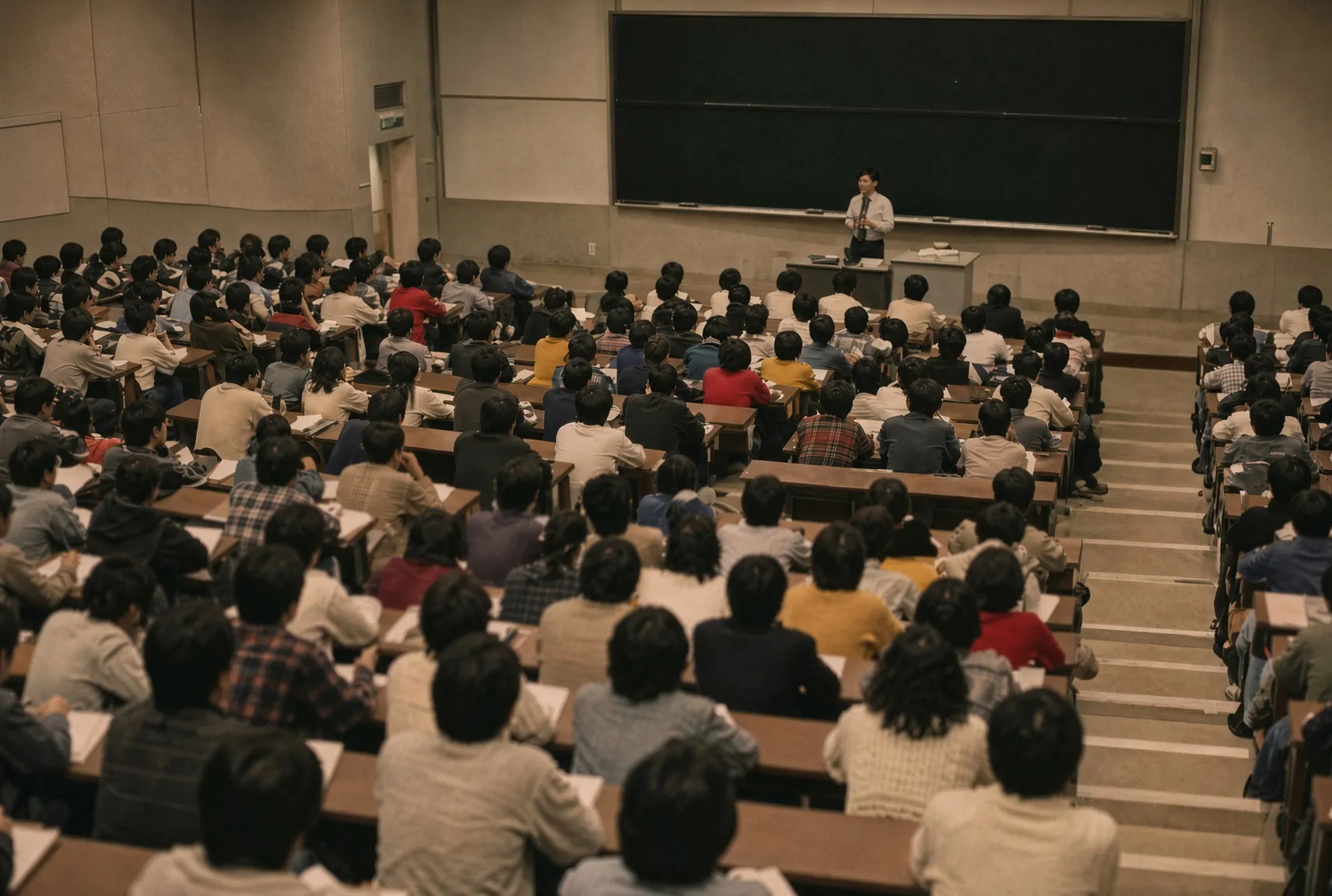

Within a single generation, South Korea transformed higher education from an elite privilege into a near-universal experience, achieving one of the highest tertiary attainment rates in the OECD. This rapid expansion was driven by a national development strategy, strong social demand, and successive policy reforms, with private institutions playing a central role in accommodating growing demand. As the system expanded, the government increasingly used evaluation and funding mechanisms to steer its development. This article traces how South Korea built a mass higher education system, how the government sought to manage it, and where it stands today.
Key Questions
#higher education #deregulation #private higher education #human capital
In 1980, fewer than one in eight South Koreans of college age was enrolled in higher education. By 2010, that figure had risen to 70%, among the highest in the OECD. In just one generation, higher education shifted from an elite privilege to a near-universal experience, helping fuel Korea’s transition to a knowledge-based economy. That achievement remains evident today: in 2024, 70.6% of Koreans aged 25–34 had attained tertiary education—the highest rate in the OECD (OECD, 2025).
However, this remarkable expansion also came with structural challenges. Growth relied heavily on private resources, while the common evaluation criteria and competitive funding used to steer the system led institutions to converge on similar models. A shrinking student population has added further pressure in recent decades. This article explores how Korea’s higher education system grew, how the government sought to manage it, and what this legacy looks like today.
Korea's higher education expansion was driven by three reinforcing conditions — national economic development strategy, sequential educational development, and strong social demand — that together made rapid expansion both possible and, in many ways, inevitable.
From the 1960s, South Korea's government used the education system as a deliberate instrument of economic planning. In the early phases of industrialization, the government strictly controlled higher education enrollment quotas to prevent graduate oversupply relative to economic absorption capacity. As the economy moved toward heavy industrialization and advanced sectors, the state progressively expanded quotas in engineering, natural sciences, business, and foreign languages (Paik, 2013). Educational supply was tightly calibrated to industrial demand: a state-directed model that integrated education directly into the national growth strategy.
Korea's expansion of higher education came after several decades of growth at the lower levels of the education system. Primary education had become nearly universal by the late 1950s, followed by wider access to middle school after the abolition of entrance examinations in 1968 and the expansion of high school enrollment under the High School Equalization Policy of 1974 (Paik, 2013; Shin, 2012). As more students moved through each level, pressure built at the next. By the late 1970s, a large cohort of high school graduates was competing for a limited number of places in higher education. The expansion of higher education was therefore closely tied to the rapid expansion that had already taken place across the rest of the education system.
Underlying these structural dynamics was intense social demand for higher education credentials, driven by both cultural and economic factors. Rooted in Confucian traditions that viewed education as the main path to social mobility, Korean parents bore heavy tuition and tutoring costs to secure higher education places for their children (Paik, 2013; Shin, 2012). Economic incentives reinforced this demand: Korea’s return to higher education was roughly double that of the United States in 1979 (Kim & Topel, 1995), and the shift toward technology-based industries in the 1980s and 1990s increased labor market demand for highly educated professionals (Paik, 2013; Shin, 2012). Together, these forces put considerable pressure on the government to expand higher education capacity (Paik, 2013; Shin, 2012).
Responding to these national development priorities and growing social demand for higher education, the Korean government progressively relaxed controls on higher education expansion and institutional entry. The July 30 Education Reform of 1980 substantially expanded enrollment, while the May 31 Education Reform of 1995 liberalized the establishment of higher education institutions (HEIs), further easing restrictions on higher education expansion. Together, these reforms dramatically expanded the scale of higher education, with private institutions accounting for a large share of the resulting growth.
The first major policy response to this growing demand came in 1980 under the military regime led by Chun Doo-hwan as part of the July 30 Education Reform. The Graduation Quota System allowed universities to admit approximately 30% more freshmen than their graduation quotas (15% for junior colleges), while requiring institutions to prevent a corresponding share of students from graduating based on academic performance. Between 1980 and 1985, South Korea's higher education enrollment rate more than doubled, rising from 11.4% to 22.9%.
The Graduation Quota System was short-lived as its unintended consequences became increasingly apparent. By the mid-1980s, the system had raised growing concerns about the quality of higher education and the feasibility of forcing institutions to remove a fixed proportion of students before graduation. In 1987, the government abolished the graduation quota system, and from 1988, it returned to the Admission Quota System. Rather than allowing institutions to determine their enrollment independently, the state continued to regulate the number of students that institutions could admit, thereby maintaining centralized control over the expansion of higher education.
The most consequential policy shift occurred with the May 31 Education Reform of 1995. Prior to 1995, establishing an HEI required passing a strict, discretionary government review. The reform proposed the Higher Education Institution Establishment Standards System, implemented in 1996, allowing institutions to be established if they met minimum requirements for faculty, facilities, campus land, and foundational assets (Jang, 2009; Paik, 2013). Coupled with the progressive liberalization of student quotas, the reform triggered a rapid surge in new HEIs.
Across all policy phases, higher education expanded primarily through private institutions. Since the postwar period, South Korea's government relied on the private sector to absorb educational demand that public budgets could not accommodate, prioritizing public funding for primary education and national R&D. By the 2000s, private institutions accounted for approximately 80% of both higher education institutions and student enrollments nationwide, the highest proportion among OECD countries (Paik, 2013; Shin, 2012).
Another key feature of this expansion was the marked growth of universities in non-Capital regions. Policies to expand higher education and strengthen regional universities, alongside the liberalization of university establishment regulations introduced by the 1995 reform, contributed to university expansion, particularly outside the Capital Region (Choi et al., 2022). Meanwhile, university growth in the Capital Region remained constrained by the Seoul Metropolitan Area Readjustment Planning Act. As a result, the number of universities in non-Capital regions rose from 43 in 1980 to 95 in 2000.
As the higher education system expanded rapidly in scale, the Korean government increasingly sought to manage and steer the expanded landscape. Over time, three policy streams took shape: building national quality assurance infrastructure, leveraging evaluation-based competitive funding, and implementing structural capacity reductions.
In response to the expansion of higher education enrollment in 1980, the newly established Korean Council for University Education (KCUE) began university evaluations in 1982. In 1994, the evaluation framework evolved into the University Comprehensive Evaluation and Accreditation System, which assessed universities against established criteria and publicized the results (Lim et al., 2017). The Korean Council for University College Education (KCCE), the junior-college counterpart of KCUE, was established as a statutory body under its governing legislation in 1995 to conduct institutional evaluations for junior colleges (Lim et al., 2017; Rhee, 2005).
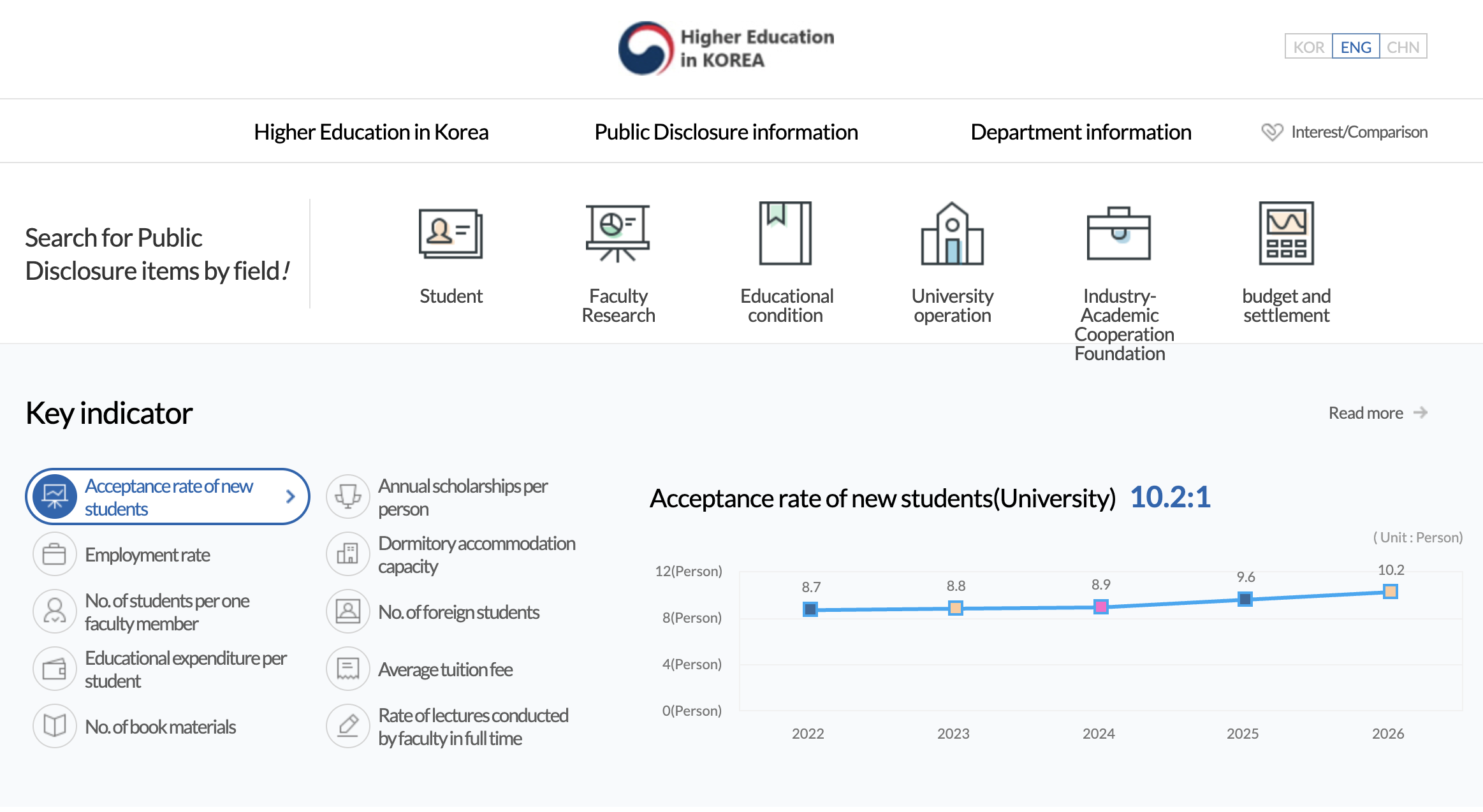
In the 2000s, the framework for higher education accountability expanded further. The Higher Education Information Disclosure System (Academyinfo; Daehak Alimi) was introduced in 2008, requiring higher education institutions to publicly disclose information on educational conditions, employment outcomes, and financial management. In 2011, the University Institutional Accreditation System was introduced, building on earlier evaluation and accreditation arrangements. It assesses universities across their institutional operations and makes accreditation results public (Lim et al., 2017). Together, these mechanisms increased the visibility of institutional performance and provided an important foundation for institutional accountability.
From the late 1990s, the government shifted toward using public financial support as a lever for quality improvement and institutional differentiation (Jang, 2009; Lim et al., 2017). Rather than distributing funds broadly, the government tied an increasing share of higher education budgets to evaluation results and competitive grant applications. The share of competitive, grant-based project subsidies in the Ministry of Education’s higher education expenditure increased from 25.3% in 1995 to 37.4% in 2007 (Jang, 2009).
Mission-specific funding projects targeted distinct dimensions of system development: educational innovation, research capacity enhancement, university–industry collaboration, and regional university competitiveness (Jang, 2009; Lim et al., 2017). Through this competitive funding model, the state retained substantial influence over institutional priorities and behavior, even as institutions gained greater formal autonomy (Jang, 2009; Shin, 2012).
Amid growing concerns over educational quality and the proliferation of overlapping academic programs, as well as mounting demographic pressures, the government initiated structural reforms. The University Structural Reform Support Program (2005–2009) provided financial support for restructuring, including institutional consolidation, particularly among national universities (Korea Development Institute [KDI], 2010). From 2015, the government shifted toward evaluation-based structural reform, using institutional evaluation results to encourage institutions to reduce enrollment capacity (KCUE, 2024; Lim et al., 2017). Because legislation that would have provided a direct legal basis for mandatory quota reductions failed to pass the National Assembly, the government relied instead on evaluation and financial incentives.
The University Structural Reform Evaluation (2015–2017) and the 2018 round of the University Basic Capacity Diagnosis assigned differentiated quota-reduction targets or recommendations by grade, with the results linked to access to government financial support, national scholarships, and student loans for lower-performing institutions (K. Kim, 2018; Koh, 2023). In the 2021 diagnosis, grade-based quota-reduction recommendations were dropped, and institutions were instead encouraged to develop their own plans for “right-sizing,” with the government subsequently using regional retention-rate monitoring to guide further recommendations.
The rapid expansion of South Korea’s higher education system produced significant quantitative achievements. However, this compressed growth also left behind deep structural trade-offs. As the system expanded, challenges in educational quality, institutional uniformity, and fiscal sustainability became increasingly entrenched.
The deregulation under the May 31 Education Reform of 1995 relaxed establishment standards of facilities and faculty, triggering a rapid proliferation of private institutions (Jang, 2009). Approximately 58.7% of the 75 HEIs established following the reform lacked the foundational infrastructure, facilities, and faculty capacity necessary to provide high-quality education (Jang, 2009). This rapid expansion weakened educational conditions across the tertiary sector, particularly among lower-ranking institutions and those in non-Capital regions (Jones, 2013; Rhee, 2005). Although the government introduced evaluation and funding mechanisms to strengthen quality and accountability, these evaluations relied heavily on quantitative indicators such as graduate employment and student recruitment, encouraging institutional compliance with government metrics rather than substantive improvements in teaching quality (Jones, 2013; Lim et al., 2017).
Government policy emphasized institutional specialization and diversity, envisioning a system in which institutions would develop distinct roles and strengths. Yet institutions operating under common evaluation criteria and competing for the same government funding projects faced strong incentives to adopt similar strategies. Rather than developing differentiated institutional identities, they increasingly converged around similar academic programs, organizational structures, and responses to government metrics (Choi et al., 2022; Rhee, 2005). This produced a paradox in which policy mechanisms intended to promote differentiation instead reinforced institutional homogenization. The result was a tertiary sector characterized by considerable institutional similarity despite persistent differences in institutional status and resources.
In 2007, only 14.2% of the Ministry of Education’s budget went to tertiary education, compared with 23.3% in Australia, 31.0% in Hong Kong, and 23.7% in the US in 2008 (Shin, 2012). Consequently, public sources accounted for just 27.5% of total tertiary spending in 2009, far below the OECD average of 73.2% (OECD, 2012). Against this funding structure, private universities remained heavily dependent on tuition, which accounted for 60.6% of their operating revenue as of 2016 (Korea Foundation for the Promotion of Private Schools [KFPP], 2017). This heavy reliance on private resources in Korean higher education made it particularly vulnerable to demographic decline (KCUE, 2024).
The rapid expansion initiated in the 1980s established South Korea as a global leader in tertiary education access and attainment (OECD, 2025). However, concerns about educational quality persisted throughout this quantitative growth, and high attainment has not been matched by strong labor market outcomes. In 2024, Korea’s employment rate among tertiary-educated adults aged 25–34 stood at 80%, below the OECD average of 87% (OECD, 2025). At the same time, as the school-age population has shrunk, unfilled admission places have become a pressing problem, leading to mounting financial pressure, particularly among private institutions outside the Capital Region (KCUE, 2024). Yet efforts to restructure the system have been constrained by legal and political obstacles, as well as resistance from higher education institutions and local communities.
Amid these compounding challenges, policy attention has increasingly turned toward strengthening the connections between higher education institutions, industries, and regional economies. Since the 2000s, successive governments have sought to position regional universities as hubs of regional innovation, and recent reforms have delegated greater authority and responsibility for funding higher education institutions from the central government to local governments. These efforts reflect a broader shift in the central question facing Korean higher education: from how to expand the system to how to restructure it in response to demographic decline, weak labor market outcomes, and regional disparities.