

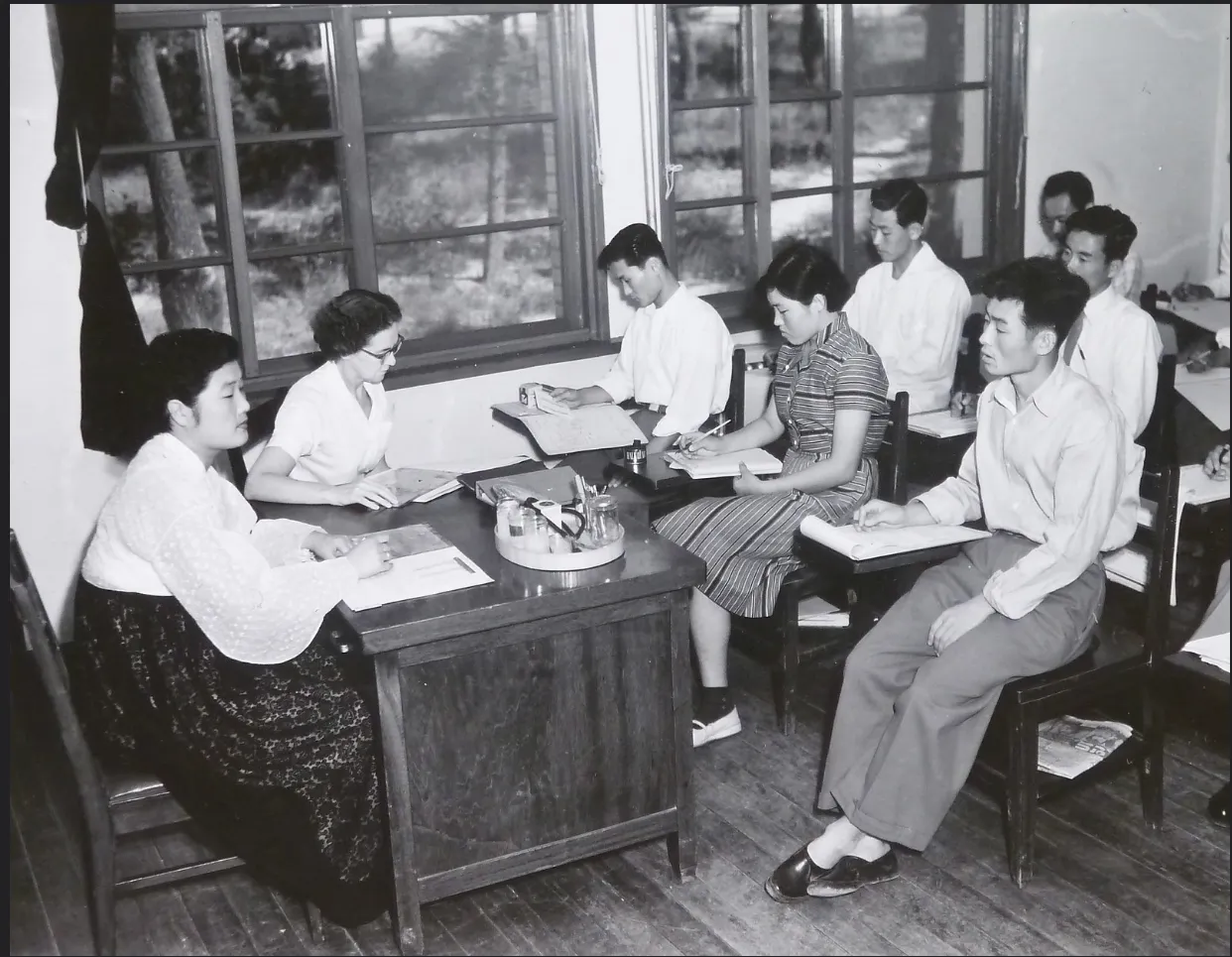
Following Korea’s liberation in 1945, U.S. assistance played a transformative role in rebuilding and democratizing the nation’s education system. Under the U.S. Military Government, education was viewed as a tool for both democratic reform and skill development. Massive investments through AFAK, UNKRA, and ICA during the 1950s rebuilt classrooms, trained teachers, and revived higher education. Equally significant were nationwide adult literacy campaigns—through civic schools and military programs—that rapidly reduced illiteracy from 78% to below 10% within decades. This integration of ideological reform, technical aid, and civic participation laid the human capital foundation for South Korea’s postwar economic and social modernization.
#U.S. aid #education aid #postwar reconstruction #literacy campaign
In 1945, as the 35-year Japanese colonization of Korea came to an end, the nation faced a monumental challenge in education. Before this period, formal schooling at any level was a privilege reserved for a small ruling elite. The Japanese system had been restrictive, and the result was a staggering level of illiteracy. An estimated 78% of the Korean population could not read or write Hangeul or any other language in 1945, leaving the vast majority of citizens without the foundational skills needed to build a new nation.
The U.S. Military Government, which administered the southern half of the peninsula from 1945 to 1948, viewed education as a critical tool for geopolitical and economic stability. As McGinn et al. (1980, p86) note, the U.S. was “determined to use education in Korea as a major vehicle for the democratization of society.” This mission was clearly defined. Mason et al. (1980) write, “Schools under the US Military Government (1945-48) also had clearly defined political and economic purposes: to convert Korean youth and adults to the American conception of democracy and to provide basic skill training.” This dual focus on ideological transformation and practical skills training, presented as a single, unified strategy, formed the bedrock of America's initial educational policy in post-liberation Korea.
This new vision was immediately put into practice through sweeping curricular and systemic changes. A primary act was the formal reintroduction of the Korean language, Hangeul, into the curriculum, and the simultaneous discarding of all elements of Japanese tradition in education. To support this linguistic and cultural reclamation, the U.S. backed a massive textbook printing initiative, distributing 15 million new books by 1948. The pedagogical approach also shifted dramatically, incorporating scientific methods that emphasized "problem solving" and "learning-by-doing" (Mason et al. 1980, p344), a stark departure from older rote-based systems.
These foundational ideological and structural reforms set the stage for a new educational system, but the country would soon be devastated by war, requiring a reconstruction effort of an entirely different magnitude.
The devastation of the Korean War left the nation's nascent educational infrastructure in ruins, making foreign aid not just helpful, but absolutely essential for its reconstruction. The United States, in particular, provided a significant infusion of capital and expertise to rebuild the system from the ground up. An estimated US $100 million was directed specifically toward education and training during the post-war reconstruction period, a massive investment designed to get schools running and people learning again.
This financial assistance was administered through a series of key bodies, beginning with the Armed Forces Aid to Korea (AFAK) and the United Nations Korean Reconstruction Agency (UNKRA) in the immediate post-war years, before responsibility was transferred to the International Cooperation Administration (ICA).[1] The aid was highly targeted, with UNKRA alone providing nearly US $11 million, most of which was used to repair schools destroyed during the conflict.[2] The goals of this post-1953 assistance were clear and strategic, centering on four primary pillars: classroom construction, the development of secondary and vocational education, comprehensive teacher training, and the rebuilding of higher education. There was also a good deal of technical assistance carried in the military.
Educational aid was a key component of a much larger U.S. assistance program aimed at stabilizing the Korean economy and society as a whole, as demonstrated by the diverse range of commodities funded by the ICA.
The sheer scale of the rebuilding challenge is evident in the pre-war data from 1950, which reveals a nation with over 6 million school-aged children but fewer than 43,000 total classrooms.
By the 1960s, major progress had been made in providing access to primary and middle school education in Korea. Between 1952 and 1967, nearly 20,000 classrooms were built and 3,000 more repaired, material and technical assistance helped to improve vocational education, SNU Colleges of Agriculture, Engineering, and Medicine, were rebuilt and equipped, and assistance was provided to improve textbooks, science education, early childhood education, and the libraries. Indeed, the Ministry of Education claimed achieving a literacy rate of nearly 90% in 1968 for people over the age of 6 years.[4] Based on the rapid growth in the number of institutions, teachers and students, the results of the heavy investments in education supported by foreign aid were undeniable from 1945 to 1965, as seen below.
Beyond constructing classrooms for children, a central pillar of the U.S.-backed strategy was a multifaceted national campaign to eradicate adult illiteracy. This effort recognized that a modern democratic state required an educated citizenry, and it could not wait for a new generation to come of age. The approach was two-pronged, leveraging both civilian and military structures to deliver basic education to the masses.
Civic Schools for the People
The primary vehicle for civilian adult education was the civic school system. These schools were established to teach basic reading, writing, and math to adults who had missed out on compulsory education, but they also served a clear ideological purpose, providing instruction on the values and beliefs of Western democratic institutions, dubbed “the American Way of Life.” The scale of this initiative was remarkable. By 1948, nearly 15,400 civic schools were established and more than 1 million adults were enrolled.
The Korean government formalized and expanded this U.S. policy initiative by passing the Education Act in December 1949. This law gave civic schools a statutory basis and made attendance compulsory for adults born after 1910 who had not completed a primary education. The Act was designed for maximum accessibility, requiring a minimum of 200 hours of classes over 70 days, with courses intentionally held during the farming off-seasons so that rural populations could attend. The curriculum was practical, covering not just basic literacy but also math, science, and social studies.
A key element of this campaign was the Ministry of Education's emphasis on “education for Koreans by Koreans.” Starting in the summer of 1946, the Adult Education Bureau took charge of training Korean leaders who would then travel to cities and provinces to train local instructors, creating a cascading system of peer-to-peer education that reached into neighborhoods and villages, as detailed.
Education in the Military
The second major front in the war on illiteracy was the South Korean military. Since military service was a requirement for all able-bodied Korean males, it provided a unique and powerful institution for delivering basic education on a national scale. As part of significant U.S. military assistance, a robust educational component was built directly into basic training.
The military curriculum was intensive and focused on essential skills. Trainees were required to complete 44 hours of education per week for six weeks. This program included 220 hours dedicated to reading and writing and an additional 44 hours of mathematics. The impact of this program was enormous, reaching hundreds of thousands of young men over nearly two decades. Approximately 600,000 servicemen received basic education between 1952 and 1970.[3]
With the combined efforts of civic schools and military education programs, the illiteracy rate declined rapidly. From an estimated 78% in 1945, the adult illiteracy rate fell dramatically to just 42% by 1948. The sharp decline continued, especially between 1948 and 1959, with the illiteracy rate eventually dropping below 10% in the 1990s.[5]
In conclusion, the educational revolution in South Korea between 1945 and 1965 was the direct result of a powerful partnership. It combined significant U.S. financial and technical aid with a clear strategic vision focused on democratization and skill-building. By simultaneously building a formal school system for children and launching a comprehensive national campaign to educate adults, South Korea transformed one of the world's least literate societies into one of its most educated. This foundational investment in human capital became a fundamental pillar of the nation's subsequent economic development and democratic consolidation.
[1] The Agency for International Development became the US aid administrator after the Foreign Assistance Act was passed in 1961.
[2] UNKRA also provided aid in education totaling nearly US$ 11 million, most of which was used to repair schools destroyed during the Korean War.
[3] After the Military Coup in 1961, the educational training for the adults in basic education continued under the National Reconstruction Movement
[4] The standard of literacy was measured by the ability to identify and write the 24 letters of the Hangul alphabet.
[5] The Korean national illiteracy rate was 77.7% in 1930, where the illiteracy rate for women was 92.0% and 63.9% for men.

Following Korea’s liberation in 1945, U.S. assistance played a transformative role in rebuilding and democratizing the nation’s education system. Under the U.S. Military Government, education was viewed as a tool for both democratic reform and skill development. Massive investments through AFAK, UNKRA, and ICA during the 1950s rebuilt classrooms, trained teachers, and revived higher education. Equally significant were nationwide adult literacy campaigns—through civic schools and military programs—that rapidly reduced illiteracy from 78% to below 10% within decades. This integration of ideological reform, technical aid, and civic participation laid the human capital foundation for South Korea’s postwar economic and social modernization.
#U.S. aid #education aid #postwar reconstruction #literacy campaign
In 1945, as the 35-year Japanese colonization of Korea came to an end, the nation faced a monumental challenge in education. Before this period, formal schooling at any level was a privilege reserved for a small ruling elite. The Japanese system had been restrictive, and the result was a staggering level of illiteracy. An estimated 78% of the Korean population could not read or write Hangeul or any other language in 1945, leaving the vast majority of citizens without the foundational skills needed to build a new nation.
The U.S. Military Government, which administered the southern half of the peninsula from 1945 to 1948, viewed education as a critical tool for geopolitical and economic stability. As McGinn et al. (1980, p86) note, the U.S. was “determined to use education in Korea as a major vehicle for the democratization of society.” This mission was clearly defined. Mason et al. (1980) write, “Schools under the US Military Government (1945-48) also had clearly defined political and economic purposes: to convert Korean youth and adults to the American conception of democracy and to provide basic skill training.” This dual focus on ideological transformation and practical skills training, presented as a single, unified strategy, formed the bedrock of America's initial educational policy in post-liberation Korea.
This new vision was immediately put into practice through sweeping curricular and systemic changes. A primary act was the formal reintroduction of the Korean language, Hangeul, into the curriculum, and the simultaneous discarding of all elements of Japanese tradition in education. To support this linguistic and cultural reclamation, the U.S. backed a massive textbook printing initiative, distributing 15 million new books by 1948. The pedagogical approach also shifted dramatically, incorporating scientific methods that emphasized "problem solving" and "learning-by-doing" (Mason et al. 1980, p344), a stark departure from older rote-based systems.
These foundational ideological and structural reforms set the stage for a new educational system, but the country would soon be devastated by war, requiring a reconstruction effort of an entirely different magnitude.
The devastation of the Korean War left the nation's nascent educational infrastructure in ruins, making foreign aid not just helpful, but absolutely essential for its reconstruction. The United States, in particular, provided a significant infusion of capital and expertise to rebuild the system from the ground up. An estimated US $100 million was directed specifically toward education and training during the post-war reconstruction period, a massive investment designed to get schools running and people learning again.
This financial assistance was administered through a series of key bodies, beginning with the Armed Forces Aid to Korea (AFAK) and the United Nations Korean Reconstruction Agency (UNKRA) in the immediate post-war years, before responsibility was transferred to the International Cooperation Administration (ICA).[1] The aid was highly targeted, with UNKRA alone providing nearly US $11 million, most of which was used to repair schools destroyed during the conflict.[2] The goals of this post-1953 assistance were clear and strategic, centering on four primary pillars: classroom construction, the development of secondary and vocational education, comprehensive teacher training, and the rebuilding of higher education. There was also a good deal of technical assistance carried in the military.
Educational aid was a key component of a much larger U.S. assistance program aimed at stabilizing the Korean economy and society as a whole, as demonstrated by the diverse range of commodities funded by the ICA.
The sheer scale of the rebuilding challenge is evident in the pre-war data from 1950, which reveals a nation with over 6 million school-aged children but fewer than 43,000 total classrooms.
By the 1960s, major progress had been made in providing access to primary and middle school education in Korea. Between 1952 and 1967, nearly 20,000 classrooms were built and 3,000 more repaired, material and technical assistance helped to improve vocational education, SNU Colleges of Agriculture, Engineering, and Medicine, were rebuilt and equipped, and assistance was provided to improve textbooks, science education, early childhood education, and the libraries. Indeed, the Ministry of Education claimed achieving a literacy rate of nearly 90% in 1968 for people over the age of 6 years.[4] Based on the rapid growth in the number of institutions, teachers and students, the results of the heavy investments in education supported by foreign aid were undeniable from 1945 to 1965, as seen below.
Beyond constructing classrooms for children, a central pillar of the U.S.-backed strategy was a multifaceted national campaign to eradicate adult illiteracy. This effort recognized that a modern democratic state required an educated citizenry, and it could not wait for a new generation to come of age. The approach was two-pronged, leveraging both civilian and military structures to deliver basic education to the masses.
Civic Schools for the People
The primary vehicle for civilian adult education was the civic school system. These schools were established to teach basic reading, writing, and math to adults who had missed out on compulsory education, but they also served a clear ideological purpose, providing instruction on the values and beliefs of Western democratic institutions, dubbed “the American Way of Life.” The scale of this initiative was remarkable. By 1948, nearly 15,400 civic schools were established and more than 1 million adults were enrolled.
The Korean government formalized and expanded this U.S. policy initiative by passing the Education Act in December 1949. This law gave civic schools a statutory basis and made attendance compulsory for adults born after 1910 who had not completed a primary education. The Act was designed for maximum accessibility, requiring a minimum of 200 hours of classes over 70 days, with courses intentionally held during the farming off-seasons so that rural populations could attend. The curriculum was practical, covering not just basic literacy but also math, science, and social studies.
A key element of this campaign was the Ministry of Education's emphasis on “education for Koreans by Koreans.” Starting in the summer of 1946, the Adult Education Bureau took charge of training Korean leaders who would then travel to cities and provinces to train local instructors, creating a cascading system of peer-to-peer education that reached into neighborhoods and villages, as detailed.
Education in the Military
The second major front in the war on illiteracy was the South Korean military. Since military service was a requirement for all able-bodied Korean males, it provided a unique and powerful institution for delivering basic education on a national scale. As part of significant U.S. military assistance, a robust educational component was built directly into basic training.
The military curriculum was intensive and focused on essential skills. Trainees were required to complete 44 hours of education per week for six weeks. This program included 220 hours dedicated to reading and writing and an additional 44 hours of mathematics. The impact of this program was enormous, reaching hundreds of thousands of young men over nearly two decades. Approximately 600,000 servicemen received basic education between 1952 and 1970.[3]
With the combined efforts of civic schools and military education programs, the illiteracy rate declined rapidly. From an estimated 78% in 1945, the adult illiteracy rate fell dramatically to just 42% by 1948. The sharp decline continued, especially between 1948 and 1959, with the illiteracy rate eventually dropping below 10% in the 1990s.[5]
In conclusion, the educational revolution in South Korea between 1945 and 1965 was the direct result of a powerful partnership. It combined significant U.S. financial and technical aid with a clear strategic vision focused on democratization and skill-building. By simultaneously building a formal school system for children and launching a comprehensive national campaign to educate adults, South Korea transformed one of the world's least literate societies into one of its most educated. This foundational investment in human capital became a fundamental pillar of the nation's subsequent economic development and democratic consolidation.
[1] The Agency for International Development became the US aid administrator after the Foreign Assistance Act was passed in 1961.
[2] UNKRA also provided aid in education totaling nearly US$ 11 million, most of which was used to repair schools destroyed during the Korean War.
[3] After the Military Coup in 1961, the educational training for the adults in basic education continued under the National Reconstruction Movement
[4] The standard of literacy was measured by the ability to identify and write the 24 letters of the Hangul alphabet.
[5] The Korean national illiteracy rate was 77.7% in 1930, where the illiteracy rate for women was 92.0% and 63.9% for men.

In 1945, as the 35-year Japanese colonization of Korea came to an end, the nation faced a monumental challenge in education. Before this period, formal schooling at any level was a privilege reserved for a small ruling elite. The Japanese system had been restrictive, and the result was a staggering level of illiteracy. An estimated 78% of the Korean population could not read or write Hangeul or any other language in 1945, leaving the vast majority of citizens without the foundational skills needed to build a new nation.
The U.S. Military Government, which administered the southern half of the peninsula from 1945 to 1948, viewed education as a critical tool for geopolitical and economic stability. As McGinn et al. (1980, p86) note, the U.S. was “determined to use education in Korea as a major vehicle for the democratization of society.” This mission was clearly defined. Mason et al. (1980) write, “Schools under the US Military Government (1945-48) also had clearly defined political and economic purposes: to convert Korean youth and adults to the American conception of democracy and to provide basic skill training.” This dual focus on ideological transformation and practical skills training, presented as a single, unified strategy, formed the bedrock of America's initial educational policy in post-liberation Korea.
This new vision was immediately put into practice through sweeping curricular and systemic changes. A primary act was the formal reintroduction of the Korean language, Hangeul, into the curriculum, and the simultaneous discarding of all elements of Japanese tradition in education. To support this linguistic and cultural reclamation, the U.S. backed a massive textbook printing initiative, distributing 15 million new books by 1948. The pedagogical approach also shifted dramatically, incorporating scientific methods that emphasized "problem solving" and "learning-by-doing" (Mason et al. 1980, p344), a stark departure from older rote-based systems.
These foundational ideological and structural reforms set the stage for a new educational system, but the country would soon be devastated by war, requiring a reconstruction effort of an entirely different magnitude.
The devastation of the Korean War left the nation's nascent educational infrastructure in ruins, making foreign aid not just helpful, but absolutely essential for its reconstruction. The United States, in particular, provided a significant infusion of capital and expertise to rebuild the system from the ground up. An estimated US $100 million was directed specifically toward education and training during the post-war reconstruction period, a massive investment designed to get schools running and people learning again.
This financial assistance was administered through a series of key bodies, beginning with the Armed Forces Aid to Korea (AFAK) and the United Nations Korean Reconstruction Agency (UNKRA) in the immediate post-war years, before responsibility was transferred to the International Cooperation Administration (ICA).[1] The aid was highly targeted, with UNKRA alone providing nearly US $11 million, most of which was used to repair schools destroyed during the conflict.[2] The goals of this post-1953 assistance were clear and strategic, centering on four primary pillars: classroom construction, the development of secondary and vocational education, comprehensive teacher training, and the rebuilding of higher education. There was also a good deal of technical assistance carried in the military.
Educational aid was a key component of a much larger U.S. assistance program aimed at stabilizing the Korean economy and society as a whole, as demonstrated by the diverse range of commodities funded by the ICA.
The sheer scale of the rebuilding challenge is evident in the pre-war data from 1950, which reveals a nation with over 6 million school-aged children but fewer than 43,000 total classrooms.
By the 1960s, major progress had been made in providing access to primary and middle school education in Korea. Between 1952 and 1967, nearly 20,000 classrooms were built and 3,000 more repaired, material and technical assistance helped to improve vocational education, SNU Colleges of Agriculture, Engineering, and Medicine, were rebuilt and equipped, and assistance was provided to improve textbooks, science education, early childhood education, and the libraries. Indeed, the Ministry of Education claimed achieving a literacy rate of nearly 90% in 1968 for people over the age of 6 years.[4] Based on the rapid growth in the number of institutions, teachers and students, the results of the heavy investments in education supported by foreign aid were undeniable from 1945 to 1965, as seen below.
Beyond constructing classrooms for children, a central pillar of the U.S.-backed strategy was a multifaceted national campaign to eradicate adult illiteracy. This effort recognized that a modern democratic state required an educated citizenry, and it could not wait for a new generation to come of age. The approach was two-pronged, leveraging both civilian and military structures to deliver basic education to the masses.
Civic Schools for the People
The primary vehicle for civilian adult education was the civic school system. These schools were established to teach basic reading, writing, and math to adults who had missed out on compulsory education, but they also served a clear ideological purpose, providing instruction on the values and beliefs of Western democratic institutions, dubbed “the American Way of Life.” The scale of this initiative was remarkable. By 1948, nearly 15,400 civic schools were established and more than 1 million adults were enrolled.
The Korean government formalized and expanded this U.S. policy initiative by passing the Education Act in December 1949. This law gave civic schools a statutory basis and made attendance compulsory for adults born after 1910 who had not completed a primary education. The Act was designed for maximum accessibility, requiring a minimum of 200 hours of classes over 70 days, with courses intentionally held during the farming off-seasons so that rural populations could attend. The curriculum was practical, covering not just basic literacy but also math, science, and social studies.
A key element of this campaign was the Ministry of Education's emphasis on “education for Koreans by Koreans.” Starting in the summer of 1946, the Adult Education Bureau took charge of training Korean leaders who would then travel to cities and provinces to train local instructors, creating a cascading system of peer-to-peer education that reached into neighborhoods and villages, as detailed.
Education in the Military
The second major front in the war on illiteracy was the South Korean military. Since military service was a requirement for all able-bodied Korean males, it provided a unique and powerful institution for delivering basic education on a national scale. As part of significant U.S. military assistance, a robust educational component was built directly into basic training.
The military curriculum was intensive and focused on essential skills. Trainees were required to complete 44 hours of education per week for six weeks. This program included 220 hours dedicated to reading and writing and an additional 44 hours of mathematics. The impact of this program was enormous, reaching hundreds of thousands of young men over nearly two decades. Approximately 600,000 servicemen received basic education between 1952 and 1970.[3]
With the combined efforts of civic schools and military education programs, the illiteracy rate declined rapidly. From an estimated 78% in 1945, the adult illiteracy rate fell dramatically to just 42% by 1948. The sharp decline continued, especially between 1948 and 1959, with the illiteracy rate eventually dropping below 10% in the 1990s.[5]
In conclusion, the educational revolution in South Korea between 1945 and 1965 was the direct result of a powerful partnership. It combined significant U.S. financial and technical aid with a clear strategic vision focused on democratization and skill-building. By simultaneously building a formal school system for children and launching a comprehensive national campaign to educate adults, South Korea transformed one of the world's least literate societies into one of its most educated. This foundational investment in human capital became a fundamental pillar of the nation's subsequent economic development and democratic consolidation.
[1] The Agency for International Development became the US aid administrator after the Foreign Assistance Act was passed in 1961.
[2] UNKRA also provided aid in education totaling nearly US$ 11 million, most of which was used to repair schools destroyed during the Korean War.
[3] After the Military Coup in 1961, the educational training for the adults in basic education continued under the National Reconstruction Movement
[4] The standard of literacy was measured by the ability to identify and write the 24 letters of the Hangul alphabet.
[5] The Korean national illiteracy rate was 77.7% in 1930, where the illiteracy rate for women was 92.0% and 63.9% for men.