

Back to List
K-Dev Original

International Medical and Social Assistance to Post-War Korea

Summary

International medical and social aid played a critical role in Korea's post-war recovery, evolving from emergency relief during the Korean War to long-term reconstruction support. Multilateral organizations, bilateral donors, and NGOs collectively provided USD 575 million between 1947 and 1975, with NGOs supplying 76% of all assistance. Flagship projects such as the National Medical Center showcased both ambition and the pitfalls of limited local ownership. Broader public health programs—including family planning, nutrition support, and water supply improvements—helped rebuild national capacity. Together, these interventions shaped Korea's modern healthcare foundation while offering enduring lessons on sustainability and institution-building.

Key Questions

  • How did international medical aid shape Korea's healthcare system during its post-war reconstruction period?
  • Why did NGO-led assistance become the dominant source of medical and social support, and what implications does this have for today's development strategies?
  • What lessons does Korea's experience offer on ensuring local ownership and long-term sustainability in donor-funded projects?

#medical aid #social assistance #public health programs #post-war reconstruction

Following the devastation of the Korean War, the Republic of Korea faced a critical need for medical and social services, as the conflict left infrastructure in ruins and the population in urgent need of care. In response, Korea began to receive medical and social services grants-in-aid in the form of emergency relief and basic necessities during and immediately after the war.

Over time, the nature of this assistance evolved. While wartime aid centered on emergency relief—including troop contributions from 16 countries under the United Nations Forces and medical support from UN Security Council members [1]—the mid-to-late 1950s marked a shift toward structured, long-term reconstruction support. International assistance expanded to include family planning initiatives, maternal health programs, and other foundational public health systems, with support continuing into the 1970s.

These efforts were delivered through a diverse coalition of multilateral organizations, bilateral donors, and non-governmental organizations, each playing a distinct role in rebuilding Korea’s health and social service systems.

The Landscape of Aid: Analyzing the Key Contributors and Financial Scale

To fully appreciate the scope of the post-war reconstruction, it is essential to understand the sources and scale of the foreign aid Korea received. A detailed breakdown of the financial contributions and the organizations involved reveals the primary drivers of support for the nation's recovery in the medical and social sectors.

Assistance came from a wide array of sources, which can be grouped into three main categories. First were multilateral organizations such as the UN Korean Reconstruction Agency (UNKRA), the World Health Organization (WHO), the UN International Children's Emergency Fund (UNICEF), and the UN Fund for Population Activities (UNFPA). Second were bilateral sources, with the United States and Japan providing significant country-to-country assistance. Finally, a multitude of non-governmental organizations (NGOs) from across the globe were active in Korea, providing critical on-the-ground services.

Between 1947 and 1975, Korea received a total of USD 575.1 million in medical and social services assistance. While contributions from multilateral and bilateral partners were substantial, the dominant role was played by nongovernmental organizations. According to records compiled by the Korea Association of Voluntary Agencies (KAVA), foreign NGOs provided USD 440.5 million—representing 76 percent of all assistance—and their cumulative support eventually reached USD 1.2 billion by the early 1990s.

To illustrate how these various forms of assistance were implemented in practice, the following section examines a representative program in greater detail.

Case Study: The National Medical Center (NMC)

The National Medical Center (NMC) represents a major example of a large-scale, capital-intensive development project from this era. Its trajectory provides critical lessons on program design and institutional resilience, offering insights into both the remarkable successes and the sustainability challenges inherent in international cooperation.

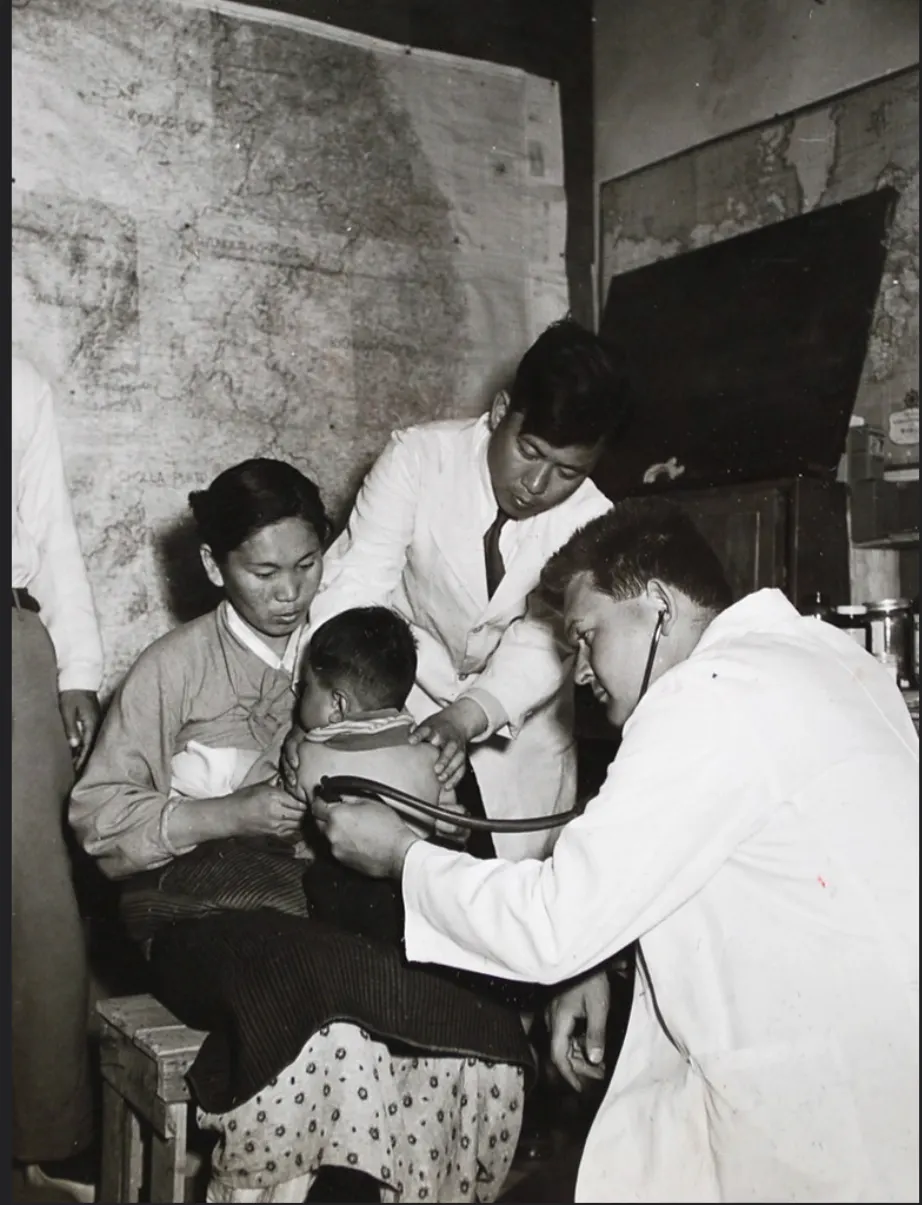
The NMC was established as a collaborative project under UNKRA between the Korean Government and three Scandinavian countries: Norway, Sweden, and Denmark. Founded with the dual mission of providing modern medical treatment and training Korean medical personnel, the center was an extension of the war relief efforts of Scandinavian medical staff who had served under the UN flag.

National Medical Center in Seoul (Source: UN Photo)

During the 1960s, the NMC flourished, growing into one of Korea's premier medical institutions. As a public health program, it made high-quality care accessible to a large number of patients who could not have afforded the costs of private hospitals. However, the NMC continued to be largely staffed and operated by expats from the donor countries, totaling 367 foreigners (139 Norway, 134 Sweden, and 94 Denmark) for 10 years. Once their contract period ended and they returned home, the medical center experienced a gradual decline in the quality of care and facilities. Its slow demise led to the takeover of its management by the Korean government, which sought to reform it. However, the situation did not improve under the management of the government, as the NMC continued to experience deterioration in quality of care and facilities due to lack of investments and reduced pay scale for physicians. The uncompetitive pay scale has led to a decline in morale among the physicians, many of whom have sought work elsewhere, and difficulties in retaining and recruiting well-qualified physicians.

Other Major Public Health and Social Assistance Programs

In addition to the National Medical Center, Korea also received support through several other public health and social assistance programs. These included the Family Planning Support Project, established with the assistance of the UN Fund for Population Activities (UNFPA) and the International Planned Parenthood Federation (IPPF), as well as the Health and Sanitation Project and the Work for Food Program provided by the World Food Program (WFP).

The family planning project, which emerged in the 1970s, involved the participation of both multilateral and international organizations as well as bilateral cooperation agencies. The agreement with the UNFPA[2] systematized the project, and occasioned participation by the Swedish International Development Cooperation Agency (SIDA), the American Population Association, and other such organizations. The UNFPA agreement earmarked USD 6.4 million for family planning, with USD 1.4 million put toward that purpose in 1974 alone.

The family planning project was a major success, but its long-term impact deserves a more in-depth and nuanced analysis, considering the situation in which Korea now finds itself, i.e. with a drastically declined birth rate and a surging older population.

The family planning project proceeded alongside the Work for Food Program and the Temporary Water Supply Improvement Project, on the basis of the aid agreement signed between Korea, the Food and Agriculture Organization, and the WFP in 1968.[3] Accordingly, the WFP provided food worth USD 99 million in total, between 1969 and 1982.[4]

Overall, Korea’s post-war medical and social services assistance encompassed diverse forms, including institution-based support such as the National Medical Center and program-based initiatives in family planning and food aid. These interventions contributed to improvements in service provision during the reconstruction period, while also revealing challenges related to sustainability and longer-term effects.

Notes

[1] Upon the outbreak of the Korean War, the UN Security Council convened two meetings, one on June 25, 1950, and the other two days later, on June 27. The Council declared the war a result of North Korea's invasion of the South, and resolved to support the South. It adopted the Resolution of July 7, 1950, which exhorted UN member states to gather their military and non-military contributions to South Korea's war effort under the US-led General Command. Under the Resolution, 16 countries—the United States, the United Kingdom, Australia, New Zealand, France, Canada, the Republic of South Africa, Turkey, Thailand, Greece, the Netherlands, Colombia, Ethiopia, the Philippines, Belgium, and Luxembourg—deployed their troops, and Switzerland and numerous other countries provided emergency medical relief.

[2] Agreement on a Population Program between the Government of the Republic of Korea and the United Nations Fund for Population Activities, signed in March 1974.

[3] Basic Agreement between the Government of the Republic of Korea and the United Nations/ FAO World Food Program Concerning Assistance from the World Food Program, signed on May 3, 1968.

[4] International Development Statistics, OECD/DAC

Author
Curated by K-Dev Team
cite this work

International Medical and Social Assistance to Post-War Korea

K-Dev Original
February 3, 2026
This is some text inside of a div block.

Summary

International medical and social aid played a critical role in Korea's post-war recovery, evolving from emergency relief during the Korean War to long-term reconstruction support. Multilateral organizations, bilateral donors, and NGOs collectively provided USD 575 million between 1947 and 1975, with NGOs supplying 76% of all assistance. Flagship projects such as the National Medical Center showcased both ambition and the pitfalls of limited local ownership. Broader public health programs—including family planning, nutrition support, and water supply improvements—helped rebuild national capacity. Together, these interventions shaped Korea's modern healthcare foundation while offering enduring lessons on sustainability and institution-building.

Key Questions

  • How did international medical aid shape Korea's healthcare system during its post-war reconstruction period?
  • Why did NGO-led assistance become the dominant source of medical and social support, and what implications does this have for today's development strategies?
  • What lessons does Korea's experience offer on ensuring local ownership and long-term sustainability in donor-funded projects?

#medical aid #social assistance #public health programs #post-war reconstruction

Following the devastation of the Korean War, the Republic of Korea faced a critical need for medical and social services, as the conflict left infrastructure in ruins and the population in urgent need of care. In response, Korea began to receive medical and social services grants-in-aid in the form of emergency relief and basic necessities during and immediately after the war.

Over time, the nature of this assistance evolved. While wartime aid centered on emergency relief—including troop contributions from 16 countries under the United Nations Forces and medical support from UN Security Council members [1]—the mid-to-late 1950s marked a shift toward structured, long-term reconstruction support. International assistance expanded to include family planning initiatives, maternal health programs, and other foundational public health systems, with support continuing into the 1970s.

These efforts were delivered through a diverse coalition of multilateral organizations, bilateral donors, and non-governmental organizations, each playing a distinct role in rebuilding Korea’s health and social service systems.

The Landscape of Aid: Analyzing the Key Contributors and Financial Scale

To fully appreciate the scope of the post-war reconstruction, it is essential to understand the sources and scale of the foreign aid Korea received. A detailed breakdown of the financial contributions and the organizations involved reveals the primary drivers of support for the nation's recovery in the medical and social sectors.

Assistance came from a wide array of sources, which can be grouped into three main categories. First were multilateral organizations such as the UN Korean Reconstruction Agency (UNKRA), the World Health Organization (WHO), the UN International Children's Emergency Fund (UNICEF), and the UN Fund for Population Activities (UNFPA). Second were bilateral sources, with the United States and Japan providing significant country-to-country assistance. Finally, a multitude of non-governmental organizations (NGOs) from across the globe were active in Korea, providing critical on-the-ground services.

Between 1947 and 1975, Korea received a total of USD 575.1 million in medical and social services assistance. While contributions from multilateral and bilateral partners were substantial, the dominant role was played by nongovernmental organizations. According to records compiled by the Korea Association of Voluntary Agencies (KAVA), foreign NGOs provided USD 440.5 million—representing 76 percent of all assistance—and their cumulative support eventually reached USD 1.2 billion by the early 1990s.

To illustrate how these various forms of assistance were implemented in practice, the following section examines a representative program in greater detail.

Case Study: The National Medical Center (NMC)

The National Medical Center (NMC) represents a major example of a large-scale, capital-intensive development project from this era. Its trajectory provides critical lessons on program design and institutional resilience, offering insights into both the remarkable successes and the sustainability challenges inherent in international cooperation.

The NMC was established as a collaborative project under UNKRA between the Korean Government and three Scandinavian countries: Norway, Sweden, and Denmark. Founded with the dual mission of providing modern medical treatment and training Korean medical personnel, the center was an extension of the war relief efforts of Scandinavian medical staff who had served under the UN flag.

National Medical Center in Seoul (Source: UN Photo)

During the 1960s, the NMC flourished, growing into one of Korea's premier medical institutions. As a public health program, it made high-quality care accessible to a large number of patients who could not have afforded the costs of private hospitals. However, the NMC continued to be largely staffed and operated by expats from the donor countries, totaling 367 foreigners (139 Norway, 134 Sweden, and 94 Denmark) for 10 years. Once their contract period ended and they returned home, the medical center experienced a gradual decline in the quality of care and facilities. Its slow demise led to the takeover of its management by the Korean government, which sought to reform it. However, the situation did not improve under the management of the government, as the NMC continued to experience deterioration in quality of care and facilities due to lack of investments and reduced pay scale for physicians. The uncompetitive pay scale has led to a decline in morale among the physicians, many of whom have sought work elsewhere, and difficulties in retaining and recruiting well-qualified physicians.

Other Major Public Health and Social Assistance Programs

In addition to the National Medical Center, Korea also received support through several other public health and social assistance programs. These included the Family Planning Support Project, established with the assistance of the UN Fund for Population Activities (UNFPA) and the International Planned Parenthood Federation (IPPF), as well as the Health and Sanitation Project and the Work for Food Program provided by the World Food Program (WFP).

The family planning project, which emerged in the 1970s, involved the participation of both multilateral and international organizations as well as bilateral cooperation agencies. The agreement with the UNFPA[2] systematized the project, and occasioned participation by the Swedish International Development Cooperation Agency (SIDA), the American Population Association, and other such organizations. The UNFPA agreement earmarked USD 6.4 million for family planning, with USD 1.4 million put toward that purpose in 1974 alone.

The family planning project was a major success, but its long-term impact deserves a more in-depth and nuanced analysis, considering the situation in which Korea now finds itself, i.e. with a drastically declined birth rate and a surging older population.

The family planning project proceeded alongside the Work for Food Program and the Temporary Water Supply Improvement Project, on the basis of the aid agreement signed between Korea, the Food and Agriculture Organization, and the WFP in 1968.[3] Accordingly, the WFP provided food worth USD 99 million in total, between 1969 and 1982.[4]

Overall, Korea’s post-war medical and social services assistance encompassed diverse forms, including institution-based support such as the National Medical Center and program-based initiatives in family planning and food aid. These interventions contributed to improvements in service provision during the reconstruction period, while also revealing challenges related to sustainability and longer-term effects.

Notes

[1] Upon the outbreak of the Korean War, the UN Security Council convened two meetings, one on June 25, 1950, and the other two days later, on June 27. The Council declared the war a result of North Korea's invasion of the South, and resolved to support the South. It adopted the Resolution of July 7, 1950, which exhorted UN member states to gather their military and non-military contributions to South Korea's war effort under the US-led General Command. Under the Resolution, 16 countries—the United States, the United Kingdom, Australia, New Zealand, France, Canada, the Republic of South Africa, Turkey, Thailand, Greece, the Netherlands, Colombia, Ethiopia, the Philippines, Belgium, and Luxembourg—deployed their troops, and Switzerland and numerous other countries provided emergency medical relief.

[2] Agreement on a Population Program between the Government of the Republic of Korea and the United Nations Fund for Population Activities, signed in March 1974.

[3] Basic Agreement between the Government of the Republic of Korea and the United Nations/ FAO World Food Program Concerning Assistance from the World Food Program, signed on May 3, 1968.

[4] International Development Statistics, OECD/DAC

References
Cite this work
.

More to explore from
In Perspective

No items found.

International Medical and Social Assistance to Post-War Korea

K-Dev Original
February 3, 2026

I am the text that will be copied.

Following the devastation of the Korean War, the Republic of Korea faced a critical need for medical and social services, as the conflict left infrastructure in ruins and the population in urgent need of care. In response, Korea began to receive medical and social services grants-in-aid in the form of emergency relief and basic necessities during and immediately after the war.

Over time, the nature of this assistance evolved. While wartime aid centered on emergency relief—including troop contributions from 16 countries under the United Nations Forces and medical support from UN Security Council members [1]—the mid-to-late 1950s marked a shift toward structured, long-term reconstruction support. International assistance expanded to include family planning initiatives, maternal health programs, and other foundational public health systems, with support continuing into the 1970s.

These efforts were delivered through a diverse coalition of multilateral organizations, bilateral donors, and non-governmental organizations, each playing a distinct role in rebuilding Korea’s health and social service systems.

The Landscape of Aid: Analyzing the Key Contributors and Financial Scale

To fully appreciate the scope of the post-war reconstruction, it is essential to understand the sources and scale of the foreign aid Korea received. A detailed breakdown of the financial contributions and the organizations involved reveals the primary drivers of support for the nation's recovery in the medical and social sectors.

Assistance came from a wide array of sources, which can be grouped into three main categories. First were multilateral organizations such as the UN Korean Reconstruction Agency (UNKRA), the World Health Organization (WHO), the UN International Children's Emergency Fund (UNICEF), and the UN Fund for Population Activities (UNFPA). Second were bilateral sources, with the United States and Japan providing significant country-to-country assistance. Finally, a multitude of non-governmental organizations (NGOs) from across the globe were active in Korea, providing critical on-the-ground services.

Between 1947 and 1975, Korea received a total of USD 575.1 million in medical and social services assistance. While contributions from multilateral and bilateral partners were substantial, the dominant role was played by nongovernmental organizations. According to records compiled by the Korea Association of Voluntary Agencies (KAVA), foreign NGOs provided USD 440.5 million—representing 76 percent of all assistance—and their cumulative support eventually reached USD 1.2 billion by the early 1990s.

To illustrate how these various forms of assistance were implemented in practice, the following section examines a representative program in greater detail.

Case Study: The National Medical Center (NMC)

The National Medical Center (NMC) represents a major example of a large-scale, capital-intensive development project from this era. Its trajectory provides critical lessons on program design and institutional resilience, offering insights into both the remarkable successes and the sustainability challenges inherent in international cooperation.

The NMC was established as a collaborative project under UNKRA between the Korean Government and three Scandinavian countries: Norway, Sweden, and Denmark. Founded with the dual mission of providing modern medical treatment and training Korean medical personnel, the center was an extension of the war relief efforts of Scandinavian medical staff who had served under the UN flag.

National Medical Center in Seoul (Source: UN Photo)

During the 1960s, the NMC flourished, growing into one of Korea's premier medical institutions. As a public health program, it made high-quality care accessible to a large number of patients who could not have afforded the costs of private hospitals. However, the NMC continued to be largely staffed and operated by expats from the donor countries, totaling 367 foreigners (139 Norway, 134 Sweden, and 94 Denmark) for 10 years. Once their contract period ended and they returned home, the medical center experienced a gradual decline in the quality of care and facilities. Its slow demise led to the takeover of its management by the Korean government, which sought to reform it. However, the situation did not improve under the management of the government, as the NMC continued to experience deterioration in quality of care and facilities due to lack of investments and reduced pay scale for physicians. The uncompetitive pay scale has led to a decline in morale among the physicians, many of whom have sought work elsewhere, and difficulties in retaining and recruiting well-qualified physicians.

Other Major Public Health and Social Assistance Programs

In addition to the National Medical Center, Korea also received support through several other public health and social assistance programs. These included the Family Planning Support Project, established with the assistance of the UN Fund for Population Activities (UNFPA) and the International Planned Parenthood Federation (IPPF), as well as the Health and Sanitation Project and the Work for Food Program provided by the World Food Program (WFP).

The family planning project, which emerged in the 1970s, involved the participation of both multilateral and international organizations as well as bilateral cooperation agencies. The agreement with the UNFPA[2] systematized the project, and occasioned participation by the Swedish International Development Cooperation Agency (SIDA), the American Population Association, and other such organizations. The UNFPA agreement earmarked USD 6.4 million for family planning, with USD 1.4 million put toward that purpose in 1974 alone.

The family planning project was a major success, but its long-term impact deserves a more in-depth and nuanced analysis, considering the situation in which Korea now finds itself, i.e. with a drastically declined birth rate and a surging older population.

The family planning project proceeded alongside the Work for Food Program and the Temporary Water Supply Improvement Project, on the basis of the aid agreement signed between Korea, the Food and Agriculture Organization, and the WFP in 1968.[3] Accordingly, the WFP provided food worth USD 99 million in total, between 1969 and 1982.[4]

Overall, Korea’s post-war medical and social services assistance encompassed diverse forms, including institution-based support such as the National Medical Center and program-based initiatives in family planning and food aid. These interventions contributed to improvements in service provision during the reconstruction period, while also revealing challenges related to sustainability and longer-term effects.

Notes

[1] Upon the outbreak of the Korean War, the UN Security Council convened two meetings, one on June 25, 1950, and the other two days later, on June 27. The Council declared the war a result of North Korea's invasion of the South, and resolved to support the South. It adopted the Resolution of July 7, 1950, which exhorted UN member states to gather their military and non-military contributions to South Korea's war effort under the US-led General Command. Under the Resolution, 16 countries—the United States, the United Kingdom, Australia, New Zealand, France, Canada, the Republic of South Africa, Turkey, Thailand, Greece, the Netherlands, Colombia, Ethiopia, the Philippines, Belgium, and Luxembourg—deployed their troops, and Switzerland and numerous other countries provided emergency medical relief.

[2] Agreement on a Population Program between the Government of the Republic of Korea and the United Nations Fund for Population Activities, signed in March 1974.

[3] Basic Agreement between the Government of the Republic of Korea and the United Nations/ FAO World Food Program Concerning Assistance from the World Food Program, signed on May 3, 1968.

[4] International Development Statistics, OECD/DAC

References
Cite this work
.

More to explore from
In Perspective

No items found.