South Korea experienced a remarkable transformation, rising from one of the world's poorest nations in the 1960s to a top-ten global economy. This journey, marked by rapid industrialization and unprecedented growth, was powered by more than just ambition; it was fueled by a strategic, adaptable, and forward-looking energy policy. Such an unprecedented economic achievement would not have been possible without a key role of energy. By systematically building and upgrading its infrastructure, diversifying its energy portfolio, and fostering a robust domestic industry, Korea secured the power needed for its economic miracle. This analysis explores the history, strategies, and institutional frameworks of Korea's energy policy evolution, deriving valuable lessons for developing nations seeking to chart their own course toward sustainable economic growth.
Key Questions
How did Korea’s energy policy evolve from addressing energy poverty to ensuring sustainability?
What institutional and policy mechanisms enabled Korea to balance economic growth with environmental goals?
What lessons can developing countries draw from Korea’s energy transition for their own growth paths?
#energy policy #energy transition
How Did Energy Drive Korea’s Economic Transformation?
Korea rose from one of the poorest countries in the 1960s to one of the top ten economies in the 21st century. Such an unprecedented economic achievement would not have been possible without a key role of energy. Over the last half century, the Republic of Korea has rapidly built and upgraded the electricity infrastructure, diversifying its electricity supply portfolio, developed a robust nuclear industry and become one of the pioneers in the liquefied natural gas (LNG) trade. Such remarkable progress is enviable to those developing countries that had been in a better position than Korea 60 years ago when the Korean Civil War (1950~1952) devastated the peninsula and made Korea one of the poorest countries in the world Korea has developed and implemented a series of energy policies during a half century of its economic development, growth and stabilization (1960s~2000s). Between 1960s and 2000s, the most remarkable trend in energy policies has been the awareness of the close nexus between energy and the environment that emerged. The second key trend was the introduction of competition and the third one was a shift of policy weight from energy supply-oriented into demand-oriented one. As these trends progressed, Korean energy policy evolved towards a policy target that balanced economy and the environment in lieu of the initial energy security-oriented focus This report attempts to derive lessons that could help policy makers in the developing world in developing and implementing efficient and cost-effective energy policies as a high priority area of the policy agenda to pursue national economic growth. Developing countries recognize the Korean economic achievement, but without a systematic approach to understand how Korea attained its unprecedented economic growth, they do not have a clear idea of the steps required to emulate this success.
Energy as the Engine of Korea’s Economic Development
Energy is indispensable for economic development and growth. Productive demand caused by the increase in economic production will increase faster than that of economic growth in the earlier stage, but, eventually slow down passing the certain point. This phenomenon takes place due to a change in industrial structure, technological advance, and substitution of labor by capital. As an economy grows, the structure of industry transforms from a labor-intensive primary industry to a secondary industry in which relatively more capital- and energy-intensive heavy and petrochemical industry will be dominant. Later, the higher level of economic growth calls for a tertiary industry which requires less energy consumption.
From Energy Poverty to Sustainability: The Evolution of Korea’s Energy Policy
In the Korean energy context, energy problems have been endogenously and exogenously emerging in a successive manner. Accordingly, energy policy regimes have changed in the course of time. In the 1960s, sufficient and cheaper supply of energy required for the successful take-off of nation's economy was the key condition. During the oil shock in 1970s and 1980s, the vulnerability of nation's energy system to external shocks was the major issue. Thereafter, the degrading environment due to the increasing use of fossil fuels ensued as another issue of a top priority to be addressed. There also emerged the problem of obsolescent governance structure on industry management, owing to the increasing scale and complexity of energy industries. In recent years, as a result of higher oil price trend and the escalating global climate change issue, the sustainability of Korea's energy system has become a national agenda of a top priority.
1. Domestic Coal Development to overcome Energy Poverty (1950s)
In the 1940s and 1950s, energy poverty was an issue of a top-priority, calling for a concerted national response. Entering the 1950s, policies aiming at the development of domestic coal, mostly anthracite, were implemented. Many railways were constructed to connect coal mines and consumers along with construction of coal-fired power plants. As a result, the share of coal in the primary energy supply had fast increased from 19.2% in 1955 up to 43.6% in 1965, which planted seed for modern industrialization.
2. Oilization Policy Regime (1960s~1970s)
The first 5-year economic development plan (1962~1966) began in 1962. In order to achieve a rapid economic growth, the Korean government shifted its strategy to oilization policy away from coal-based strategy, realizing the limit of domestic coal production not enough to fuel the massive economic take-off. The oil-based development regime triggered the construction rush of oil refineries, which results in oil consumption galloped at an annual growth rate of over 30% from the past annual 2%. The oilization of energy system had improved the overall fuel efficiency which again devoted to the successful take-off of the Korean economy.
3. Energy Security Policy Regime (late 1970s~1980s)
In response to the two oil shock in the 1970s, the Korean government adopted energy security enhancement policies. Energy security measures such as diversification of energy sources and suppliers, conservation and oil stockpiling, the construction of nuclear and bituminous coal-fired power plants along with the establishment of an institute specialized in energy conservation (currently KEA) and a little later an independent energy ministry (Ministry of Energy & Resources: MOER) in1978. Overall, the economic hardship during the 2nd oil shock era and the stringent policy responses thereof brought forth a significant structural change in Korea's energy system.
Air-pollution level had increased significantly in urban areas, and became a source of great concern in the 1970s and1980s. This degradation of air quality was due to two causes: the ever-increasing use of fossil fuels and the lack of well-organized environmental policy. The environmental policy became one of the top priority national agenda, starting with the enactment of the Environmental Conservation Law in 1977, followed by the establishment of the Agency of Environment in 1980 (currently, the Ministry of Environment). Indebted to the shift in energy mix and the stringent emission control, the once-deteriorating environmental quality improved slowly to reach the standards recommended by international health institutes
5. Market-Oriented Policy Regime (1990s~2000s)
Korea's energy market was dominated by the government through stringent regulation, intervention, subsidization and the operation of government-running monopolies. However, the Korean government had introduced more market mechanism into the nation's macro-economic management, allowing more autonomy to the private actors and, thereby, enhancing innovations required for further economic growth. The reform policy consisted of three strategies: to provide more autonomy in management decisions, to make the relevant industry competitive by way of de-monopolization, and finally to privatize public enterprises. The Public Enterprise Management law was enacted to facilitate the process, which was culminated in a massive restructuring scheme on public energy monopolies (KEPCO, KOGAS), which remains only as a half success.
6. Energy Technology Policy Regime (2000s~)
The first agenda of Korea's energy technology policy is to develop technological competitiveness of Korea's energy-related industries up to the level of advanced nations. The rapid evolution of technology policy started with the 1st National Energy Technology Development Plan (2006~2015). Thereafter, a series of plans for energy technology development have been introduced by then newly established the Korea Institute of Energy Technology Evaluation and Planning (KETEP). Hundreds of R&DD projects are organized and promoted under the long-term technology development roadmap. The projects are categorized into four major fields: energy efficiency, new and renewable energy sources, clean fossil fuel, and power generation and nuclear energy.
Building the Energy Foundations: How Korea Strengthened Its Energy Security and Industry
Considering multidimensional aspects of energy security, the Korean government has promoted a wide range of policy efforts to achieve the policy goal of energy security, including:
Diversifying energy sources from oil to coal, natural gas and nuclear
Expanding energy infrastructures
Encouraging overseas energy development projects
Emergency strategic oil stockpiles
1. Energy Security
Energy Source Diversification: The most notable policy development for energy security in Korea was active policy efforts for fuel diversification away from oil to more economic and stable energy sources such as coal, natural gas and nuclear. After the second oil shocks, the Korean government implemented actively diversification of both energy and import sources in the 1980s.
Energy Import Diversification: With regard to crude oil import sources, despite the heavy reliance on imports from the Middle East, the countries of origin are relatively well diversified from the Mid-East to the South East, Australia, etc. and significant share of crude oil imports are covered by long-term commercial contracts, which is beneficial in terms of security of supply. Similarly, coal and natural gas (incl. LNG) imports have taken a similar path.
Strategic Oil Stockpiling: As a measure for emergency preparedness to implement in the short-term, the Korean government developed the strategic oil stockpiling system since 1980. Korea’s emergency reserves consist of both government and industry stocks. Korea held some 175.7 million barrel (mb) of emergency oil stocks at the end of December 2011, equating to 189.1 days of 2010 net imports. This was composed of 89.6 mb of government stocks (held by KNOC) and 86.1 mb of industry stocks. Some 67.4% of the total stocks were held in the form of crude oil.
Energy Production and Supply Infrastructure Expansion: Expansion of energy production and supply (network) system in a timely manner is an important energy security measure particularly for the end-users in the sense that it could guarantee the people’s accessibility to the energy which they need and want to consume. Since the early 1990’s, Korea heavily has invested for the establishment of the energy network infrastructures; gas and oil pipelines and power transmission & distribution grids system mainly invested and constructed by the state-owned public utility companies, namely the KOGAS (Korea Gas Corporation) and the KEPCO (Korea Electricity Power Corporation), although the oil and city gas industries in Korea are completely privatized.
Overseas Energy Resources Development: With no domestic reserves of energy resources, Korea has promoted overseas resource development in the upstream to strengthen the foundation of energy supply security. Korean overseas resource development projects were launched from 1977. Since then, Korean companies have participated in 341 overseas oil and gas development projects, and currently, a total of 198 overseas oil and gas exploration and production projects are in progress in production fields in Vietnam, Indonesia, Australia, Canada and the Gulf of Mexico, in addition to exploration and development projects in several other countries
2. Fostering Energy Industry
As the role of energy as an important input for economic development rapidly grew, the Korean government actively promoted fostering the energy industry. The government initiated and helped the industry in expanding the production of energy-supply facilities construction, to ensure energy supply uninterrupted. The energy industry in Korea has been developed through three major approaches, 1) openness, 2) government's strong leadership, and 3) industrial structure based on the market mechanism.
Oil Industry Development: The oil refining industry in Korea was launched in 1964 with an initial capacity of 35,000 barrels per stream day (BPSD). Along with the increase in petroleum demand, the Korean refining sector expanded its crude distillation capacity. The combined crude refinery capacity of Korea’s oil refineries stood at 2,925 thousand BPSD as of the end of 2010, about 84 times that of 1964 and the world’s sixth largest refinery capacity as of 2010. There are technically no non-market barriers to entry into the Korean refining and retail markets by new competitors, or to their accessing the DOPCO pipelines on a commercial basis. The oil industry is also subject to general business regulation by the Fair Trade Commission
Gas Industry Development: Korea relies on imported liquefied natural gas (LNG) for most of its natural gas whose main use is in electricity generation and city gas. Imports of LNG began in 1986, after the founding of the state-owned monopoly LNG importer Korea Gas Company (KOGAS). There are four LNG terminals in operation in Korea. Three terminals are owned and operated by KOGAS. The privately owned Posco, a steel mill owner, operates an LNG terminal in Gwangyang to support its power plant. The four terminals are currently able to supply the national gas transmission system with about 33 million tons of natural gas per year
Electricity and Power Development: The electricity sector in Korea has grown rapidly with its generation capacity increasing more than eight times since 1980, from 9 gigawatts (GW) in 1980 to 76 GW in 2010. Gross power generation also increased significantly from 37 TWh in 1980 to 475 TWh in 2010, in line with increases in demand for electricity. In Korea’s installed capacity of 73.1 GW in 2010, coal (24.2 GW) was the largest source, followed by natural gas (20.0 GW) and nuclear (17.7 GW). The generation capacity also contains a small amount of hydro (5.5 GW) and oil-fired capacity, (5.9 GW) and a very small amount of new and renewable energy (excluding hydro). The Korea Electric Power Corporation (KEPCO), major state-owned utility power company, owns and operates the national power grid and all distribution networks. The transmission network is approximately 31 250 km long including 835 km of 765 kV lines, 8 653 km of 345 kV lines and 21 530 km of 154 kV and below lines.
3. Building of Policy Infrastructure
As energy issues emerges, spreads and permeates in all aspects of the national economy, a number of ministries and institutions have become more or less involved in developing and implementing of energy policies and relevant legislations in their own ways. Consequently, the National Energy Committee chaired by the President was established to deliberate and mediate major energy policies and plans.
Government Organizations and Institutions: The Ministry of Trade, Industry, and Energy: MOTIE) is the primary government body for energy policy planning, supervision of the industrial sector, climate change matters and price controls, among others. Transportation matters are mostly handled by the Ministry of Infrastructure and Transport (MOLIT). Policy related to finance and taxation is generally handled by the Ministry of Economy and Finance (MOEF). Policies related to the production of energy statistics and demand and supply overviews, energy conservation and climate change, the petroleum industry, the gas industry, the electricity industry and the new and renewable energy industry, among others. It is financed directly by the government
Legislation: Energy-related legislations are enacted to define basic matters for establishment and enforcement of energy policies and energy related plan to secure stable, efficient and environment friendly energy demand and supply. Major contents of the National Energy Basic law are: 1) establishment of regional energy plan; 2) establishment of energy emergency plan: 3) organization and operation of National energy committee; 4) establishment of energy technology development plan. As sub-level of this law, a series of legislations were enacted: 1) Special Account Law for Energy and Resources Projects; 2) Promotional Law of New and Renewable Energy DevelopmentㆍUtilizationㆍDeployment; 3) Law of Rational Energy Use; 4) Collective Energy Business Law; 5) City Gas Business Law, etc.
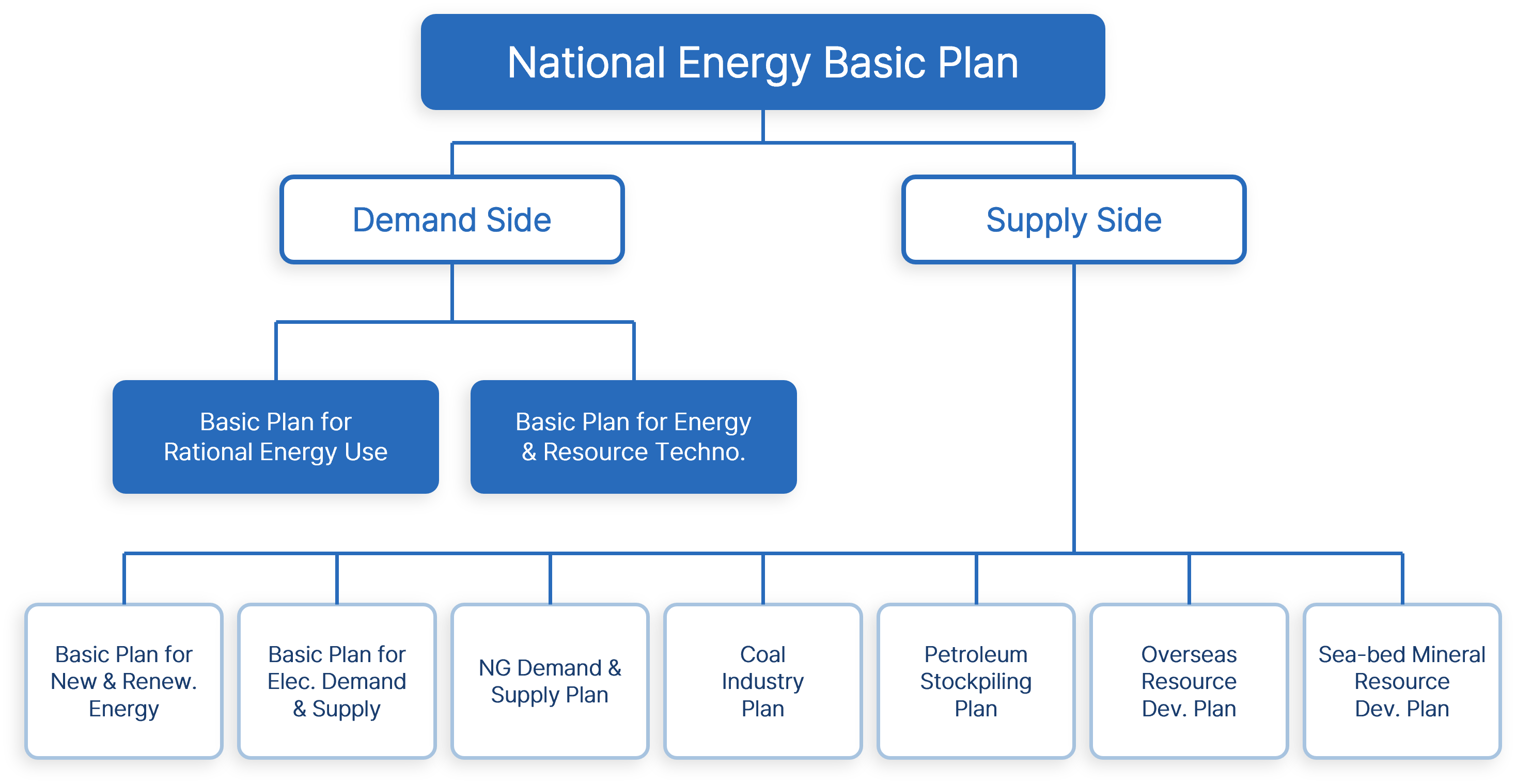
National Energy Basic Plan: Most of major economies periodically establish mid- and long-term national energy strategies as energy is recognized as one of the key strategic commodities. Korea has established the National Energy Basic Plan with a span of 25 years. The time horizon of the latest one is up to 2035. This basic plan is the highest level in the hierarchy of basic plans under which there are many other sub-level energy-related plans. The plan also includes policies to minimise energy-related factors which damage the environment and also to effectively contribute to the achievement of national energy policies for expediting the development of energy related technologies. The basic plan shall cover all fields related to energy, be systematically connected with other energy related plans and be coordinated at a high level. The plan shall have priority over other energy-related plans and provide principles and directions for the plans in each energy source and sector. The plan is subject to intensive consultation; the government shall collect diverse opinions from government agencies, suppliers and citizens' bodies throughout the process and aim to reach a consensus. Since the plan is set to be published every five years, three basic plans have been established and the Third Basic Plan of National Energy will be developed towards the end of 2018.
Hierarchy of Energy Basic Plans
Energy Statistics: Energy statistics provides energy planners and analysts with basic means and information required in energy planning and in establishing energy policy development and assessment and also in conducting research related to energy market and industry. the Korea Energy Economics Institute (KEEI) in collaboration with the government and other relevant institutes compiles a comprehensive energy database, which include energy supply and demand statistics and, the domestic and international energy-related indicators, and publishes the ‘Yearbook of Energy Statistics’ from 1983 on the annual basis. This Yearbook is Korea’s country's only comprehensive publication of the national energy statistics, covering total energy demand, energy source supply and demand, price, energy facilities, mineral resources, and so on. In December 1979, the government enacted the Energy Use Rationalization Act to mandate the conduct of ‘Energy Census’ every three years. The objective of the Energy Census is to investigate the energy demand end-use sector in more details. The Korea Energy Economics Institute conduct the Energy Census every three year, since the first Census was done in 1981.
4.Technology Development: Introduction and Indigenization
After a long and tedious evolution process, energy technology issue became one of the top-priority policy agenda in Korea's energy policy arena. In response to the UNFCCC and the following global trend towards a future green and clean sustainable energy system, a technology-oriented breakthrough strategy was called for further development of Korea's energy industry, and the growing voices for sustainable growth among civil society. The full-fledged evolution began in 2006 when the 1st National Energy Technology Development Plan (2006~2015) was adopted by the National Science and Technology Committee.
Institutional Arrangements: Many corresponding laws and basic plans serve as the institutional platform for energy technology development. The Energy Basic Law, the Rational Energy Use Law, Electricity Business Law, Atomic Energy Law, and Korea Institute of Energy and Resources Research Law have chapters or articles for the government to formulate and implement a long-term energy technology development plan. Responsibilities for energy technology R&D are shared between ministries and government organizations. many research institutes, public corporations, private companies and universities are participating in the policy process and playing their specific roles in the overall R&D activities. Korea Energy Technology Evaluation and Planning Institute(KETEP) was establish in 2007 whose mission is to develop a long-term technology development road-map, and to manage the overall R&D projects by means of evaluation, coordination and fund allocation under the oversight of the MOTIE.
Policy Measures: Various policy measures are being employed in order to promote technological innovation and commercialization: investment of government R&D budget, employment of financial and tax incentives for investments, creation of markets for new technologies, creation of informed consumers, and creation/ improvement of infra for technological innovation. Since the establishment of the National Energy Technology Development Plan in 2006, R&D investment budget has increased rapidly at the growth rate of annual 19%, positioning Korea on the 6th largest nation of the world in terms of annual government R&D investment in the field of energy technology (the 3rd highest nation in terms of investment amount per GDP ratio). The budget is allocated to R&D actors such as private industries, research institute, universities and consortiums thereof
5. Energy Conservation and Energy Efficiency
Right after the 1st and 2nd Oil Shocks, the Korean government introduced energy conservation policy which contains reduced oil use, establishment of the Energy Conservation Committee, “Heat Management Law (1974),” followed by the legislation of “Rational Energy Use Law’ at the end of 1970s. During the 1980s-1990s, energy conservation policy had been up-scaled with the establishment of the Energy Management Corporation (KEMCO, currently, Korea Energy Agency: KEA). Since 1993, Korea has developed a series of the Basic Plan for Rational Energy Use, which are to be revised at the end of each five-year period. The 5th Basic Plan was announced in 2013, and set the target of improving energy intensity 4.1% by 2017, while introducing various measures to achieve this target. The MOTIE announced several energy savings measures to encourage the general public to voluntarily conserve energy.
Voluntary Agreements: Korean government has been implementing voluntary agreements (VAs) as a major of its energy efficiency strategy in a company sets its own energy conservation targets, proposes implementation methods and executes the plan. On the government’s side, it provides incentives in the form of either direct financial support or tax incentives. In addition, the government performs the preliminary energy assessment. Voluntary agreement periods cover five years and the target indicator is the efficiency improvement rate or the emissions reduction rate of CO2. There are no penalties for non-compliance, although companies that do not comply with the standards will be publicly named and may lose incentives.
Energy Audits: By measuring and analyzing the actual use of energy in large companies or buildings that consume significant amounts of energy, loss factors are determined and improvement measures can be proposed. The government offers free energy audits for small and medium-sized companies, while other companies can purchase the audit. As a result of the 6 200 audits the government performed between 1980 and 2004, the government estimates that a 10% average energy savings rate has been achieved, equivalent to savings of 3.5 Mtoe over the period.
Energy Service Companies (ESCOs): Amending the Rational Energy Use Law in 1991, the government introduced the ESCO program which encourages a more voluntary participation from the private sector. It provides two types of support for energy service companies (ESCOs). It provides money directly to ESCOs to support preliminary work for still-unproven efficiency technologies and provides funding directly to industrial companies to pay for ESCO services. The government pays the initial investment cost and then collects repayment based on subsequent energy savings. Once the government’s initial investment has been repaid, the remaining benefits flow directly to the customer.
Building Codes and Efficiency Audits: To improve the building energy codes, the government prepared and implemented action plans since 2007, which strengthens and expands the existing program. The government is currently working on more stringent building insulation standards which are currently mandatory for all new buildings will also be expanded to apply to significant renovations of existing buildings. In addition, Korea is studying whether to mandate that all real estate transactions for large buildings include an energy efficiency certification, with the associated document attached to all sale and purchase transactions.
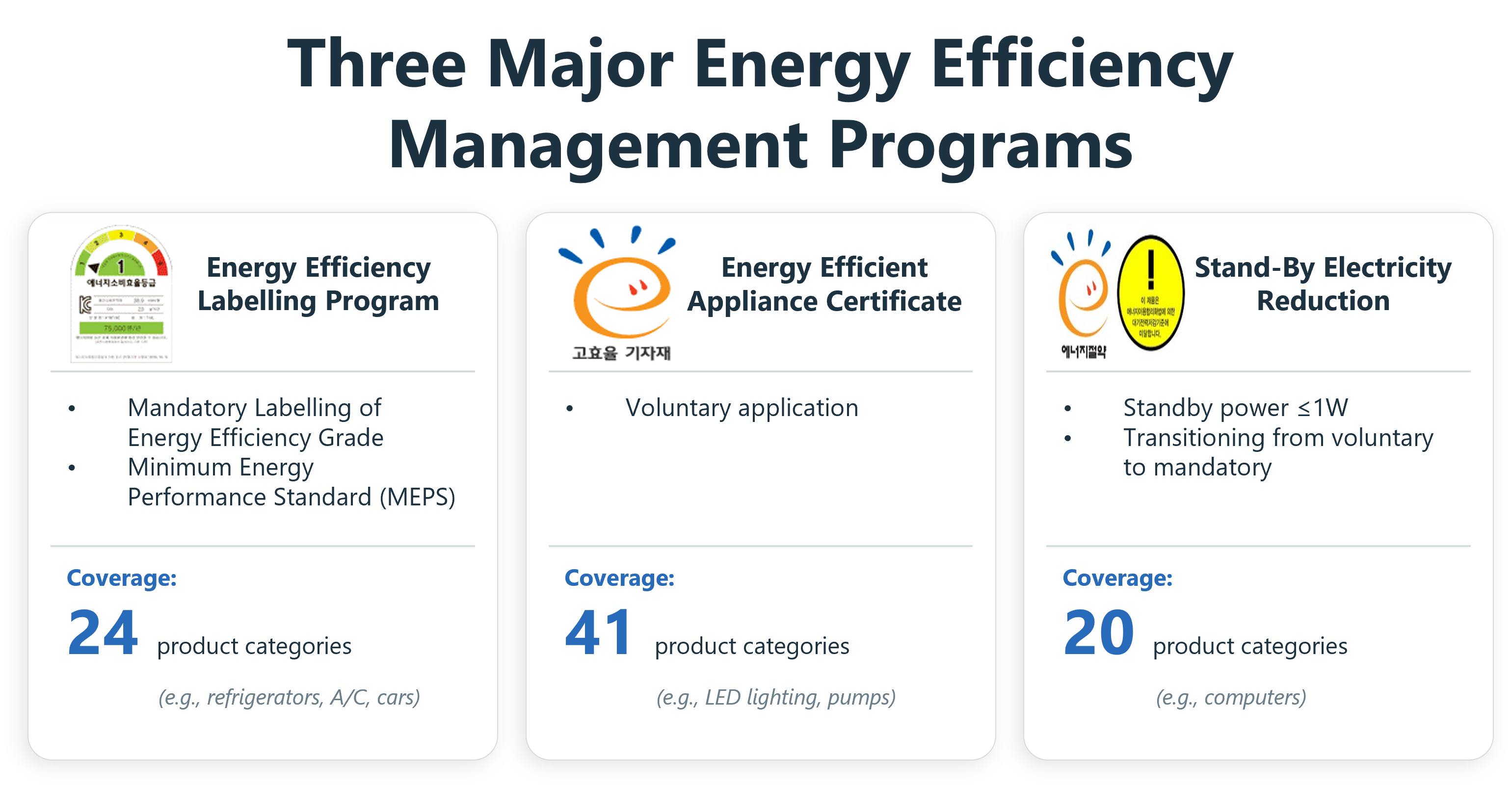
Appliance Labeling and Standards: Korea has been actively working to promote energy efficiency standards and labeling for appliances. The energy efficiency standards and labeling program, launched in 1992 requires companies to label the energy efficiency of products in 18 categories, including refrigerators, air- conditioners and cars. In 1996, The government also introduced a program to certify and label high-efficiency products, which covers 34 items including inductor motors, boilers, pumps and lighting equipment. In 1999, the government started the standby power saving program, a voluntary system that initially labeled products in 14 categories, including computers, printers, copying machines, televisions and video-cassette recorders (VCRs).
Fuel Economy: The Korean government has introduced its first mandatory fuel economy standards. Up to that time, the government had set only voluntary targets. In January 2006, a set of regulations entered into force requiring car manufacturers to meet average fuel economy standards. It also provides incentives for the manufacturers that achieved the target which was to improve fuel economy within each vehicle category. A Fuel Efficiency Labeling Program was introduced to inform consumers about the relative fuel efficiency of the vehicle they intend to purchase. Since January 1988, sales advertisements have been required to include information on vehicle mileage rating. This applies to domestic passenger cars and imports.
Public Transit and Mode Shifting: Public transit is a favorable transport mode in urban areas. Korea is working to further expand public transport usage through a variety of measures, including enhanced public transit service and financial and other incentives to encourage the use of public transport. Korea is rapidly expanding its public transport service. It added over 80 km of light railroad service in five cities between 2001 and 2008. In 2004, the government drew up plans to build 22 rapid transit bus routes measuring 540 km by 2012, all located in the Seoul metropolitan area. In addition to an enhanced light railroad service, the government is expanding the heavy railroad service
6. New and Renewable Energy Development and Deployment
New & Renewable Energy (hereinafter, NRE) is currently seen as a key solution to the two major issues: energy security and climate change. In this regard, many countries, regardless of developed or developing countries, are taking great efforts to develop and deploy renewable energies, fostering relevant industries. To keep up with this global trend, the Korean government has developed and implemented a variety of policy incentives and programs to promote a larger uptake of NREs and to promote NRE industries. In recent years, the Korean government’s investment in NRE has been accelerated in response to the climate change as well as energy security.
Evolution of New & Renewable Energy Policies: Korea, without any conventional energy sources, has been making a great effort to develop and deploy NRE as a clean, environment-friendly and indigenous energy source. In this context, the 1st, 2nd, and 3rd Basic Plans for Renewable Energy Development and Deployment were established in series in which deployment targets and strategies were introduced and implemented to foster relevant industries and create market for NREs. During implementation of those basic plans, policy infrastructure has undergone an evolutionary process. Many policy measures and programs have been devised some of which have been obsoleted and replaced by more advanced ones.
In recent years, as environmental problems such as climate change and local air, soil, water pollution become a major issue, NRE is regarded as a core area of low-carbon green growth which is being implemented, domestically as well as globally. In addition, it is to be seen as a new growth engine which will feed the economy in the coming decades. It is highly expected that this industry would become a lucrative export item based on the current technology, industry, and policy infrastructure most touted by other developing countries.
Eco-Friendly Energy Policies: In the energy sector, environmental issues have emerged as a major task amid stronger environmental regulations on a global scale, following establishment of 1987 Montreal Protocol and United Nations Framework Convention on Climate Change (hereinafter, "Climate Change Convention"). Based on such belief, the government has executed various energy policies to implement low-carbon-type, eco-friendly energy systems that can appropriately respond to environmental issues, such as climate change. In particular, policies that utilize environmental measures as a new growth engine for Korea was executed. It can be potentially as a good development model for developing countries faced with environmental problems.
Energy Policies for Addressing Climate Change: The key points of environment friendly policies are a larger uptake of clean energy sources (renewable energy, nuclear energy, and natural gas), energy saving, and energy efficiency improvement. Moreover, the policy in response to environmental regulations was also pushed ahead. Environmental impact assessments, various support programs, disclosure of the safety information of nuclear power plants, and establishment of the environment monitoring organization were implemented to secure construction sites and to attest safety concern.
Low-polluting, Clean Energy Supply Expansion Policy: The government’s low-polluting clean energy supply expansion policy has been in full swing since the mid-1980s. Although low-sulfur supply expansion policy had previously been pursued, it remained a passive response measure. However, it has gradually shifted to proactive measures, in accordance with atmospheric emissions regulations policies targeting energy and industrial sectors. As such, government policies have been continuously strengthened to this day amid stronger attention to the environmental issues following the Climate Change Convention of 1992. In particular, greater supply of LNG has been on the top of the agenda leading to anincrease in the supply
Energy Safety and Siting Policy: In the energy sector, safety issues have become a major task following series of relevant major domestic and overseas accidents following the expansion of energy facilities. A gas safety management policy was launched after a rise inthe number of gas accidents amid increasing supply and use of LPG produced as petroleum byproducts in the early 1960s. Another reason behind the policy enforcement was public sentiment and sense of entitlement for a pleasant and safe environment, due to higher national income after the 1980s. The public anxiety over energy safety led residents to strongly shun energy facilities located in their neighborhoods, which complicated securing locations for energy facilities, as well as to address the safety issues in the energy sector.
Nuclear Safety: The mounting public anxiety over nuclear power plants triggered fierce collective protests in the areas scheduled for nuclear power plant construction. As the anti-nuclear power plant movement gained its momentum from the late 1980s until the mid-1990s, nuclear power plant safety management system was systematically overhauled. As a major strategy for nuclear safety, a series of actions were executed: 1) overhauling the relevant organizations and systems; 2) strict safety management standards for the entire process from siting to final disposal; 3) an environmental impact assessment for the areas surrounding the nuclear power plants; 4) a civic environmental watchdog agency along with disclosing nuclear power plant information; 5) Nuclear Power Plant Safety Performance Index; 6) technology development and human resources training.
Lessons from Korea’s Energy Policy Success
The history of South Korea's energy policy offers a compelling blueprint for developing countries navigating the complex nexus of energy access, economic development, and environmental sustainability. Its journey from an energy-poor nation to a global industrial leader was not the result of a single master plan but rather a dynamic, problem-solving process that evolved over decades. For policymakers today, the Korean experience yields four fundamental principles for success.
First is the principle of responsive policy-making. Korea’s history shows that while policy responses were sometimes delayed, nearly every major energy challenge was eventually met with a corresponding policy action. This demonstrates a flexible and healthy policy process capable of adapting to changing internal and external variables rather than remaining locked into an obsolete strategy.
Second is the commitment to a long-term vision. Critical solutions, from developing domestic coal to enhancing energy security and reforming governance, were treated as evolutionary processes, not quick fixes. This highlights a crucial insight: in order to resolve a problem, policy efforts need to be promoted consistently over a decade or decades with clear a task orientation and ongoing modifications as lessons are learned through implementation.
Third is the power of planning. The use of a formal plan system, anchored by the National Energy Basic Plan, proved to be an indispensable tool for organizing national efforts, creating a feedback mechanism to correct errors, and allowing for a continuous conversation between policy goals and implementation realities.
Finally, success requires robust institutional and financial support. Every major policy initiative was underpinned by the enactment of corresponding laws, the establishment of dedicated organizations, and the allocation of adequate and consistent financial resources, ensuring that strategic goals could be translated into tangible outcomes.