

.png)
Korea’s Vocational Education and Training (VET) system evolved from providing initial training for industrialization (1960s–1980s) to continuing education for a knowledge-based economy (1990s–present).Early VET policies—backed by strong state coordination and laws like the Vocational Training Act (1967)—built a skilled workforce that fueled rapid economic growth.Later, the Employment Insurance System (EIS, 1995) shifted focus to lifelong learning, empowering workers and employers through demand-driven training and private participation.Supported by five institutional pillars—qualification, quality assurance, private involvement, coordination, and employment services—the Korean model shows how strategic alignment between human capital policy and economic goals can drive sustainable development.
#vocational education and training #VET #employment insurance system #human capital development
A nation's Vocational Education and Training (VET) system is a critical prerequisite for competing successfully in a world market defined by rapid economic and technological change. As a primary supplier of a skilled workforce, VET can serve as a powerful engine for national development. The Republic of Korea stands as a prime example of this principle in action. The country's initial VET system made a great contribution to its economic growth, especially during the period between 1960 and 1980, by supplying the skilled workers and technicians required to implement a series of ambitious 5-year economic development plans.
The success of any VET framework hinges on how policymakers provide coherent, evidence-based answers to four fundamental design questions:
This analysis will explore the evolution of Korea's VET system, examining its strategic design from the early focus on initial training for a manufacturing-based economy to its modern emphasis on continuing education for a knowledge-based society. By dissecting this journey, we can uncover a comprehensive case study in leveraging human capital for national prosperity.
During the 1960s and 1970s, South Korea established the foundational framework of its national VET system. This was not an isolated policy initiative but a core component of a broader, export-oriented development strategy. As the government aggressively promoted labor-intensive light industries and later shifted toward heavy and chemical industries, the demand for skilled workers and technicians surged. The initial VET system was strategically designed to meet this demand head-on, creating a pipeline of talent that powered the country's rapid industrialization. This was achieved through a dual-system approach encompassing both formal vocational education and a parallel vocational training system, centrally coordinated by the powerful Economic Planning Board (EPB), a super-ministry that ensured alignment between human capital development and national economic goals.
The Vocational Education System
With universal primary education achieved, the government strengthened vocational education at the high school level, a logical policy choice given that the private VET market was not yet well developed. This decision was based on the reasoning that a middle school education was the minimum requirement for employees to grasp the skills and knowledge needed to perform as skilled workers.
To meet the increasing demand for technicians, the government established nine 5-year professional institutes in 1963 by extending existing 3-year vocational high schools. These institutes, strategically located in different regions based on local industrial characteristics, provided a hybrid of high school and junior college-level technical courses. The model proved successful, and the number of institutes grew from 9 in 1963 to 23 by 1969. They were transformed into 2-year junior colleges since 1970, which continued to be a main supplier of technicians. Due to government budget constraints, the government encouraged private sector to establish and run private vocational high schools and junior colleges.
The Vocational Training System
Despite the expansion of the formal education system, a persistent shortage of skilled workers led the government to introduce a vocational training system in 1967 to provide training opportunities to unemployed youth without skills in more flexible and prompt ways through employers' involvement. The government enacted the Vocational Training Act, tasking the Ministry of Labor with managing the system, including the establishment of public vocational training institutes, the creation of a national skills testing system, and the provision of employment services for graduates.
The government further solidified this system with the 1976 Basic Law for Vocational Training. This landmark legislation made it mandatory for employers to provide in-plant training for their employees; those who could not were required to pay a training levy. The law set high standards for this mandatory training. As a result, in-company training made a significant contribution to supplying skilled labor. To attract talented youth into these vocational tracks, the government also worked to enhance the social perception of skilled labor. For example, winners of national and international skills competitions were highly praised and rewarded, framing technical expertise as a respected and valuable asset to society.
As Korea's economy continued to advance and its industrial structure changed, this foundational VET system had to evolve in tandem to meet new and more complex skill demands.
Beginning in the mid-1990s, Korea's VET policy underwent a strategic pivot. As the national economy transformed from a labor-intensive model to a technology-intensive one, the need to upgrade the skills of the existing workforce became paramount. This shift increased the demand for lifelong learning and continuing education, prompting a fundamental restructuring of the VET landscape to prioritize upskilling and reskilling.
A New Paradigm: The Employment Insurance System (EIS)
The introduction of the Employment Insurance System (EIS) in 1995 marked a turning point, creating a new backbone for Korea's continuing VET system. The EIS is composed of three interconnected components, all financed from the Employment Insurance Fund (EIF):
These three programs are financed by employees and employers through the EIF, with additional fiscal support from the government.
The EIS ushered in four major paradigm shifts for vocational training in Korea:
This new system proved its resilience and utility during the 1997-1999 foreign currency crisis, when it played a crucial role in providing vocational training for the large number of workers who became unemployed.
Expanding Opportunities for SMEs and the Disadvantaged
To ensure more equitable access to training, the government enacted the 'Worker Vocational Competency Development Act' in 2004. This legislation specifically aimed to support Small and Medium Enterprises (SMEs) and disadvantaged groups. The VCDP provides targeted support for SMEs, such as funding for training consortiums formed with other businesses and VET providers, and assistance for companies seeking to become formal "learning organizations."
While the VCDP supports SMEs through the EIF, the system also supports disadvantaged populations, including female heads of household and unemployed youth, through the general budget of the Ministry of Employment and Labor. More recently, voucher schemes have been introduced to promote self-directed training for individuals.
Structural Changes and Modern Challenges
In line with the economy's growing sophistication, the focus of vocational education shifted from high schools to junior colleges in the 1990s to meet the demand for higher-level skills. However, by the 2000s, the initial VET system faced new challenges, including a decreasing youth cohort, rising rates of over-education, and a poor link between schools and industry. The government responded with several initiatives, such as strengthening direct links between schools and industries and encouraging collaboration between local governments, businesses, and junior colleges. Since 2010, the Ministry of Education has undertaken major reform efforts, including:
.png)
The success of both the initial and continuing VET systems was not solely due to these programmatic shifts; it relied on a set of robust institutional mechanisms that ensured quality, relevance, and effectiveness.
A VET system, no matter how well-funded, cannot succeed without well-designed supporting mechanisms. In Korea, five critical institutional pillars were established to create a robust policy ecosystem that de-risked private investment, guaranteed quality, and ensured VET outputs were tightly coupled with the dynamic needs of the national economic plan.
Qualification System
A national qualification system is crucial for connecting VET programs with the skill demands of the labor market and for providing a clear standard to assess performance. The Korean government introduced the Skill Test and Certification System in 1967 and enacted the 'National Technical Qualification Law' in 1973. This framework officially recognized an individual's skills, guided VET curriculum toward market needs, and enhanced the socio-economic status of workers. This system allowed individuals to be employed and treated equally based on their government-approved qualification certificate, regardless of where they were trained. More recently, Korea has been reforming this framework by introducing the National Competency Standards (NCS) as a new basis for developing curricula and qualification standards.
Quality Assurance Mechanism
A quality assurance mechanism is required to guarantee a consistent level of service across all VET programs and institutes. By generating and providing public information on the performance of these programs, the government empowers consumers -both individuals and firms-to make informed decisions about their investment in training. This transparency also promotes healthy competition among VET providers, driving continuous quality improvement. Since the introduction of the demand-side VCDP in 1995, the government has generated and disseminated evaluation data annually via its website.
Private Sector Participation
Involving the private sector is vital for easing government budget constraints and enabling the VET system to respond more promptly to changing skill demands. Korea encouraged private participation through key legislative actions like the Private School Law of 1963 and the introduction of the EIS in 1995, which opened the training market to private institutes. As the Korean case demonstrates, attracting sustainable private investment requires a stable policy environment with clear laws and regulations, robust financial incentives, and a fair, open training market that guarantees equal treatment for all providers.
Coordination Among Stakeholders
Effective coordination among government bodies, employers, labor unions, and VET institutes is essential for creating synergy. This ensures that VET development plans are tightly linked to national economic development strategies and that program content reflects actual labor market needs. The powerful coordinating function of the Economic Planning Board, as established in the initial development phase (1960s-1980s), exemplifies this principle. In the modern era, Industry-University Corporations established since the 2000s serve a similar function, fostering collaboration between academia and industry.
Employment Service
Ultimately, the effectiveness of VET policies is measured by whether graduates find jobs. Employment services play a crucial role in making this connection. These services include job matching, career guidance, and VET consultancy. Designing a one-stop service system that is effectively marketed to employers and builds close relationships between public and private employment agencies is critical to maximizing the return on a nation's investment in vocational training.
The principles and structures of Korea's VET system are best understood through concrete examples. The following three cases illustrate different facets of the system's application, from leveraging international partnerships to specializing institutions to meet specific industrial demands.
Korea-Germany Public Vocational Training Center
This center represents a strategic implementation of international aid to accelerate domestic capacity building and absorb world-class technical standards. With financial and technical support from countries like Germany, Korea established public training institutes that functioned as critical nodes for technology transfer. This assistance included expert guidance, education for Korean trainers, and modern equipment. The Korea-Germany Public Vocational Training Center played a vital role during the development period by supplying highly sought-after mechanics, welders, electricians, and sheet metal workers to fuel industrial growth. On March 1, 2006, following the integration of functional colleges and vocational training institutes, it was reorganized as the Dongbusan Campus of Korea Polytechnic University.
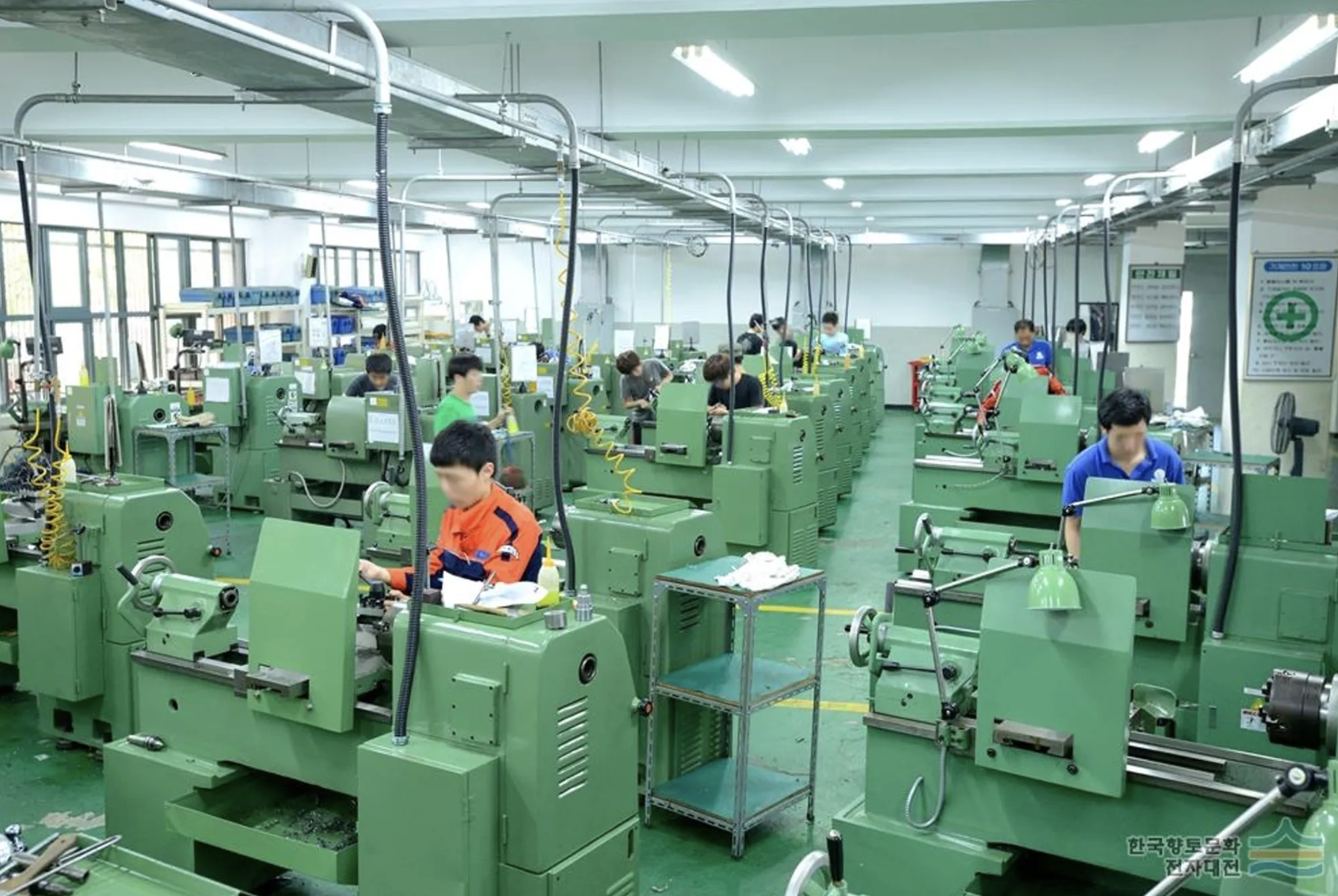
Jungsoo Vocational Training Center
This case demonstrates a policy tool for enhancing social mobility and ensuring a broad-based distribution of skills, providing a critical safety net for youth excluded from formal higher education. Established in 1973 with government funds, the center was designed to train adolescents who were unable to pursue higher schooling due to family financial constraints. It became a vital institution, contributing a steady supply of high-quality skilled workers in areas such as lathe, welding, sheet metal, automobile repair, and machine milling, offering a pathway to economic self-sufficiency for its students.
.png)
Kumoh Technical High School
This school is a clear example of targeted, sector-specific human capital investment, where the government strategically over-invested in specialized education to create an elite technical workforce for its priority industries. In 1973, the government designated Kumoh as a specialized mechanical high school to meet the acute demand for high-level skills in the heavy and chemical industries. To accelerate its development, the government invested a significantly larger amount of funding into the school compared to general technical high schools, demonstrating a deliberate, strategic approach to workforce development.
South Korea's journey from a developing nation to a global economic powerhouse offers valuable lessons for any country seeking to leverage Vocational Education and Training for national development. The evolution of its VET system provides a checklist of critical success factors and key considerations for policymakers. The Korean experience demonstrates that a VET system is most effective when it is dynamic, strategically aligned with economic goals, and supported by robust institutional pillars.
The success of the Korean VET model can be attributed to four overarching factors:
Ultimately, the Korean model is a testament to the power of a strategic, adaptable, and well-supported VET system as a cornerstone of sustainable economic progress.
.png)
Korea’s Vocational Education and Training (VET) system evolved from providing initial training for industrialization (1960s–1980s) to continuing education for a knowledge-based economy (1990s–present).Early VET policies—backed by strong state coordination and laws like the Vocational Training Act (1967)—built a skilled workforce that fueled rapid economic growth.Later, the Employment Insurance System (EIS, 1995) shifted focus to lifelong learning, empowering workers and employers through demand-driven training and private participation.Supported by five institutional pillars—qualification, quality assurance, private involvement, coordination, and employment services—the Korean model shows how strategic alignment between human capital policy and economic goals can drive sustainable development.
#vocational education and training #VET #employment insurance system #human capital development
A nation's Vocational Education and Training (VET) system is a critical prerequisite for competing successfully in a world market defined by rapid economic and technological change. As a primary supplier of a skilled workforce, VET can serve as a powerful engine for national development. The Republic of Korea stands as a prime example of this principle in action. The country's initial VET system made a great contribution to its economic growth, especially during the period between 1960 and 1980, by supplying the skilled workers and technicians required to implement a series of ambitious 5-year economic development plans.
The success of any VET framework hinges on how policymakers provide coherent, evidence-based answers to four fundamental design questions:
This analysis will explore the evolution of Korea's VET system, examining its strategic design from the early focus on initial training for a manufacturing-based economy to its modern emphasis on continuing education for a knowledge-based society. By dissecting this journey, we can uncover a comprehensive case study in leveraging human capital for national prosperity.
During the 1960s and 1970s, South Korea established the foundational framework of its national VET system. This was not an isolated policy initiative but a core component of a broader, export-oriented development strategy. As the government aggressively promoted labor-intensive light industries and later shifted toward heavy and chemical industries, the demand for skilled workers and technicians surged. The initial VET system was strategically designed to meet this demand head-on, creating a pipeline of talent that powered the country's rapid industrialization. This was achieved through a dual-system approach encompassing both formal vocational education and a parallel vocational training system, centrally coordinated by the powerful Economic Planning Board (EPB), a super-ministry that ensured alignment between human capital development and national economic goals.
The Vocational Education System
With universal primary education achieved, the government strengthened vocational education at the high school level, a logical policy choice given that the private VET market was not yet well developed. This decision was based on the reasoning that a middle school education was the minimum requirement for employees to grasp the skills and knowledge needed to perform as skilled workers.
To meet the increasing demand for technicians, the government established nine 5-year professional institutes in 1963 by extending existing 3-year vocational high schools. These institutes, strategically located in different regions based on local industrial characteristics, provided a hybrid of high school and junior college-level technical courses. The model proved successful, and the number of institutes grew from 9 in 1963 to 23 by 1969. They were transformed into 2-year junior colleges since 1970, which continued to be a main supplier of technicians. Due to government budget constraints, the government encouraged private sector to establish and run private vocational high schools and junior colleges.
The Vocational Training System
Despite the expansion of the formal education system, a persistent shortage of skilled workers led the government to introduce a vocational training system in 1967 to provide training opportunities to unemployed youth without skills in more flexible and prompt ways through employers' involvement. The government enacted the Vocational Training Act, tasking the Ministry of Labor with managing the system, including the establishment of public vocational training institutes, the creation of a national skills testing system, and the provision of employment services for graduates.
The government further solidified this system with the 1976 Basic Law for Vocational Training. This landmark legislation made it mandatory for employers to provide in-plant training for their employees; those who could not were required to pay a training levy. The law set high standards for this mandatory training. As a result, in-company training made a significant contribution to supplying skilled labor. To attract talented youth into these vocational tracks, the government also worked to enhance the social perception of skilled labor. For example, winners of national and international skills competitions were highly praised and rewarded, framing technical expertise as a respected and valuable asset to society.
As Korea's economy continued to advance and its industrial structure changed, this foundational VET system had to evolve in tandem to meet new and more complex skill demands.
Beginning in the mid-1990s, Korea's VET policy underwent a strategic pivot. As the national economy transformed from a labor-intensive model to a technology-intensive one, the need to upgrade the skills of the existing workforce became paramount. This shift increased the demand for lifelong learning and continuing education, prompting a fundamental restructuring of the VET landscape to prioritize upskilling and reskilling.
A New Paradigm: The Employment Insurance System (EIS)
The introduction of the Employment Insurance System (EIS) in 1995 marked a turning point, creating a new backbone for Korea's continuing VET system. The EIS is composed of three interconnected components, all financed from the Employment Insurance Fund (EIF):
These three programs are financed by employees and employers through the EIF, with additional fiscal support from the government.
The EIS ushered in four major paradigm shifts for vocational training in Korea:
This new system proved its resilience and utility during the 1997-1999 foreign currency crisis, when it played a crucial role in providing vocational training for the large number of workers who became unemployed.
Expanding Opportunities for SMEs and the Disadvantaged
To ensure more equitable access to training, the government enacted the 'Worker Vocational Competency Development Act' in 2004. This legislation specifically aimed to support Small and Medium Enterprises (SMEs) and disadvantaged groups. The VCDP provides targeted support for SMEs, such as funding for training consortiums formed with other businesses and VET providers, and assistance for companies seeking to become formal "learning organizations."
While the VCDP supports SMEs through the EIF, the system also supports disadvantaged populations, including female heads of household and unemployed youth, through the general budget of the Ministry of Employment and Labor. More recently, voucher schemes have been introduced to promote self-directed training for individuals.
Structural Changes and Modern Challenges
In line with the economy's growing sophistication, the focus of vocational education shifted from high schools to junior colleges in the 1990s to meet the demand for higher-level skills. However, by the 2000s, the initial VET system faced new challenges, including a decreasing youth cohort, rising rates of over-education, and a poor link between schools and industry. The government responded with several initiatives, such as strengthening direct links between schools and industries and encouraging collaboration between local governments, businesses, and junior colleges. Since 2010, the Ministry of Education has undertaken major reform efforts, including:
.png)
The success of both the initial and continuing VET systems was not solely due to these programmatic shifts; it relied on a set of robust institutional mechanisms that ensured quality, relevance, and effectiveness.
A VET system, no matter how well-funded, cannot succeed without well-designed supporting mechanisms. In Korea, five critical institutional pillars were established to create a robust policy ecosystem that de-risked private investment, guaranteed quality, and ensured VET outputs were tightly coupled with the dynamic needs of the national economic plan.
Qualification System
A national qualification system is crucial for connecting VET programs with the skill demands of the labor market and for providing a clear standard to assess performance. The Korean government introduced the Skill Test and Certification System in 1967 and enacted the 'National Technical Qualification Law' in 1973. This framework officially recognized an individual's skills, guided VET curriculum toward market needs, and enhanced the socio-economic status of workers. This system allowed individuals to be employed and treated equally based on their government-approved qualification certificate, regardless of where they were trained. More recently, Korea has been reforming this framework by introducing the National Competency Standards (NCS) as a new basis for developing curricula and qualification standards.
Quality Assurance Mechanism
A quality assurance mechanism is required to guarantee a consistent level of service across all VET programs and institutes. By generating and providing public information on the performance of these programs, the government empowers consumers -both individuals and firms-to make informed decisions about their investment in training. This transparency also promotes healthy competition among VET providers, driving continuous quality improvement. Since the introduction of the demand-side VCDP in 1995, the government has generated and disseminated evaluation data annually via its website.
Private Sector Participation
Involving the private sector is vital for easing government budget constraints and enabling the VET system to respond more promptly to changing skill demands. Korea encouraged private participation through key legislative actions like the Private School Law of 1963 and the introduction of the EIS in 1995, which opened the training market to private institutes. As the Korean case demonstrates, attracting sustainable private investment requires a stable policy environment with clear laws and regulations, robust financial incentives, and a fair, open training market that guarantees equal treatment for all providers.
Coordination Among Stakeholders
Effective coordination among government bodies, employers, labor unions, and VET institutes is essential for creating synergy. This ensures that VET development plans are tightly linked to national economic development strategies and that program content reflects actual labor market needs. The powerful coordinating function of the Economic Planning Board, as established in the initial development phase (1960s-1980s), exemplifies this principle. In the modern era, Industry-University Corporations established since the 2000s serve a similar function, fostering collaboration between academia and industry.
Employment Service
Ultimately, the effectiveness of VET policies is measured by whether graduates find jobs. Employment services play a crucial role in making this connection. These services include job matching, career guidance, and VET consultancy. Designing a one-stop service system that is effectively marketed to employers and builds close relationships between public and private employment agencies is critical to maximizing the return on a nation's investment in vocational training.
The principles and structures of Korea's VET system are best understood through concrete examples. The following three cases illustrate different facets of the system's application, from leveraging international partnerships to specializing institutions to meet specific industrial demands.
Korea-Germany Public Vocational Training Center
This center represents a strategic implementation of international aid to accelerate domestic capacity building and absorb world-class technical standards. With financial and technical support from countries like Germany, Korea established public training institutes that functioned as critical nodes for technology transfer. This assistance included expert guidance, education for Korean trainers, and modern equipment. The Korea-Germany Public Vocational Training Center played a vital role during the development period by supplying highly sought-after mechanics, welders, electricians, and sheet metal workers to fuel industrial growth. On March 1, 2006, following the integration of functional colleges and vocational training institutes, it was reorganized as the Dongbusan Campus of Korea Polytechnic University.

Jungsoo Vocational Training Center
This case demonstrates a policy tool for enhancing social mobility and ensuring a broad-based distribution of skills, providing a critical safety net for youth excluded from formal higher education. Established in 1973 with government funds, the center was designed to train adolescents who were unable to pursue higher schooling due to family financial constraints. It became a vital institution, contributing a steady supply of high-quality skilled workers in areas such as lathe, welding, sheet metal, automobile repair, and machine milling, offering a pathway to economic self-sufficiency for its students.
.png)
Kumoh Technical High School
This school is a clear example of targeted, sector-specific human capital investment, where the government strategically over-invested in specialized education to create an elite technical workforce for its priority industries. In 1973, the government designated Kumoh as a specialized mechanical high school to meet the acute demand for high-level skills in the heavy and chemical industries. To accelerate its development, the government invested a significantly larger amount of funding into the school compared to general technical high schools, demonstrating a deliberate, strategic approach to workforce development.
South Korea's journey from a developing nation to a global economic powerhouse offers valuable lessons for any country seeking to leverage Vocational Education and Training for national development. The evolution of its VET system provides a checklist of critical success factors and key considerations for policymakers. The Korean experience demonstrates that a VET system is most effective when it is dynamic, strategically aligned with economic goals, and supported by robust institutional pillars.
The success of the Korean VET model can be attributed to four overarching factors:
Ultimately, the Korean model is a testament to the power of a strategic, adaptable, and well-supported VET system as a cornerstone of sustainable economic progress.
.png)
A nation's Vocational Education and Training (VET) system is a critical prerequisite for competing successfully in a world market defined by rapid economic and technological change. As a primary supplier of a skilled workforce, VET can serve as a powerful engine for national development. The Republic of Korea stands as a prime example of this principle in action. The country's initial VET system made a great contribution to its economic growth, especially during the period between 1960 and 1980, by supplying the skilled workers and technicians required to implement a series of ambitious 5-year economic development plans.
The success of any VET framework hinges on how policymakers provide coherent, evidence-based answers to four fundamental design questions:
This analysis will explore the evolution of Korea's VET system, examining its strategic design from the early focus on initial training for a manufacturing-based economy to its modern emphasis on continuing education for a knowledge-based society. By dissecting this journey, we can uncover a comprehensive case study in leveraging human capital for national prosperity.
During the 1960s and 1970s, South Korea established the foundational framework of its national VET system. This was not an isolated policy initiative but a core component of a broader, export-oriented development strategy. As the government aggressively promoted labor-intensive light industries and later shifted toward heavy and chemical industries, the demand for skilled workers and technicians surged. The initial VET system was strategically designed to meet this demand head-on, creating a pipeline of talent that powered the country's rapid industrialization. This was achieved through a dual-system approach encompassing both formal vocational education and a parallel vocational training system, centrally coordinated by the powerful Economic Planning Board (EPB), a super-ministry that ensured alignment between human capital development and national economic goals.
The Vocational Education System
With universal primary education achieved, the government strengthened vocational education at the high school level, a logical policy choice given that the private VET market was not yet well developed. This decision was based on the reasoning that a middle school education was the minimum requirement for employees to grasp the skills and knowledge needed to perform as skilled workers.
To meet the increasing demand for technicians, the government established nine 5-year professional institutes in 1963 by extending existing 3-year vocational high schools. These institutes, strategically located in different regions based on local industrial characteristics, provided a hybrid of high school and junior college-level technical courses. The model proved successful, and the number of institutes grew from 9 in 1963 to 23 by 1969. They were transformed into 2-year junior colleges since 1970, which continued to be a main supplier of technicians. Due to government budget constraints, the government encouraged private sector to establish and run private vocational high schools and junior colleges.
The Vocational Training System
Despite the expansion of the formal education system, a persistent shortage of skilled workers led the government to introduce a vocational training system in 1967 to provide training opportunities to unemployed youth without skills in more flexible and prompt ways through employers' involvement. The government enacted the Vocational Training Act, tasking the Ministry of Labor with managing the system, including the establishment of public vocational training institutes, the creation of a national skills testing system, and the provision of employment services for graduates.
The government further solidified this system with the 1976 Basic Law for Vocational Training. This landmark legislation made it mandatory for employers to provide in-plant training for their employees; those who could not were required to pay a training levy. The law set high standards for this mandatory training. As a result, in-company training made a significant contribution to supplying skilled labor. To attract talented youth into these vocational tracks, the government also worked to enhance the social perception of skilled labor. For example, winners of national and international skills competitions were highly praised and rewarded, framing technical expertise as a respected and valuable asset to society.
As Korea's economy continued to advance and its industrial structure changed, this foundational VET system had to evolve in tandem to meet new and more complex skill demands.
Beginning in the mid-1990s, Korea's VET policy underwent a strategic pivot. As the national economy transformed from a labor-intensive model to a technology-intensive one, the need to upgrade the skills of the existing workforce became paramount. This shift increased the demand for lifelong learning and continuing education, prompting a fundamental restructuring of the VET landscape to prioritize upskilling and reskilling.
A New Paradigm: The Employment Insurance System (EIS)
The introduction of the Employment Insurance System (EIS) in 1995 marked a turning point, creating a new backbone for Korea's continuing VET system. The EIS is composed of three interconnected components, all financed from the Employment Insurance Fund (EIF):
These three programs are financed by employees and employers through the EIF, with additional fiscal support from the government.
The EIS ushered in four major paradigm shifts for vocational training in Korea:
This new system proved its resilience and utility during the 1997-1999 foreign currency crisis, when it played a crucial role in providing vocational training for the large number of workers who became unemployed.
Expanding Opportunities for SMEs and the Disadvantaged
To ensure more equitable access to training, the government enacted the 'Worker Vocational Competency Development Act' in 2004. This legislation specifically aimed to support Small and Medium Enterprises (SMEs) and disadvantaged groups. The VCDP provides targeted support for SMEs, such as funding for training consortiums formed with other businesses and VET providers, and assistance for companies seeking to become formal "learning organizations."
While the VCDP supports SMEs through the EIF, the system also supports disadvantaged populations, including female heads of household and unemployed youth, through the general budget of the Ministry of Employment and Labor. More recently, voucher schemes have been introduced to promote self-directed training for individuals.
Structural Changes and Modern Challenges
In line with the economy's growing sophistication, the focus of vocational education shifted from high schools to junior colleges in the 1990s to meet the demand for higher-level skills. However, by the 2000s, the initial VET system faced new challenges, including a decreasing youth cohort, rising rates of over-education, and a poor link between schools and industry. The government responded with several initiatives, such as strengthening direct links between schools and industries and encouraging collaboration between local governments, businesses, and junior colleges. Since 2010, the Ministry of Education has undertaken major reform efforts, including:
.png)
The success of both the initial and continuing VET systems was not solely due to these programmatic shifts; it relied on a set of robust institutional mechanisms that ensured quality, relevance, and effectiveness.
A VET system, no matter how well-funded, cannot succeed without well-designed supporting mechanisms. In Korea, five critical institutional pillars were established to create a robust policy ecosystem that de-risked private investment, guaranteed quality, and ensured VET outputs were tightly coupled with the dynamic needs of the national economic plan.
Qualification System
A national qualification system is crucial for connecting VET programs with the skill demands of the labor market and for providing a clear standard to assess performance. The Korean government introduced the Skill Test and Certification System in 1967 and enacted the 'National Technical Qualification Law' in 1973. This framework officially recognized an individual's skills, guided VET curriculum toward market needs, and enhanced the socio-economic status of workers. This system allowed individuals to be employed and treated equally based on their government-approved qualification certificate, regardless of where they were trained. More recently, Korea has been reforming this framework by introducing the National Competency Standards (NCS) as a new basis for developing curricula and qualification standards.
Quality Assurance Mechanism
A quality assurance mechanism is required to guarantee a consistent level of service across all VET programs and institutes. By generating and providing public information on the performance of these programs, the government empowers consumers -both individuals and firms-to make informed decisions about their investment in training. This transparency also promotes healthy competition among VET providers, driving continuous quality improvement. Since the introduction of the demand-side VCDP in 1995, the government has generated and disseminated evaluation data annually via its website.
Private Sector Participation
Involving the private sector is vital for easing government budget constraints and enabling the VET system to respond more promptly to changing skill demands. Korea encouraged private participation through key legislative actions like the Private School Law of 1963 and the introduction of the EIS in 1995, which opened the training market to private institutes. As the Korean case demonstrates, attracting sustainable private investment requires a stable policy environment with clear laws and regulations, robust financial incentives, and a fair, open training market that guarantees equal treatment for all providers.
Coordination Among Stakeholders
Effective coordination among government bodies, employers, labor unions, and VET institutes is essential for creating synergy. This ensures that VET development plans are tightly linked to national economic development strategies and that program content reflects actual labor market needs. The powerful coordinating function of the Economic Planning Board, as established in the initial development phase (1960s-1980s), exemplifies this principle. In the modern era, Industry-University Corporations established since the 2000s serve a similar function, fostering collaboration between academia and industry.
Employment Service
Ultimately, the effectiveness of VET policies is measured by whether graduates find jobs. Employment services play a crucial role in making this connection. These services include job matching, career guidance, and VET consultancy. Designing a one-stop service system that is effectively marketed to employers and builds close relationships between public and private employment agencies is critical to maximizing the return on a nation's investment in vocational training.
The principles and structures of Korea's VET system are best understood through concrete examples. The following three cases illustrate different facets of the system's application, from leveraging international partnerships to specializing institutions to meet specific industrial demands.
Korea-Germany Public Vocational Training Center
This center represents a strategic implementation of international aid to accelerate domestic capacity building and absorb world-class technical standards. With financial and technical support from countries like Germany, Korea established public training institutes that functioned as critical nodes for technology transfer. This assistance included expert guidance, education for Korean trainers, and modern equipment. The Korea-Germany Public Vocational Training Center played a vital role during the development period by supplying highly sought-after mechanics, welders, electricians, and sheet metal workers to fuel industrial growth. On March 1, 2006, following the integration of functional colleges and vocational training institutes, it was reorganized as the Dongbusan Campus of Korea Polytechnic University.

Jungsoo Vocational Training Center
This case demonstrates a policy tool for enhancing social mobility and ensuring a broad-based distribution of skills, providing a critical safety net for youth excluded from formal higher education. Established in 1973 with government funds, the center was designed to train adolescents who were unable to pursue higher schooling due to family financial constraints. It became a vital institution, contributing a steady supply of high-quality skilled workers in areas such as lathe, welding, sheet metal, automobile repair, and machine milling, offering a pathway to economic self-sufficiency for its students.
.png)
Kumoh Technical High School
This school is a clear example of targeted, sector-specific human capital investment, where the government strategically over-invested in specialized education to create an elite technical workforce for its priority industries. In 1973, the government designated Kumoh as a specialized mechanical high school to meet the acute demand for high-level skills in the heavy and chemical industries. To accelerate its development, the government invested a significantly larger amount of funding into the school compared to general technical high schools, demonstrating a deliberate, strategic approach to workforce development.
South Korea's journey from a developing nation to a global economic powerhouse offers valuable lessons for any country seeking to leverage Vocational Education and Training for national development. The evolution of its VET system provides a checklist of critical success factors and key considerations for policymakers. The Korean experience demonstrates that a VET system is most effective when it is dynamic, strategically aligned with economic goals, and supported by robust institutional pillars.
The success of the Korean VET model can be attributed to four overarching factors:
Ultimately, the Korean model is a testament to the power of a strategic, adaptable, and well-supported VET system as a cornerstone of sustainable economic progress.