


Back to List
K-Dev Original

Building a Digital Nation: ICT Policy and Governance in South Korea

Summary

South Korea’s emergence as a global ICT leader reflects sustained investment in digital infrastructure, long-term policy commitment, and adaptive governance reform. Beginning in the 1990s, the government implemented successive national network strategies that expanded from high-speed broadband to ultra-broadband and, more recently, nationwide Giga Internet and early 5G deployment. These efforts were reinforced by comprehensive legal frameworks and dedicated funding mechanisms that ensured continuous support for digital development. Governance structures also evolved as technologies advanced, shifting from early informatization bodies to integrated ICT ministries and high-level coordination committees directly linked to national decision-making. This combination of infrastructure expansion, strategic policymaking, and centralized governance enabled South Korea to transition from limited ICT access to one of the world’s most advanced digital environments.

Key Questions

  • What policy instruments and legal frameworks enabled continuous and stable investment in Korea’s digital infrastructure over multiple decades?
  • What impacts did broadband expansion have on reducing digital gaps?
  • How did funding mechanisms accelerate infrastructure and service growth?

#ICT #digitalization #governance

South Korea has achieved a significant transformation over the last 50 years, emerging as a world-leading country in information and communication, driven by remarkable development in Information and Communication Technology (ICT). In 1960, Korea’s telephone penetration rate was only 0.36 per 100 inhabitants, barely one-tenth of the world average at the time; however, Korea caught up with the world average by 1981. Today, Korea leads the world in broadband Internet access penetration. This emergence as a global leader in ICT—in fields like broadband Internet, semiconductors, and smartphones—is not an accident, but the result of the government specifically targeting this objective. The Korean government's various policy supports played a major role in establishing Korea's world-class information and communication infrastructure. South Korea serves as a leading example of a country rising from a low level of ICT access to one of the highest in the world.

Strategic ICT Development Stages in South Korea

The Republic of Korea has made remarkable progress in ICT over the past 30 years by constantly enforcing strategic policies for network construction. The development of information and communication in Korea can be summarized in three key stages: High-speed Network Strategy (1995–2005), Broadband Network Strategy (2004–2010), and Broadband Convergence Network Strategy (2009–2014).

  • High-speed Network Strategy (1995–2005): Building an Information Super Highway

The initial phase focused on building an Information Super Highway. In 1993, the government sought to build a super highway capable of transmitting multimedia information, including voice, data, and video. The Ministry of Information and Communication (MIC) was launched in 1994 as the authority responsible for promoting informatization. One year later, the MIC developed a comprehensive plan to construct infrastructure for the universal use of broadband ICT services, such as remote education, telemedicine, and telecommuting.

A key component was the Project for Building Korea Information Infrastructure (KII), developed by the MIC and the National Computerization Agency. The KII project aimed to connect all government agencies, local governments, and public institutions with fiber optic cables. Estimated to cost 811.4 billion KRW, the KII was a three-stage project initially scheduled from 1995 to 2010.

The first stage (1995–1997) deployed a fiber optic backbone network across 80 locations nationwide, investing 175.5 billion KRW. This provided broadband services to 15,000 public institutions at a rate 40–50% cheaper than private providers. The second stage (1998–2002) focused on expanding coverage and enhancing network service by transitioning the core network from ATM-based to router-based. The third stage (2003–2005) completed a converged broadband multimedia service transmission network five years ahead of the planned schedule, providing transmission speeds ranging from tens of Gbps to several Tbps.

Between 1996 and 2005, the KII Project expanded network subscribers 19 times and dramatically increased network speed, establishing the basic infrastructure for Korea’s current e-Government. The KII-Government remains key infrastructure for most government organizations.

  • Broadband Network Strategy (2004–2007)

This phase followed a period of rapid broadband growth between 2000 and 2002, where the total number of subscribers increased by 200%, and the household penetration rate rose from 27% to 69%.

In 2004, the government announced the details of a three-stage Broadband Convergence Network (BcN) initiative (2004–2010). BcN was defined as an integrated next-generation network providing seamless, quality-guaranteed broadband multimedia services that converged telecommunications, broadcasting, and the Internet at any time and any place. The initiative planned to provide 50–100Mbps broadband services for fixed subscribers. The BcN was valuable infrastructure which enabled the development and provision of a wide variety of new profit-generating models that integrated broadcasting and communications.

The directions for BcN establishment included: 1) applying broadband on subscriber networks, 2) advancing the transmission network to integrate communications, broadcasting, and the internet, 3) managing the network and establishing a service control network, and 4) developing and providing a wide range of convergence services. The service control plan aimed for an integrated network allowing comprehensive control and management of subscribers and resources, utilizing open technology for service continuity.

The implementation was divided into Stage 1 (2004–2005, foundation formation), Stage 2 (2006–2007, intensive establishment), and Stage 3 (2008–2010, completion). Support mechanisms included promoting new service models, supplying core technologies, operating R&D networks, promoting standardization, and maintaining legal systems.

Through BcN, the government aimed to provide a foundation for participatory democracy using electronic governance services (M-Gov and T-Gov) and governmental surveillance. Furthermore, it sought to establish ubiquitous service environments (u-Learning, u-Healthcare, u-Work) allowing all Koreans to conveniently access high-quality education, welfare, and employment. The goal for 2010 was to provide services to 100 million wired households and 100 million wireless users, while also targeting 67 trillion KRW in related device production and $20.1 billion in export value.

  • Ultra Broadband Convergence Network Strategy (2009–2013)

In January 2009, the government announced a “Medium-to Long-term Plan to Develop the Communications Network” to build the Ultra Broadband Convergence Network (UBcN), meeting future demands for communication services that were experienced, converged, intelligent, and private. This UBcN was an ALL-IP based network, achieving an average speed of 1Gbps for wired services and 10Mbps for wireless, making it 10 times faster than the previous network.

UBcN enabled the Multiple Play Service (MPS), combining telephone, internet, and broadcasting across various environments, such as Service over TV (SoTV) and mobile, often involving ultra-high resolution and two-directional TV. Forecasts suggested this revitalization would bring a "living revolution" by making people’s lives more comfortable and efficient.

South Korea boasts the world’s highest number of broadband services per capita. By 2015, approximately 95% of households and 40% of the population were broadband subscribers, with over 60% using Fiber To The Home (FTTH) or Apartment LANs. Broadband services like e-health, e-learning, e-government, and u-City were developed and demonstrated. By providing services such as e-health to remote island regions, broadband was utilized to narrow the gap among different classes and regions. By 2016, fixed broadband subscribers exceeded 20 million, and market penetration is expected to continue growing, driven by converged solutions like IPTV and Smart Home services.

  • Advancement of Convergence Infrastructure (2014–Present)

Since 2014, following the successful BcN deployment, the Korean government has launched the Giga Internet infrastructure. Preparation had begun in 2009, included as a national task in the ‘Broadcasting Network Mid-to Long Term Development Plan’.

Policies included the K-ICT network development strategy (2016–2020). In 2016, the 'Giga Internet Demonstration Construction and Operation Project' was promoted to increase public awareness and supported seven application services, including super high-definition HDR UHD TV and Giga Smart Home Care. In the initial stage of commercialization, application services requiring 1Gbps speed were lacking, leading the government to encourage both foundation building and application service development simultaneously. In 2017, the government and the private sector planned joint construction to expand coverage in small and mid-sized cities. As Giga Internet service coverage reached 100% in 85 cities nationwide in 2017, the commercialization of 10 gigabit internet began in earnest, with pilot projects launched in March 2018.

In February 2018, the world's first 5G pilot service was launched at the Pyeongchang Winter Olympics. In April 2019, Korea launched the world's first 5G mobile network commercialization service, maintaining its position as a global leader. By 2025, nearly 60 percent of mobile subscriptions in South Korea are expected to be for 5G networks.

The early 5G commercial launch is attributed to the close cooperation among government, carriers and vendors. The government paved the way by advancing the 5G spectrum auction date and forming a 5G Strategy Promotion Committee, while carriers ensured early and successful commercialization with fast deployment and compelling services, such as unlimited data plans.

Law and Institutional Support

Institutional support through laws and budgets has been a critical success factor for Korea's ICT development.

  • The Era of High-speed Network Construction (1990s)

Enactment of the Framework Act on Informatization Promotion (August 1995), enforced on January 1, 1996, served as the basic law of the Korean information legal system. It was enacted to provide the necessary legal and institutional arrangements to consistently and efficiently promote informatization policies across the country, covering the adoption of information technology and the construction of high-speed networks. This law provided the institutional basis for the field of digital government in Korea.

Budgetary support was an important factor for Korea to become a global leader in digital government. Even before formal funds were used, the government supported the sector in the 1980s via “Investment First, Settlement Later,” recognizing the importance of national informatization. Funds, unlike standard budgets, represent an administration’s continuing commitment and are less subject to congressional control.

The ICT Promotion Fund (1993–1995) was initiated in January 1993 to foster the information industry as a national strategic industry. This initial fund (about 100 billion KRW) supported R&D projects like digital mobile communications, and the purchase of domestic host computers and equipment, contributing greatly to the development of mobile communication, memory semiconductors, and Digital Electronic Switching System technology.

The Informatization Promotion Fund (1996–2004) was expanded and reorganized in 1995 with the enactment of the Informatization Promotion Act. It aimed to enhance the quality of life and national economy by promoting informatization, establishing infrastructure, and supporting R&D. During this period, nearly 1 trillion KRW was raised annually, primarily to fund the high-speed information communication infrastructure project. This fund enabled the establishment of a high-speed information network (155M ~ 5Gbps) and was utilized in the e-government projects of the early 2000s. It helped the ICT industry emerge as the core growth engine and created supportive environments (like S/W Support Centers) for IT venture companies. Since 2002, the use of funds was made subject to deliberation by the National Assembly.

  • The Era of Broadband Communication (2000s)

The E-Government Act came into effect on July 1, 2001, making it the first of its kind globally (compared to the US Act in 2002). The Act stipulates: basic principles for e-Government policy, the provision and utilization of e-Government services (including electronic processing of civil services), the construction and utilization of common infrastructure systems (e-documents, administrative digital signatures, hubs), the adoption of information technology architecture, and the efficient management of information resources.

ICT Promotion Fund succeeded the R&D account of the Information Promotion Fund in December 2004. Its resources include government contributions, telecommunications carrier R&D charges, frequency allocation fees, and proceeds from fund management. The fund supports R&D on information and communication, the development and dissemination of standards, personnel training, and the establishment of industry infrastructure.

The results of development supported by this fund include: securing world-class industrial source technology; expanding the growth base of SMEs by supporting technology development in promising areas; achieving standardization success (e.g., adopting 4G mobile communication standards like WiBro and LTE); and investing in master’s and doctoral programs in fields like AI, IOT, and Big Data. The ICT Promotion Fund has contributed greatly to Korea in becoming a global leader in digital government. As of 2019, the fund (approximately 1.2 trillion KRW annually) is managed by the Ministry of Science and ICT (MSIT).

  • The Era of Ubiquitous and IoT (2010s)

The government reorganization of 2008 dismantled the MIC, reflecting a paradigm shift from promoting informatization to focusing on information utilization. In response, the Framework Act on National Informatization was enacted in May 2009 to set the basic philosophy and principles of the new national informatization policy. The purpose is to contribute to the realization of a sustainable knowledge and information based society and improve the nation's quality of life.

  • The Era of Artificial Intelligence and Digital Transformation (2020s)

Recognizing that AI technology and data analysis are crucial factors of national competitiveness, and driven by the need for hyper-connection and intelligent innovation based on Data, Network, and Artificial Intelligence (DNA), the law was amended in June 2020 (effective December 2020). The Framework Act on Intelligent Information aims to contribute to realizing an intelligent information society and securing national competitiveness. This complete reorganization expanded definitions to specifically stipulate basic matters concerning new concepts such as ‘data’ or ‘algorithm’, which were not defined in previous laws, providing grounds for responding to AI-triggered social changes.

ICT Governance Analysis

The governance model for ICT policies in Korea exhibits two primary characteristics: the long-term operation of a dedicated ICT department, and the use of a powerful control tower system to promote government-wide policy.
  • Changes in Government Ministries Dedicated to ICT

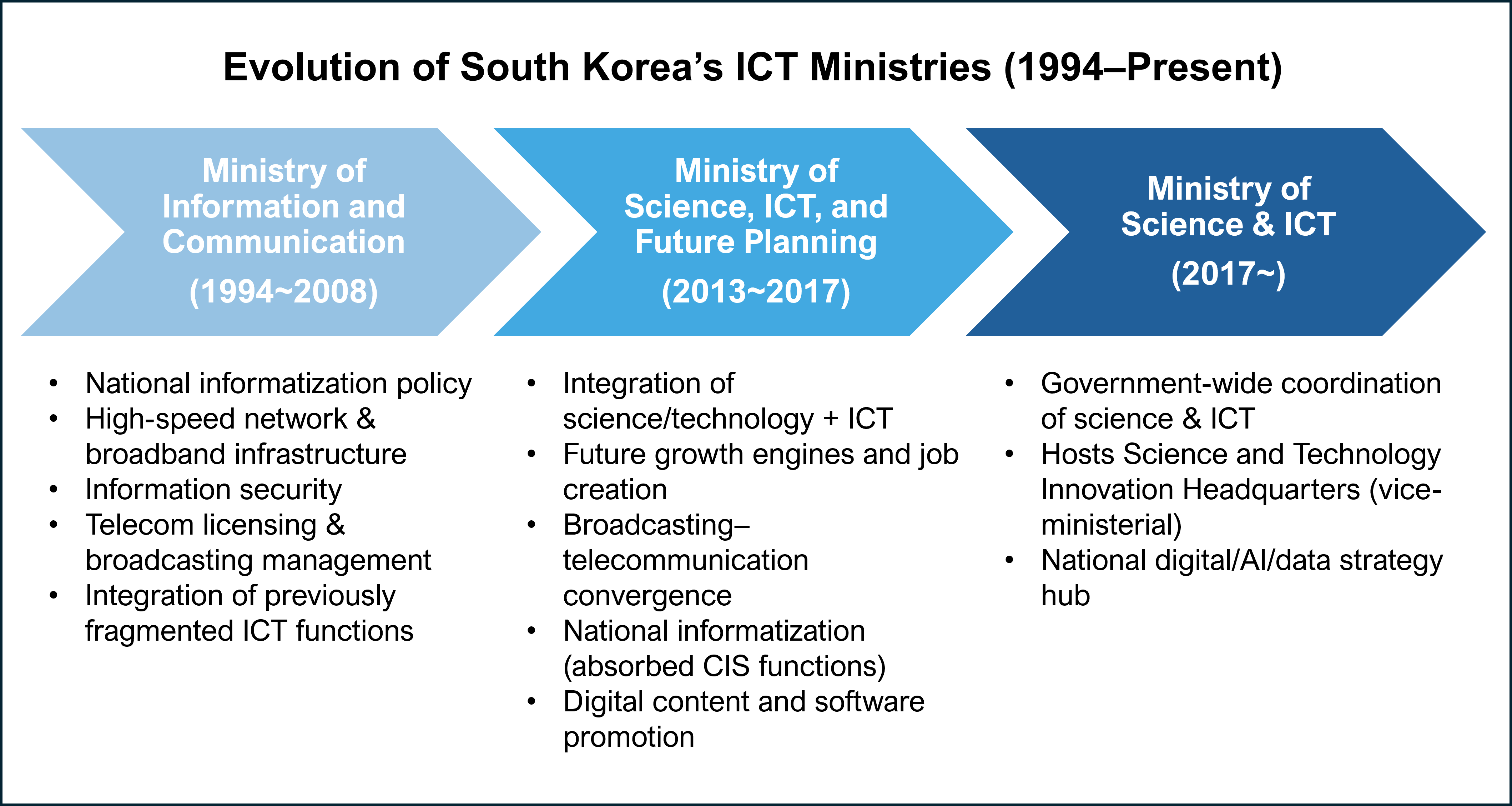
Recognizing the need for a dedicated ministry to promote the information industry and improve administrative services, the Korean government reorganized the existing post office ministry in December 1994 and established the Ministry of Information and Communication. The MIC concentrated various information policies that had previously been dispersed, wielding great power and attracting high-quality officials. Its roles included formulating national informatization policies, managing high-speed networks, protecting information security, licensing carriers, and managing broadcasting policies. This integration enhanced expertise, efficiency, and policy consistency. Until its abolition in 2008, the MIC was key in transforming Korea into an information and communication powerhouse, successfully commercializing the world’s first CDMA mobile communication service and establishing the broadband Internet network.

After the MIC's abolition was widely criticized, the Ministry of Science, ICT, and Future Planning (MISP) was created in 2013 to oversee science/technology and ICT, aiming to identify future growth engines and create jobs. The MISP integrated complex functions, including broadcasting/communication convergence, national informatization, digital contents, and software promotion. Following the transfer of the national informatization function to MISP, the Presidential Council for Informatization Society (CIS) was abolished, and the Special Act on ICT Promotion and Convergence (ICT Special Act) was enacted in 2014 to improve international competitiveness and revitalize convergence. The ICT Special Act mandated the formation of the ICT Strategy Council.

In July 2017, the Ministry of Science, ICT, and Future Planning was reorganized into the Ministry of Science & ICT (MSIT). To strengthen the science and technology control tower and coordinate policies across all ministries, the Science and Technology Innovation Headquarters, a vice-ministerial level body, was newly established within MSIT.

  • Changes in the Control Tower that Coordinated ICT Policies

Formed in 1996 based on the Framework Act on Informatization Promotion, the IPC was chaired by the Prime Minister and included all ministries, intended to comprehensively review and coordinate informatization policies. However, the Ministry of Information and Communication effectively performed the comprehensive coordination function in reality, particularly concerning the Informatization Promotion Fund. As e-government emerged separately, the IPC’s influence lessened, and it was disbanded in August 2009.

The Special Committee for e-Government was formed in January 2001 under the Presidential Commission on Government Innovation. Operating as an independent body reporting to the president, its goal was to coordinate inter-agency collaboration and rapidly complete the e-Government infrastructure. Key principles included integrating interagency initiatives, maximizing information sharing, eliminating overlap of duties, and promoting IT use based on Business Process Reengineering (BPR). The committee completed 11 major e-Government initiatives by 2002.

Established in April 2003, the PCGID promoted e-government as a presidential agenda through its special committee. This special committee developed, deliberated on, and coordinated the e-Government Roadmap projects in the initial stages. The Ministry of Government Administration and Home Affairs (MOGAHA) provided administrative assistance, while the National Information Society Agency (NIA) conducted project management. Promotion of e-government was pursued in cooperation with the presidential office, which created a senior secretary position for innovation management.

Following the dismantling of the MIC, the Presidential Council on Information Society (CIS) was established in January 2009 under the President to serve as the control tower for overseeing and coordinating national ICT projects. Its responsibilities included deliberating on the national informatization master plan, adjusting relevant policies, and fostering information culture. In practice, however, the CIS was not effective, partly because civilian committee members were selected based on reputation rather than expertise, and due to the lack of leadership by President Lee Myung-bak regarding ICT policies, which limited the council's ability to exert strong control over ministerial projects.

Formed in May 2014 based on the ICT Special Act, the ICT Strategy Committee aims to nurture professional manpower, support venture start-ups, and support key industries. The committee gained authority to oversee and organize Korea's national informatization, including the National Informatization Basic Plan, following a 2015 amendment. Its main function is to oversee mid- to long-term ICT strategies and coordinate policy priorities.

The Moon Jae-in administration established the Presidential Committee on the Fourth Industrial Revolution (PCFIR) in 2017, reporting directly to the President. This committee deliberates upon and coordinates important policy matters related to the development of new science and technology (including AI and data technology) and necessary new industries. Its composition includes a chairperson, five relevant ministers, and 25 civilian experts. The PCFIR prepares the groundwork for regulatory and institutional reforms, organizes public campaigns, and fosters ecosystems for new industries (e.g., Smart City and Healthcare). In November 2017, PCFIR announced the “The People-Centered Response Plan for the 4th industrial Revolution to Promote Innovative Growth,” which outlined strategies for securing growth engine technologies, creating infrastructure/ecosystems (hyper-connected networks, data sharing), and preparing for future social changes.

Success Factors derived from the Korean Experience

  • ICT was Selected as a National Agenda

The construction and utilization of ICT require innovation across the nation and society. In Korea, this task was promoted as a national agenda across several governments. From the mid-1990s, the national effort focused on informatization under the motto “Latecomer to Industrialization, but Frontrunner in informatization”. As a result, in 2020, South Korea had the largest share of added-value in the ICT sector among OECD countries, with about 36% of Korea’s total exports attributed to the ICT industry. ICT development was consistently selected as a major national agenda under the five-year single term system.

  • Leading Role of the Government

The Korean government played the largest role in promoting national ICT projects, spanning from the establishment of high-speed information infrastructure in the mid-1990s to the world's first commercialization of 5G in 2019. The government's role was realized through budget support, the enactment of related laws, and the construction of the implementation system. For instance, in 5G commercialization, the government paved the way for an early launch by advancing the spectrum auction date.

  • Implementing the President's Leadership

Presidential leadership converts ICT policy into a presidential agenda and strengthens policy implementation. Many presidents have prioritized informatization, often directly presiding over ICT-related meetings. This interest secured increased budgets and strengthened the status of ICT promotion ministries. Crucially, presidential leadership facilitates the adjustment of policies and the resolution of conflicts that arise between ministries due to the converging fields of ICT policy. This is exemplified by the establishment of ICT policy promotion governance as an organization directly under the president.

  • Composition of a Strong Cross- and Joint Governmental Promotion System

Korea utilized a two-part governance system: 1) establishing a specialized ICT department, and 2) operating a government-wide ICT promotion system in the form of a committee directly controlled by the president. Because ICT policy fuses the work of many ministries, this pan-governmental committee, backed by the president’s leadership, secured the necessary authority to direct and coordinate the ICT tasks of various ministries. This committee approach was consistently used by successive governments to promote policies with strong authority and coordinate inter-ministerial interests.

Notes

  • [1] The ICT Development Index (IDI) is an index published by the United Nations International Telecommunication Union based on internationally agreed information and communication technologies (ICT) indicators. This makes it a valuable tool for benchmarking the most important indicators for measuring the information society. The IDI is a standard tool that governments, operators, development agencies, researchers and others can use to measure the digital divide and compare ICT performance within and across countries. The ICT Development Index is based on 11 ICT indicators, grouped in three clusters: access, use and skills. ITU has been working on the revision of 11 ICT indicators since 2017 to develop new index.
  • [2] The contents of this section are citations from some of the author's recent publications (Chung, 2020a: 204-207).
Author
Choong-sik Chung
Kyungsung University
References
cite this work

Building a Digital Nation: ICT Policy and Governance in South Korea

K-Dev Original
March 12, 2026
This is some text inside of a div block.

Summary

South Korea’s emergence as a global ICT leader reflects sustained investment in digital infrastructure, long-term policy commitment, and adaptive governance reform. Beginning in the 1990s, the government implemented successive national network strategies that expanded from high-speed broadband to ultra-broadband and, more recently, nationwide Giga Internet and early 5G deployment. These efforts were reinforced by comprehensive legal frameworks and dedicated funding mechanisms that ensured continuous support for digital development. Governance structures also evolved as technologies advanced, shifting from early informatization bodies to integrated ICT ministries and high-level coordination committees directly linked to national decision-making. This combination of infrastructure expansion, strategic policymaking, and centralized governance enabled South Korea to transition from limited ICT access to one of the world’s most advanced digital environments.

Key Questions

  • What policy instruments and legal frameworks enabled continuous and stable investment in Korea’s digital infrastructure over multiple decades?
  • What impacts did broadband expansion have on reducing digital gaps?
  • How did funding mechanisms accelerate infrastructure and service growth?

#ICT #digitalization #governance

South Korea has achieved a significant transformation over the last 50 years, emerging as a world-leading country in information and communication, driven by remarkable development in Information and Communication Technology (ICT). In 1960, Korea’s telephone penetration rate was only 0.36 per 100 inhabitants, barely one-tenth of the world average at the time; however, Korea caught up with the world average by 1981. Today, Korea leads the world in broadband Internet access penetration. This emergence as a global leader in ICT—in fields like broadband Internet, semiconductors, and smartphones—is not an accident, but the result of the government specifically targeting this objective. The Korean government's various policy supports played a major role in establishing Korea's world-class information and communication infrastructure. South Korea serves as a leading example of a country rising from a low level of ICT access to one of the highest in the world.

Strategic ICT Development Stages in South Korea

The Republic of Korea has made remarkable progress in ICT over the past 30 years by constantly enforcing strategic policies for network construction. The development of information and communication in Korea can be summarized in three key stages: High-speed Network Strategy (1995–2005), Broadband Network Strategy (2004–2010), and Broadband Convergence Network Strategy (2009–2014).

  • High-speed Network Strategy (1995–2005): Building an Information Super Highway

The initial phase focused on building an Information Super Highway. In 1993, the government sought to build a super highway capable of transmitting multimedia information, including voice, data, and video. The Ministry of Information and Communication (MIC) was launched in 1994 as the authority responsible for promoting informatization. One year later, the MIC developed a comprehensive plan to construct infrastructure for the universal use of broadband ICT services, such as remote education, telemedicine, and telecommuting.

A key component was the Project for Building Korea Information Infrastructure (KII), developed by the MIC and the National Computerization Agency. The KII project aimed to connect all government agencies, local governments, and public institutions with fiber optic cables. Estimated to cost 811.4 billion KRW, the KII was a three-stage project initially scheduled from 1995 to 2010.

The first stage (1995–1997) deployed a fiber optic backbone network across 80 locations nationwide, investing 175.5 billion KRW. This provided broadband services to 15,000 public institutions at a rate 40–50% cheaper than private providers. The second stage (1998–2002) focused on expanding coverage and enhancing network service by transitioning the core network from ATM-based to router-based. The third stage (2003–2005) completed a converged broadband multimedia service transmission network five years ahead of the planned schedule, providing transmission speeds ranging from tens of Gbps to several Tbps.

Between 1996 and 2005, the KII Project expanded network subscribers 19 times and dramatically increased network speed, establishing the basic infrastructure for Korea’s current e-Government. The KII-Government remains key infrastructure for most government organizations.

  • Broadband Network Strategy (2004–2007)

This phase followed a period of rapid broadband growth between 2000 and 2002, where the total number of subscribers increased by 200%, and the household penetration rate rose from 27% to 69%.

In 2004, the government announced the details of a three-stage Broadband Convergence Network (BcN) initiative (2004–2010). BcN was defined as an integrated next-generation network providing seamless, quality-guaranteed broadband multimedia services that converged telecommunications, broadcasting, and the Internet at any time and any place. The initiative planned to provide 50–100Mbps broadband services for fixed subscribers. The BcN was valuable infrastructure which enabled the development and provision of a wide variety of new profit-generating models that integrated broadcasting and communications.

The directions for BcN establishment included: 1) applying broadband on subscriber networks, 2) advancing the transmission network to integrate communications, broadcasting, and the internet, 3) managing the network and establishing a service control network, and 4) developing and providing a wide range of convergence services. The service control plan aimed for an integrated network allowing comprehensive control and management of subscribers and resources, utilizing open technology for service continuity.

The implementation was divided into Stage 1 (2004–2005, foundation formation), Stage 2 (2006–2007, intensive establishment), and Stage 3 (2008–2010, completion). Support mechanisms included promoting new service models, supplying core technologies, operating R&D networks, promoting standardization, and maintaining legal systems.

Through BcN, the government aimed to provide a foundation for participatory democracy using electronic governance services (M-Gov and T-Gov) and governmental surveillance. Furthermore, it sought to establish ubiquitous service environments (u-Learning, u-Healthcare, u-Work) allowing all Koreans to conveniently access high-quality education, welfare, and employment. The goal for 2010 was to provide services to 100 million wired households and 100 million wireless users, while also targeting 67 trillion KRW in related device production and $20.1 billion in export value.

  • Ultra Broadband Convergence Network Strategy (2009–2013)

In January 2009, the government announced a “Medium-to Long-term Plan to Develop the Communications Network” to build the Ultra Broadband Convergence Network (UBcN), meeting future demands for communication services that were experienced, converged, intelligent, and private. This UBcN was an ALL-IP based network, achieving an average speed of 1Gbps for wired services and 10Mbps for wireless, making it 10 times faster than the previous network.

UBcN enabled the Multiple Play Service (MPS), combining telephone, internet, and broadcasting across various environments, such as Service over TV (SoTV) and mobile, often involving ultra-high resolution and two-directional TV. Forecasts suggested this revitalization would bring a "living revolution" by making people’s lives more comfortable and efficient.

South Korea boasts the world’s highest number of broadband services per capita. By 2015, approximately 95% of households and 40% of the population were broadband subscribers, with over 60% using Fiber To The Home (FTTH) or Apartment LANs. Broadband services like e-health, e-learning, e-government, and u-City were developed and demonstrated. By providing services such as e-health to remote island regions, broadband was utilized to narrow the gap among different classes and regions. By 2016, fixed broadband subscribers exceeded 20 million, and market penetration is expected to continue growing, driven by converged solutions like IPTV and Smart Home services.

  • Advancement of Convergence Infrastructure (2014–Present)

Since 2014, following the successful BcN deployment, the Korean government has launched the Giga Internet infrastructure. Preparation had begun in 2009, included as a national task in the ‘Broadcasting Network Mid-to Long Term Development Plan’.

Policies included the K-ICT network development strategy (2016–2020). In 2016, the 'Giga Internet Demonstration Construction and Operation Project' was promoted to increase public awareness and supported seven application services, including super high-definition HDR UHD TV and Giga Smart Home Care. In the initial stage of commercialization, application services requiring 1Gbps speed were lacking, leading the government to encourage both foundation building and application service development simultaneously. In 2017, the government and the private sector planned joint construction to expand coverage in small and mid-sized cities. As Giga Internet service coverage reached 100% in 85 cities nationwide in 2017, the commercialization of 10 gigabit internet began in earnest, with pilot projects launched in March 2018.

In February 2018, the world's first 5G pilot service was launched at the Pyeongchang Winter Olympics. In April 2019, Korea launched the world's first 5G mobile network commercialization service, maintaining its position as a global leader. By 2025, nearly 60 percent of mobile subscriptions in South Korea are expected to be for 5G networks.

The early 5G commercial launch is attributed to the close cooperation among government, carriers and vendors. The government paved the way by advancing the 5G spectrum auction date and forming a 5G Strategy Promotion Committee, while carriers ensured early and successful commercialization with fast deployment and compelling services, such as unlimited data plans.

Law and Institutional Support

Institutional support through laws and budgets has been a critical success factor for Korea's ICT development.

  • The Era of High-speed Network Construction (1990s)

Enactment of the Framework Act on Informatization Promotion (August 1995), enforced on January 1, 1996, served as the basic law of the Korean information legal system. It was enacted to provide the necessary legal and institutional arrangements to consistently and efficiently promote informatization policies across the country, covering the adoption of information technology and the construction of high-speed networks. This law provided the institutional basis for the field of digital government in Korea.

Budgetary support was an important factor for Korea to become a global leader in digital government. Even before formal funds were used, the government supported the sector in the 1980s via “Investment First, Settlement Later,” recognizing the importance of national informatization. Funds, unlike standard budgets, represent an administration’s continuing commitment and are less subject to congressional control.

The ICT Promotion Fund (1993–1995) was initiated in January 1993 to foster the information industry as a national strategic industry. This initial fund (about 100 billion KRW) supported R&D projects like digital mobile communications, and the purchase of domestic host computers and equipment, contributing greatly to the development of mobile communication, memory semiconductors, and Digital Electronic Switching System technology.

The Informatization Promotion Fund (1996–2004) was expanded and reorganized in 1995 with the enactment of the Informatization Promotion Act. It aimed to enhance the quality of life and national economy by promoting informatization, establishing infrastructure, and supporting R&D. During this period, nearly 1 trillion KRW was raised annually, primarily to fund the high-speed information communication infrastructure project. This fund enabled the establishment of a high-speed information network (155M ~ 5Gbps) and was utilized in the e-government projects of the early 2000s. It helped the ICT industry emerge as the core growth engine and created supportive environments (like S/W Support Centers) for IT venture companies. Since 2002, the use of funds was made subject to deliberation by the National Assembly.

  • The Era of Broadband Communication (2000s)

The E-Government Act came into effect on July 1, 2001, making it the first of its kind globally (compared to the US Act in 2002). The Act stipulates: basic principles for e-Government policy, the provision and utilization of e-Government services (including electronic processing of civil services), the construction and utilization of common infrastructure systems (e-documents, administrative digital signatures, hubs), the adoption of information technology architecture, and the efficient management of information resources.

ICT Promotion Fund succeeded the R&D account of the Information Promotion Fund in December 2004. Its resources include government contributions, telecommunications carrier R&D charges, frequency allocation fees, and proceeds from fund management. The fund supports R&D on information and communication, the development and dissemination of standards, personnel training, and the establishment of industry infrastructure.

The results of development supported by this fund include: securing world-class industrial source technology; expanding the growth base of SMEs by supporting technology development in promising areas; achieving standardization success (e.g., adopting 4G mobile communication standards like WiBro and LTE); and investing in master’s and doctoral programs in fields like AI, IOT, and Big Data. The ICT Promotion Fund has contributed greatly to Korea in becoming a global leader in digital government. As of 2019, the fund (approximately 1.2 trillion KRW annually) is managed by the Ministry of Science and ICT (MSIT).

  • The Era of Ubiquitous and IoT (2010s)

The government reorganization of 2008 dismantled the MIC, reflecting a paradigm shift from promoting informatization to focusing on information utilization. In response, the Framework Act on National Informatization was enacted in May 2009 to set the basic philosophy and principles of the new national informatization policy. The purpose is to contribute to the realization of a sustainable knowledge and information based society and improve the nation's quality of life.

  • The Era of Artificial Intelligence and Digital Transformation (2020s)

Recognizing that AI technology and data analysis are crucial factors of national competitiveness, and driven by the need for hyper-connection and intelligent innovation based on Data, Network, and Artificial Intelligence (DNA), the law was amended in June 2020 (effective December 2020). The Framework Act on Intelligent Information aims to contribute to realizing an intelligent information society and securing national competitiveness. This complete reorganization expanded definitions to specifically stipulate basic matters concerning new concepts such as ‘data’ or ‘algorithm’, which were not defined in previous laws, providing grounds for responding to AI-triggered social changes.

ICT Governance Analysis

The governance model for ICT policies in Korea exhibits two primary characteristics: the long-term operation of a dedicated ICT department, and the use of a powerful control tower system to promote government-wide policy.

  • Changes in Government Ministries Dedicated to ICT

Recognizing the need for a dedicated ministry to promote the information industry and improve administrative services, the Korean government reorganized the existing post office ministry in December 1994 and established the Ministry of Information and Communication. The MIC concentrated various information policies that had previously been dispersed, wielding great power and attracting high-quality officials. Its roles included formulating national informatization policies, managing high-speed networks, protecting information security, licensing carriers, and managing broadcasting policies. This integration enhanced expertise, efficiency, and policy consistency. Until its abolition in 2008, the MIC was key in transforming Korea into an information and communication powerhouse, successfully commercializing the world’s first CDMA mobile communication service and establishing the broadband Internet network.

After the MIC's abolition was widely criticized, the Ministry of Science, ICT, and Future Planning (MISP) was created in 2013 to oversee science/technology and ICT, aiming to identify future growth engines and create jobs. The MISP integrated complex functions, including broadcasting/communication convergence, national informatization, digital contents, and software promotion. Following the transfer of the national informatization function to MISP, the Presidential Council for Informatization Society (CIS) was abolished, and the Special Act on ICT Promotion and Convergence (ICT Special Act) was enacted in 2014 to improve international competitiveness and revitalize convergence. The ICT Special Act mandated the formation of the ICT Strategy Council.

In July 2017, the Ministry of Science, ICT, and Future Planning was reorganized into the Ministry of Science & ICT (MSIT). To strengthen the science and technology control tower and coordinate policies across all ministries, the Science and Technology Innovation Headquarters, a vice-ministerial level body, was newly established within MSIT.

  • Changes in the Control Tower that Coordinated ICT Policies

Formed in 1996 based on the Framework Act on Informatization Promotion, the IPC was chaired by the Prime Minister and included all ministries, intended to comprehensively review and coordinate informatization policies. However, the Ministry of Information and Communication effectively performed the comprehensive coordination function in reality, particularly concerning the Informatization Promotion Fund. As e-government emerged separately, the IPC’s influence lessened, and it was disbanded in August 2009.

The Special Committee for e-Government was formed in January 2001 under the Presidential Commission on Government Innovation. Operating as an independent body reporting to the president, its goal was to coordinate inter-agency collaboration and rapidly complete the e-Government infrastructure. Key principles included integrating interagency initiatives, maximizing information sharing, eliminating overlap of duties, and promoting IT use based on Business Process Reengineering (BPR). The committee completed 11 major e-Government initiatives by 2002.

Established in April 2003, the PCGID promoted e-government as a presidential agenda through its special committee. This special committee developed, deliberated on, and coordinated the e-Government Roadmap projects in the initial stages. The Ministry of Government Administration and Home Affairs (MOGAHA) provided administrative assistance, while the National Information Society Agency (NIA) conducted project management. Promotion of e-government was pursued in cooperation with the presidential office, which created a senior secretary position for innovation management.

Following the dismantling of the MIC, the Presidential Council on Information Society (CIS) was established in January 2009 under the President to serve as the control tower for overseeing and coordinating national ICT projects. Its responsibilities included deliberating on the national informatization master plan, adjusting relevant policies, and fostering information culture. In practice, however, the CIS was not effective, partly because civilian committee members were selected based on reputation rather than expertise, and due to the lack of leadership by President Lee Myung-bak regarding ICT policies, which limited the council's ability to exert strong control over ministerial projects.

Formed in May 2014 based on the ICT Special Act, the ICT Strategy Committee aims to nurture professional manpower, support venture start-ups, and support key industries. The committee gained authority to oversee and organize Korea's national informatization, including the National Informatization Basic Plan, following a 2015 amendment. Its main function is to oversee mid- to long-term ICT strategies and coordinate policy priorities.

The Moon Jae-in administration established the Presidential Committee on the Fourth Industrial Revolution (PCFIR) in 2017, reporting directly to the President. This committee deliberates upon and coordinates important policy matters related to the development of new science and technology (including AI and data technology) and necessary new industries. Its composition includes a chairperson, five relevant ministers, and 25 civilian experts. The PCFIR prepares the groundwork for regulatory and institutional reforms, organizes public campaigns, and fosters ecosystems for new industries (e.g., Smart City and Healthcare). In November 2017, PCFIR announced the “The People-Centered Response Plan for the 4th industrial Revolution to Promote Innovative Growth,” which outlined strategies for securing growth engine technologies, creating infrastructure/ecosystems (hyper-connected networks, data sharing), and preparing for future social changes.

Success Factors derived from the Korean Experience

  • ICT was Selected as a National Agenda

The construction and utilization of ICT require innovation across the nation and society. In Korea, this task was promoted as a national agenda across several governments. From the mid-1990s, the national effort focused on informatization under the motto “Latecomer to Industrialization, but Frontrunner in informatization”. As a result, in 2020, South Korea had the largest share of added-value in the ICT sector among OECD countries, with about 36% of Korea’s total exports attributed to the ICT industry. ICT development was consistently selected as a major national agenda under the five-year single term system.

  • Leading Role of the Government

The Korean government played the largest role in promoting national ICT projects, spanning from the establishment of high-speed information infrastructure in the mid-1990s to the world's first commercialization of 5G in 2019. The government's role was realized through budget support, the enactment of related laws, and the construction of the implementation system. For instance, in 5G commercialization, the government paved the way for an early launch by advancing the spectrum auction date.

  • Implementing the President's Leadership

Presidential leadership converts ICT policy into a presidential agenda and strengthens policy implementation. Many presidents have prioritized informatization, often directly presiding over ICT-related meetings. This interest secured increased budgets and strengthened the status of ICT promotion ministries. Crucially, presidential leadership facilitates the adjustment of policies and the resolution of conflicts that arise between ministries due to the converging fields of ICT policy. This is exemplified by the establishment of ICT policy promotion governance as an organization directly under the president.

  • Composition of a Strong Cross- and Joint Governmental Promotion System

Korea utilized a two-part governance system: 1) establishing a specialized ICT department, and 2) operating a government-wide ICT promotion system in the form of a committee directly controlled by the president. Because ICT policy fuses the work of many ministries, this pan-governmental committee, backed by the president’s leadership, secured the necessary authority to direct and coordinate the ICT tasks of various ministries. This committee approach was consistently used by successive governments to promote policies with strong authority and coordinate inter-ministerial interests.

Notes

  • [1] The ICT Development Index (IDI) is an index published by the United Nations International Telecommunication Union based on internationally agreed information and communication technologies (ICT) indicators. This makes it a valuable tool for benchmarking the most important indicators for measuring the information society. The IDI is a standard tool that governments, operators, development agencies, researchers and others can use to measure the digital divide and compare ICT performance within and across countries. The ICT Development Index is based on 11 ICT indicators, grouped in three clusters: access, use and skills. ITU has been working on the revision of 11 ICT indicators since 2017 to develop new index.
  • [2] The contents of this section are citations from some of the author's recent publications (Chung, 2020a: 204-207).
References
Cite this work
.

More to explore from
In Perspective

Building a Digital Nation: ICT Policy and Governance in South Korea

K-Dev Original
March 12, 2026

I am the text that will be copied.

South Korea has achieved a significant transformation over the last 50 years, emerging as a world-leading country in information and communication, driven by remarkable development in Information and Communication Technology (ICT). In 1960, Korea’s telephone penetration rate was only 0.36 per 100 inhabitants, barely one-tenth of the world average at the time; however, Korea caught up with the world average by 1981. Today, Korea leads the world in broadband Internet access penetration. This emergence as a global leader in ICT—in fields like broadband Internet, semiconductors, and smartphones—is not an accident, but the result of the government specifically targeting this objective. The Korean government's various policy supports played a major role in establishing Korea's world-class information and communication infrastructure. South Korea serves as a leading example of a country rising from a low level of ICT access to one of the highest in the world.

Strategic ICT Development Stages in South Korea

The Republic of Korea has made remarkable progress in ICT over the past 30 years by constantly enforcing strategic policies for network construction. The development of information and communication in Korea can be summarized in three key stages: High-speed Network Strategy (1995–2005), Broadband Network Strategy (2004–2010), and Broadband Convergence Network Strategy (2009–2014).

  • High-speed Network Strategy (1995–2005): Building an Information Super Highway

The initial phase focused on building an Information Super Highway. In 1993, the government sought to build a super highway capable of transmitting multimedia information, including voice, data, and video. The Ministry of Information and Communication (MIC) was launched in 1994 as the authority responsible for promoting informatization. One year later, the MIC developed a comprehensive plan to construct infrastructure for the universal use of broadband ICT services, such as remote education, telemedicine, and telecommuting.

A key component was the Project for Building Korea Information Infrastructure (KII), developed by the MIC and the National Computerization Agency. The KII project aimed to connect all government agencies, local governments, and public institutions with fiber optic cables. Estimated to cost 811.4 billion KRW, the KII was a three-stage project initially scheduled from 1995 to 2010.

The first stage (1995–1997) deployed a fiber optic backbone network across 80 locations nationwide, investing 175.5 billion KRW. This provided broadband services to 15,000 public institutions at a rate 40–50% cheaper than private providers. The second stage (1998–2002) focused on expanding coverage and enhancing network service by transitioning the core network from ATM-based to router-based. The third stage (2003–2005) completed a converged broadband multimedia service transmission network five years ahead of the planned schedule, providing transmission speeds ranging from tens of Gbps to several Tbps.

Between 1996 and 2005, the KII Project expanded network subscribers 19 times and dramatically increased network speed, establishing the basic infrastructure for Korea’s current e-Government. The KII-Government remains key infrastructure for most government organizations.

  • Broadband Network Strategy (2004–2007)

This phase followed a period of rapid broadband growth between 2000 and 2002, where the total number of subscribers increased by 200%, and the household penetration rate rose from 27% to 69%.

In 2004, the government announced the details of a three-stage Broadband Convergence Network (BcN) initiative (2004–2010). BcN was defined as an integrated next-generation network providing seamless, quality-guaranteed broadband multimedia services that converged telecommunications, broadcasting, and the Internet at any time and any place. The initiative planned to provide 50–100Mbps broadband services for fixed subscribers. The BcN was valuable infrastructure which enabled the development and provision of a wide variety of new profit-generating models that integrated broadcasting and communications.

The directions for BcN establishment included: 1) applying broadband on subscriber networks, 2) advancing the transmission network to integrate communications, broadcasting, and the internet, 3) managing the network and establishing a service control network, and 4) developing and providing a wide range of convergence services. The service control plan aimed for an integrated network allowing comprehensive control and management of subscribers and resources, utilizing open technology for service continuity.

The implementation was divided into Stage 1 (2004–2005, foundation formation), Stage 2 (2006–2007, intensive establishment), and Stage 3 (2008–2010, completion). Support mechanisms included promoting new service models, supplying core technologies, operating R&D networks, promoting standardization, and maintaining legal systems.

Through BcN, the government aimed to provide a foundation for participatory democracy using electronic governance services (M-Gov and T-Gov) and governmental surveillance. Furthermore, it sought to establish ubiquitous service environments (u-Learning, u-Healthcare, u-Work) allowing all Koreans to conveniently access high-quality education, welfare, and employment. The goal for 2010 was to provide services to 100 million wired households and 100 million wireless users, while also targeting 67 trillion KRW in related device production and $20.1 billion in export value.

  • Ultra Broadband Convergence Network Strategy (2009–2013)

In January 2009, the government announced a “Medium-to Long-term Plan to Develop the Communications Network” to build the Ultra Broadband Convergence Network (UBcN), meeting future demands for communication services that were experienced, converged, intelligent, and private. This UBcN was an ALL-IP based network, achieving an average speed of 1Gbps for wired services and 10Mbps for wireless, making it 10 times faster than the previous network.

UBcN enabled the Multiple Play Service (MPS), combining telephone, internet, and broadcasting across various environments, such as Service over TV (SoTV) and mobile, often involving ultra-high resolution and two-directional TV. Forecasts suggested this revitalization would bring a "living revolution" by making people’s lives more comfortable and efficient.

South Korea boasts the world’s highest number of broadband services per capita. By 2015, approximately 95% of households and 40% of the population were broadband subscribers, with over 60% using Fiber To The Home (FTTH) or Apartment LANs. Broadband services like e-health, e-learning, e-government, and u-City were developed and demonstrated. By providing services such as e-health to remote island regions, broadband was utilized to narrow the gap among different classes and regions. By 2016, fixed broadband subscribers exceeded 20 million, and market penetration is expected to continue growing, driven by converged solutions like IPTV and Smart Home services.

  • Advancement of Convergence Infrastructure (2014–Present)

Since 2014, following the successful BcN deployment, the Korean government has launched the Giga Internet infrastructure. Preparation had begun in 2009, included as a national task in the ‘Broadcasting Network Mid-to Long Term Development Plan’.

Policies included the K-ICT network development strategy (2016–2020). In 2016, the 'Giga Internet Demonstration Construction and Operation Project' was promoted to increase public awareness and supported seven application services, including super high-definition HDR UHD TV and Giga Smart Home Care. In the initial stage of commercialization, application services requiring 1Gbps speed were lacking, leading the government to encourage both foundation building and application service development simultaneously. In 2017, the government and the private sector planned joint construction to expand coverage in small and mid-sized cities. As Giga Internet service coverage reached 100% in 85 cities nationwide in 2017, the commercialization of 10 gigabit internet began in earnest, with pilot projects launched in March 2018.

In February 2018, the world's first 5G pilot service was launched at the Pyeongchang Winter Olympics. In April 2019, Korea launched the world's first 5G mobile network commercialization service, maintaining its position as a global leader. By 2025, nearly 60 percent of mobile subscriptions in South Korea are expected to be for 5G networks.

The early 5G commercial launch is attributed to the close cooperation among government, carriers and vendors. The government paved the way by advancing the 5G spectrum auction date and forming a 5G Strategy Promotion Committee, while carriers ensured early and successful commercialization with fast deployment and compelling services, such as unlimited data plans.

Law and Institutional Support

Institutional support through laws and budgets has been a critical success factor for Korea's ICT development.

  • The Era of High-speed Network Construction (1990s)

Enactment of the Framework Act on Informatization Promotion (August 1995), enforced on January 1, 1996, served as the basic law of the Korean information legal system. It was enacted to provide the necessary legal and institutional arrangements to consistently and efficiently promote informatization policies across the country, covering the adoption of information technology and the construction of high-speed networks. This law provided the institutional basis for the field of digital government in Korea.

Budgetary support was an important factor for Korea to become a global leader in digital government. Even before formal funds were used, the government supported the sector in the 1980s via “Investment First, Settlement Later,” recognizing the importance of national informatization. Funds, unlike standard budgets, represent an administration’s continuing commitment and are less subject to congressional control.

The ICT Promotion Fund (1993–1995) was initiated in January 1993 to foster the information industry as a national strategic industry. This initial fund (about 100 billion KRW) supported R&D projects like digital mobile communications, and the purchase of domestic host computers and equipment, contributing greatly to the development of mobile communication, memory semiconductors, and Digital Electronic Switching System technology.

The Informatization Promotion Fund (1996–2004) was expanded and reorganized in 1995 with the enactment of the Informatization Promotion Act. It aimed to enhance the quality of life and national economy by promoting informatization, establishing infrastructure, and supporting R&D. During this period, nearly 1 trillion KRW was raised annually, primarily to fund the high-speed information communication infrastructure project. This fund enabled the establishment of a high-speed information network (155M ~ 5Gbps) and was utilized in the e-government projects of the early 2000s. It helped the ICT industry emerge as the core growth engine and created supportive environments (like S/W Support Centers) for IT venture companies. Since 2002, the use of funds was made subject to deliberation by the National Assembly.

  • The Era of Broadband Communication (2000s)

The E-Government Act came into effect on July 1, 2001, making it the first of its kind globally (compared to the US Act in 2002). The Act stipulates: basic principles for e-Government policy, the provision and utilization of e-Government services (including electronic processing of civil services), the construction and utilization of common infrastructure systems (e-documents, administrative digital signatures, hubs), the adoption of information technology architecture, and the efficient management of information resources.

ICT Promotion Fund succeeded the R&D account of the Information Promotion Fund in December 2004. Its resources include government contributions, telecommunications carrier R&D charges, frequency allocation fees, and proceeds from fund management. The fund supports R&D on information and communication, the development and dissemination of standards, personnel training, and the establishment of industry infrastructure.

The results of development supported by this fund include: securing world-class industrial source technology; expanding the growth base of SMEs by supporting technology development in promising areas; achieving standardization success (e.g., adopting 4G mobile communication standards like WiBro and LTE); and investing in master’s and doctoral programs in fields like AI, IOT, and Big Data. The ICT Promotion Fund has contributed greatly to Korea in becoming a global leader in digital government. As of 2019, the fund (approximately 1.2 trillion KRW annually) is managed by the Ministry of Science and ICT (MSIT).

  • The Era of Ubiquitous and IoT (2010s)

The government reorganization of 2008 dismantled the MIC, reflecting a paradigm shift from promoting informatization to focusing on information utilization. In response, the Framework Act on National Informatization was enacted in May 2009 to set the basic philosophy and principles of the new national informatization policy. The purpose is to contribute to the realization of a sustainable knowledge and information based society and improve the nation's quality of life.

  • The Era of Artificial Intelligence and Digital Transformation (2020s)

Recognizing that AI technology and data analysis are crucial factors of national competitiveness, and driven by the need for hyper-connection and intelligent innovation based on Data, Network, and Artificial Intelligence (DNA), the law was amended in June 2020 (effective December 2020). The Framework Act on Intelligent Information aims to contribute to realizing an intelligent information society and securing national competitiveness. This complete reorganization expanded definitions to specifically stipulate basic matters concerning new concepts such as ‘data’ or ‘algorithm’, which were not defined in previous laws, providing grounds for responding to AI-triggered social changes.

ICT Governance Analysis

The governance model for ICT policies in Korea exhibits two primary characteristics: the long-term operation of a dedicated ICT department, and the use of a powerful control tower system to promote government-wide policy.

  • Changes in Government Ministries Dedicated to ICT

Recognizing the need for a dedicated ministry to promote the information industry and improve administrative services, the Korean government reorganized the existing post office ministry in December 1994 and established the Ministry of Information and Communication. The MIC concentrated various information policies that had previously been dispersed, wielding great power and attracting high-quality officials. Its roles included formulating national informatization policies, managing high-speed networks, protecting information security, licensing carriers, and managing broadcasting policies. This integration enhanced expertise, efficiency, and policy consistency. Until its abolition in 2008, the MIC was key in transforming Korea into an information and communication powerhouse, successfully commercializing the world’s first CDMA mobile communication service and establishing the broadband Internet network.

After the MIC's abolition was widely criticized, the Ministry of Science, ICT, and Future Planning (MISP) was created in 2013 to oversee science/technology and ICT, aiming to identify future growth engines and create jobs. The MISP integrated complex functions, including broadcasting/communication convergence, national informatization, digital contents, and software promotion. Following the transfer of the national informatization function to MISP, the Presidential Council for Informatization Society (CIS) was abolished, and the Special Act on ICT Promotion and Convergence (ICT Special Act) was enacted in 2014 to improve international competitiveness and revitalize convergence. The ICT Special Act mandated the formation of the ICT Strategy Council.

In July 2017, the Ministry of Science, ICT, and Future Planning was reorganized into the Ministry of Science & ICT (MSIT). To strengthen the science and technology control tower and coordinate policies across all ministries, the Science and Technology Innovation Headquarters, a vice-ministerial level body, was newly established within MSIT.

  • Changes in the Control Tower that Coordinated ICT Policies

Formed in 1996 based on the Framework Act on Informatization Promotion, the IPC was chaired by the Prime Minister and included all ministries, intended to comprehensively review and coordinate informatization policies. However, the Ministry of Information and Communication effectively performed the comprehensive coordination function in reality, particularly concerning the Informatization Promotion Fund. As e-government emerged separately, the IPC’s influence lessened, and it was disbanded in August 2009.

The Special Committee for e-Government was formed in January 2001 under the Presidential Commission on Government Innovation. Operating as an independent body reporting to the president, its goal was to coordinate inter-agency collaboration and rapidly complete the e-Government infrastructure. Key principles included integrating interagency initiatives, maximizing information sharing, eliminating overlap of duties, and promoting IT use based on Business Process Reengineering (BPR). The committee completed 11 major e-Government initiatives by 2002.

Established in April 2003, the PCGID promoted e-government as a presidential agenda through its special committee. This special committee developed, deliberated on, and coordinated the e-Government Roadmap projects in the initial stages. The Ministry of Government Administration and Home Affairs (MOGAHA) provided administrative assistance, while the National Information Society Agency (NIA) conducted project management. Promotion of e-government was pursued in cooperation with the presidential office, which created a senior secretary position for innovation management.

Following the dismantling of the MIC, the Presidential Council on Information Society (CIS) was established in January 2009 under the President to serve as the control tower for overseeing and coordinating national ICT projects. Its responsibilities included deliberating on the national informatization master plan, adjusting relevant policies, and fostering information culture. In practice, however, the CIS was not effective, partly because civilian committee members were selected based on reputation rather than expertise, and due to the lack of leadership by President Lee Myung-bak regarding ICT policies, which limited the council's ability to exert strong control over ministerial projects.

Formed in May 2014 based on the ICT Special Act, the ICT Strategy Committee aims to nurture professional manpower, support venture start-ups, and support key industries. The committee gained authority to oversee and organize Korea's national informatization, including the National Informatization Basic Plan, following a 2015 amendment. Its main function is to oversee mid- to long-term ICT strategies and coordinate policy priorities.

The Moon Jae-in administration established the Presidential Committee on the Fourth Industrial Revolution (PCFIR) in 2017, reporting directly to the President. This committee deliberates upon and coordinates important policy matters related to the development of new science and technology (including AI and data technology) and necessary new industries. Its composition includes a chairperson, five relevant ministers, and 25 civilian experts. The PCFIR prepares the groundwork for regulatory and institutional reforms, organizes public campaigns, and fosters ecosystems for new industries (e.g., Smart City and Healthcare). In November 2017, PCFIR announced the “The People-Centered Response Plan for the 4th industrial Revolution to Promote Innovative Growth,” which outlined strategies for securing growth engine technologies, creating infrastructure/ecosystems (hyper-connected networks, data sharing), and preparing for future social changes.

Success Factors derived from the Korean Experience

  • ICT was Selected as a National Agenda

The construction and utilization of ICT require innovation across the nation and society. In Korea, this task was promoted as a national agenda across several governments. From the mid-1990s, the national effort focused on informatization under the motto “Latecomer to Industrialization, but Frontrunner in informatization”. As a result, in 2020, South Korea had the largest share of added-value in the ICT sector among OECD countries, with about 36% of Korea’s total exports attributed to the ICT industry. ICT development was consistently selected as a major national agenda under the five-year single term system.

  • Leading Role of the Government

The Korean government played the largest role in promoting national ICT projects, spanning from the establishment of high-speed information infrastructure in the mid-1990s to the world's first commercialization of 5G in 2019. The government's role was realized through budget support, the enactment of related laws, and the construction of the implementation system. For instance, in 5G commercialization, the government paved the way for an early launch by advancing the spectrum auction date.

  • Implementing the President's Leadership

Presidential leadership converts ICT policy into a presidential agenda and strengthens policy implementation. Many presidents have prioritized informatization, often directly presiding over ICT-related meetings. This interest secured increased budgets and strengthened the status of ICT promotion ministries. Crucially, presidential leadership facilitates the adjustment of policies and the resolution of conflicts that arise between ministries due to the converging fields of ICT policy. This is exemplified by the establishment of ICT policy promotion governance as an organization directly under the president.

  • Composition of a Strong Cross- and Joint Governmental Promotion System

Korea utilized a two-part governance system: 1) establishing a specialized ICT department, and 2) operating a government-wide ICT promotion system in the form of a committee directly controlled by the president. Because ICT policy fuses the work of many ministries, this pan-governmental committee, backed by the president’s leadership, secured the necessary authority to direct and coordinate the ICT tasks of various ministries. This committee approach was consistently used by successive governments to promote policies with strong authority and coordinate inter-ministerial interests.

Notes

  • [1] The ICT Development Index (IDI) is an index published by the United Nations International Telecommunication Union based on internationally agreed information and communication technologies (ICT) indicators. This makes it a valuable tool for benchmarking the most important indicators for measuring the information society. The IDI is a standard tool that governments, operators, development agencies, researchers and others can use to measure the digital divide and compare ICT performance within and across countries. The ICT Development Index is based on 11 ICT indicators, grouped in three clusters: access, use and skills. ITU has been working on the revision of 11 ICT indicators since 2017 to develop new index.
  • [2] The contents of this section are citations from some of the author's recent publications (Chung, 2020a: 204-207).
References
Cite this work
.

More to explore from
In Perspective