

Effective disaster management systems must ensure the timely acquisition, analysis, and communication of risk information, as these functions underpin anticipation, coordination, and response during emergencies. Core digital technologies such as the Internet of Things (IoT), cloud computing, big data analytics, and mobile communication networks are utilized in Korea to support real-time hazard monitoring and inter-agency coordination within the National Disaster Management System (NDMS). These digital foundations have enabled both government-led innovations and collaborative public–civic initiatives that enhance information accessibility and responsiveness during crises. However, implementation challenges persist, particularly in translating complex real-world conditions into reliable predictive signals and ensuring continuity of technical expertise. These limitations point to the need for governance reform that reinforces institutional coordination and operational capacity while advancing technological innovation. Strengthening collaboration among state agencies, private sector innovators, and civil society actors is essential to build a disaster management system that is both technologically advanced and socially resilient.
Tags #disaster management #digitalization #governance #risk reduction
Accurate disaster management information is essential for effective disaster management. Information and communication systems that support decision-making by collecting and analyzing disaster situation information are the most important social infrastructure for predicting disaster situations. Korea employs IoT, cloud, big data, and mobile technologies to monitor disaster risks in real time and facilitate coordinated response.
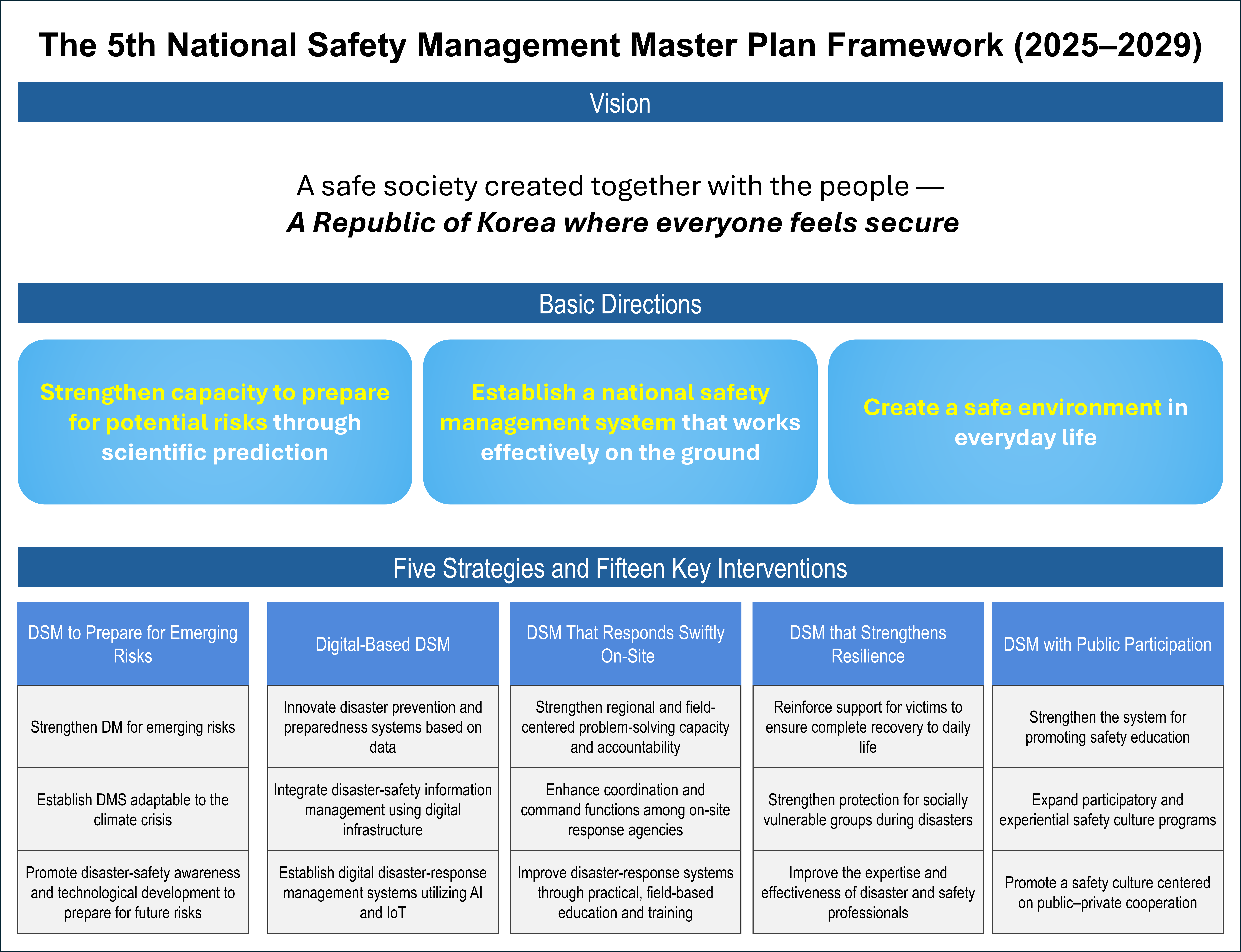
The country's disaster management planning has evolved significantly since the launch of the National Emergency Management Agency in 2005, which integrated separate plans for natural and human-caused disasters into a unified national strategy. This evolution continues with the current 5th National Safety Management Basic Plan (2025-2029), whose framework sets a clear direction by focusing on three key pillars: strengthening predictive capabilities through scientific analysis, establishing a field-operative national safety management system, and creating a safe living environment in daily life.
In order to support the safety management, the National Disaster Management System (NDMS) that collects, analyzes, and administratively manages various information on natural and social disasters is utilized. NDMS provides disaster safety services to the public by informatizing the entire process of 119 services, including systematic prevention, preparedness, rapid response, recovery work support, and fire/rescue first aid.
The central government and local governments use NDMS to perform disaster management tasks such as disaster damage situation management and recovery support. This disaster management system has three main functions. First, it performs a disaster detection function. Disaster situation information is derived from data collected and analyzed through constant monitoring of various disaster information such as weather information and observation information (water level, precipitation, and CCTV). The second function is situational propagation. NDMS distributes real-time information on disaster situations as well as response instructions to public institutions and the public. The third is the operational support function. The system provides various administrative support for step-by-step operation for disaster management, wind and flood damage insurance, and disaster management resources.
The architecture of the NDMS is built on a government cloud (G-cloud) foundation and is comprised of a series of interconnected portals and applications designed for different user groups. The National Disaster Management System Portal is a comprehensive business system for disaster management personnel, utilizing Geographic Information Systems (GIS) for integrated situation management and support. The Mobile Disaster Management Portal extends key services to on-site personnel, enabling field inspections and emergency contact management. Fulfilling a legal mandate, the public-facing National Disaster and Safety Portal (safekorea.go.kr) provides citizens with comprehensive safety information, including action tips and shelter locations.

Beyond reactive crisis communication, South Korea's digital ecosystem includes several key platforms designed to create the "safe living environment" envisioned in its national plan. An Integrated Safety Information Management System collects and discloses safety inspection results from various agencies, allowing the public to make informed decisions about multi-use facilities.
This data, along with information from 20 central ministries, feeds the Living Safety Map (safemap.go.kr), a public service providing geospatial information across eight key areas: traffic, disasters, public security, customized safety for vulnerable groups, facilities, industry, health, and accidents. This platform also displays the Regional Safety Index, a governance tool that grades municipalities from 1 (safest) to 5 on their performance in areas like fire, crime, and natural disasters, encouraging autonomous local improvement. A key component of this civic engagement is the Safety Report (safetyreport.go.kr), a system that allows citizens to report safety risks in their communities by submitting photos or videos, which are then routed to the appropriate agencies for action.
Underpinning this entire digital ecosystem, disaster management information is collected and managed using core digital technologies such as the Internet of Things (IoT), cloud, big data, and mobile. The Internet of Things (IoT) connects physical objects by embedding them with sensors. Cloud computing provides on-demand data storage and computing power. Big data refers to technologies that extract value from massive, often unstructured data sets. Finally, mobile technology delivers these information services through smartphones. The integration of these technologies forms the digital backbone of Korea's disaster management infrastructure, setting the stage for more advanced, data-driven applications.
Leveraging big data and artificial intelligence (AI) is central to effective disaster management, enabling authorities to predict potential risks and mitigate damage. Representative forms of big data include diverse visual and spatial datasets such as satellite imagery, aerial and drone footage, numerical maps, and three-dimensional building models. Through information and communication technology (ICT), these data sources are continuously collected and analyzed to predict disaster risk phenomena and to support the rapid and coordinated response of disaster management agencies.
The utilization of big data in disaster management follows a dual methodology. During normal times, it is used for prediction and risk analysis, with platforms analyzing monitoring data to identify potential hazards. In the event of a disaster, the focus shifts to real-time response, where information is used to build emergency geospatial data sets that guide decision-making. A key enabler of this is the disaster safety information sharing platform, which collects, standardizes, and shares high-quality data from various organizations to ensure interoperability and support rapid, rational decision-making.
A prime example of a big data-based prediction system is the Smart Road Lighting Platform. This multi-ministerial initiative aims to replace simple street lights with an advanced, ICT-converged platform using IoT, AI, and CCTV big data to provide accident prediction and warning services. The project is a collaboration between four key ministries:
This platform is based on "Smart Safety Lighting Technology," which uses lighting to make people aware of danger. This concept involves four key functions: detecting risks using sensor data, sending signals to smartphones or street lights, providing visual warnings through colored or flashing lights, and guiding people to safety.
The tangible benefits of this platform are expected to be significant. It is projected to contribute to a dramatic reduction in the number of casualties from traffic accidents, which amounted to approximately 345,000 people per year as of 2019. Furthermore, by replacing conventional street lights with controlled LED lamps, the system can achieve energy savings of 50-80%. While these government-led initiatives are advancing the frontier of disaster prediction, a real-world crisis demonstrated that synergy between the public and private sectors is equally essential for operational resilience.
Agility and scalability are paramount in a national crisis, and the COVID-19 pandemic stress-tested public infrastructure in unprecedented ways. This experience revealed the immense value of public-private cooperation and the power of empowering citizen-led innovation to solve problems at a scale the government could not manage alone.
In February 2020, as public demand for information on mask availability surged, government systems were overwhelmed and failed. This was not an isolated incident; similar failures occurred during the 2016 Pohang Earthquake when citizens flooded the Ministry of the Interior and Safety's portal. This time, however, the solution came not from government infrastructure, but from a partnership with private technology and citizen developers.
To solve the mask information crisis, the Korea Information Society Agency provided public mask sales data as a free cloud API, enabling 83 web and app services to operate smoothly even under the strain of 50 million citizens seeking information. Citizen-led initiatives like Mask Lion, Corona Info, and Corona Map emerged, providing stable and accessible services to millions without obstacles. These private developers achieved rapid deployment and significant cost savings; for example, the college student who developed Corona Map operated a service with two million daily views while paying server costs from his own funds, saving an estimated KRW 480 million per month in potential public expense.
.png)
Building on this success, a "public-private cooperation-based crisis response cloud platform" was planned for 2022. This platform is designed with a dual purpose: during normal times, it will serve as a creative digital space for civic hacking groups and startups to solve social issues. In a crisis, it will convert into a joint digital response space for citizens, businesses, and government. A potential application is a wildfire response service, where citizens and ICT experts could develop apps to collect and share real-time information from a fire scene to support suppression efforts. This successful collaboration model highlights the power of partnership, yet it does not eliminate the persistent challenges that emerge at the last mile of implementation.
While high-level data platforms show promise, the last mile of implementation—instrumenting the physical world—reveals critical gaps between strategic intent and operational reality. Translating sensor data from complex environments, such as steep slopes prone to collapse, into reliable, actionable warnings presents significant technical and organizational hurdles.
The "continuous monitoring system" for national highway slopes serves as a telling case study. From 2002 to 2012, more than KRW 20 billion was invested in this system, which uses a network of sensors (GPS, displacement gauges, rainfall gauges) and data loggers to detect instability. Despite this substantial investment, its success rate was limited, with risk predictions being issued for only 15% of the monitored sites.
Analysis reveals three primary problems:
The 2017 Pohang Earthquake highlighted these issues when an "automatic unmanned detection system" for ground movement caused significant social confusion. It was unclear whether changes in sensor data were due to a genuine risk of collapse or a device malfunction, leading to public anxiety. Despite these difficulties, the ultimate purpose of such systems remains vital: to realistically support the safety of citizens, such as evacuation of citizens and vehicle detours in situations where it is difficult to remove instability factors on steep slopes. These specific technical challenges point to broader strategic and structural lessons learned from Korea's entire experience.
A strategic reflection on South Korea's disaster management journey reveals that the most critical lessons extend beyond technology to the realms of governance, partnership, and the role of civil society. Building a truly resilient nation requires more than advanced systems; it demands an integrated and collaborative social framework.
South Korea's government-led disaster management system stands in contrast to the approach in the United States, which is based on the National Disaster Response Framework (NRF) and integrates the public and private sectors into a single, unified system. A core limitation identified in Korea's framework is the undervaluation of the private civil society sector in its disaster response framework. Unlike in other developed countries where the roles of government and civil society are clearly separated and cooperative, the authority and responsibility for civil society in Korea remain unclear.
The government must acknowledge the limitations of its ability to handle increasingly complex and large-scale disasters alone. The critical next step for South Korea is to architect a new "operating model" for disaster response—one where cooperative governance is not an afterthought but the central design principle. This involves creating formal frameworks that empower civic tech, integrate private sector capabilities, and define clear roles and responsibilities for all stakeholders.
Ultimately, for South Korea to build on its impressive technological infrastructure and create a truly resilient society, it must evolve its governance model. This requires establishing a more systematic and integrated disaster management system where the government, corporations, and civic groups work in close partnership, each contributing their unique strengths to the shared goal of public safety.

Effective disaster management systems must ensure the timely acquisition, analysis, and communication of risk information, as these functions underpin anticipation, coordination, and response during emergencies. Core digital technologies such as the Internet of Things (IoT), cloud computing, big data analytics, and mobile communication networks are utilized in Korea to support real-time hazard monitoring and inter-agency coordination within the National Disaster Management System (NDMS). These digital foundations have enabled both government-led innovations and collaborative public–civic initiatives that enhance information accessibility and responsiveness during crises. However, implementation challenges persist, particularly in translating complex real-world conditions into reliable predictive signals and ensuring continuity of technical expertise. These limitations point to the need for governance reform that reinforces institutional coordination and operational capacity while advancing technological innovation. Strengthening collaboration among state agencies, private sector innovators, and civil society actors is essential to build a disaster management system that is both technologically advanced and socially resilient.
Tags #disaster management #digitalization #governance #risk reduction
Accurate disaster management information is essential for effective disaster management. Information and communication systems that support decision-making by collecting and analyzing disaster situation information are the most important social infrastructure for predicting disaster situations. Korea employs IoT, cloud, big data, and mobile technologies to monitor disaster risks in real time and facilitate coordinated response.
The country's disaster management planning has evolved significantly since the launch of the National Emergency Management Agency in 2005, which integrated separate plans for natural and human-caused disasters into a unified national strategy. This evolution continues with the current 5th National Safety Management Basic Plan (2025-2029), whose framework sets a clear direction by focusing on three key pillars: strengthening predictive capabilities through scientific analysis, establishing a field-operative national safety management system, and creating a safe living environment in daily life.
In order to support the safety management, the National Disaster Management System (NDMS) that collects, analyzes, and administratively manages various information on natural and social disasters is utilized. NDMS provides disaster safety services to the public by informatizing the entire process of 119 services, including systematic prevention, preparedness, rapid response, recovery work support, and fire/rescue first aid.
The central government and local governments use NDMS to perform disaster management tasks such as disaster damage situation management and recovery support. This disaster management system has three main functions. First, it performs a disaster detection function. Disaster situation information is derived from data collected and analyzed through constant monitoring of various disaster information such as weather information and observation information (water level, precipitation, and CCTV). The second function is situational propagation. NDMS distributes real-time information on disaster situations as well as response instructions to public institutions and the public. The third is the operational support function. The system provides various administrative support for step-by-step operation for disaster management, wind and flood damage insurance, and disaster management resources.

The architecture of the NDMS is built on a government cloud (G-cloud) foundation and is comprised of a series of interconnected portals and applications designed for different user groups. The National Disaster Management System Portal is a comprehensive business system for disaster management personnel, utilizing Geographic Information Systems (GIS) for integrated situation management and support. The Mobile Disaster Management Portal extends key services to on-site personnel, enabling field inspections and emergency contact management. Fulfilling a legal mandate, the public-facing National Disaster and Safety Portal (safekorea.go.kr) provides citizens with comprehensive safety information, including action tips and shelter locations.

Beyond reactive crisis communication, South Korea's digital ecosystem includes several key platforms designed to create the "safe living environment" envisioned in its national plan. An Integrated Safety Information Management System collects and discloses safety inspection results from various agencies, allowing the public to make informed decisions about multi-use facilities.
This data, along with information from 20 central ministries, feeds the Living Safety Map (safemap.go.kr), a public service providing geospatial information across eight key areas: traffic, disasters, public security, customized safety for vulnerable groups, facilities, industry, health, and accidents. This platform also displays the Regional Safety Index, a governance tool that grades municipalities from 1 (safest) to 5 on their performance in areas like fire, crime, and natural disasters, encouraging autonomous local improvement. A key component of this civic engagement is the Safety Report (safetyreport.go.kr), a system that allows citizens to report safety risks in their communities by submitting photos or videos, which are then routed to the appropriate agencies for action.
Underpinning this entire digital ecosystem, disaster management information is collected and managed using core digital technologies such as the Internet of Things (IoT), cloud, big data, and mobile. The Internet of Things (IoT) connects physical objects by embedding them with sensors. Cloud computing provides on-demand data storage and computing power. Big data refers to technologies that extract value from massive, often unstructured data sets. Finally, mobile technology delivers these information services through smartphones. The integration of these technologies forms the digital backbone of Korea's disaster management infrastructure, setting the stage for more advanced, data-driven applications.
Leveraging big data and artificial intelligence (AI) is central to effective disaster management, enabling authorities to predict potential risks and mitigate damage. Representative forms of big data include diverse visual and spatial datasets such as satellite imagery, aerial and drone footage, numerical maps, and three-dimensional building models. Through information and communication technology (ICT), these data sources are continuously collected and analyzed to predict disaster risk phenomena and to support the rapid and coordinated response of disaster management agencies.
The utilization of big data in disaster management follows a dual methodology. During normal times, it is used for prediction and risk analysis, with platforms analyzing monitoring data to identify potential hazards. In the event of a disaster, the focus shifts to real-time response, where information is used to build emergency geospatial data sets that guide decision-making. A key enabler of this is the disaster safety information sharing platform, which collects, standardizes, and shares high-quality data from various organizations to ensure interoperability and support rapid, rational decision-making.
A prime example of a big data-based prediction system is the Smart Road Lighting Platform. This multi-ministerial initiative aims to replace simple street lights with an advanced, ICT-converged platform using IoT, AI, and CCTV big data to provide accident prediction and warning services. The project is a collaboration between four key ministries:
This platform is based on "Smart Safety Lighting Technology," which uses lighting to make people aware of danger. This concept involves four key functions: detecting risks using sensor data, sending signals to smartphones or street lights, providing visual warnings through colored or flashing lights, and guiding people to safety.
The tangible benefits of this platform are expected to be significant. It is projected to contribute to a dramatic reduction in the number of casualties from traffic accidents, which amounted to approximately 345,000 people per year as of 2019. Furthermore, by replacing conventional street lights with controlled LED lamps, the system can achieve energy savings of 50-80%. While these government-led initiatives are advancing the frontier of disaster prediction, a real-world crisis demonstrated that synergy between the public and private sectors is equally essential for operational resilience.
Agility and scalability are paramount in a national crisis, and the COVID-19 pandemic stress-tested public infrastructure in unprecedented ways. This experience revealed the immense value of public-private cooperation and the power of empowering citizen-led innovation to solve problems at a scale the government could not manage alone.
In February 2020, as public demand for information on mask availability surged, government systems were overwhelmed and failed. This was not an isolated incident; similar failures occurred during the 2016 Pohang Earthquake when citizens flooded the Ministry of the Interior and Safety's portal. This time, however, the solution came not from government infrastructure, but from a partnership with private technology and citizen developers.
To solve the mask information crisis, the Korea Information Society Agency provided public mask sales data as a free cloud API, enabling 83 web and app services to operate smoothly even under the strain of 50 million citizens seeking information. Citizen-led initiatives like Mask Lion, Corona Info, and Corona Map emerged, providing stable and accessible services to millions without obstacles. These private developers achieved rapid deployment and significant cost savings; for example, the college student who developed Corona Map operated a service with two million daily views while paying server costs from his own funds, saving an estimated KRW 480 million per month in potential public expense.
.png)
Building on this success, a "public-private cooperation-based crisis response cloud platform" was planned for 2022. This platform is designed with a dual purpose: during normal times, it will serve as a creative digital space for civic hacking groups and startups to solve social issues. In a crisis, it will convert into a joint digital response space for citizens, businesses, and government. A potential application is a wildfire response service, where citizens and ICT experts could develop apps to collect and share real-time information from a fire scene to support suppression efforts. This successful collaboration model highlights the power of partnership, yet it does not eliminate the persistent challenges that emerge at the last mile of implementation.
While high-level data platforms show promise, the last mile of implementation—instrumenting the physical world—reveals critical gaps between strategic intent and operational reality. Translating sensor data from complex environments, such as steep slopes prone to collapse, into reliable, actionable warnings presents significant technical and organizational hurdles.
The "continuous monitoring system" for national highway slopes serves as a telling case study. From 2002 to 2012, more than KRW 20 billion was invested in this system, which uses a network of sensors (GPS, displacement gauges, rainfall gauges) and data loggers to detect instability. Despite this substantial investment, its success rate was limited, with risk predictions being issued for only 15% of the monitored sites.
Analysis reveals three primary problems:
The 2017 Pohang Earthquake highlighted these issues when an "automatic unmanned detection system" for ground movement caused significant social confusion. It was unclear whether changes in sensor data were due to a genuine risk of collapse or a device malfunction, leading to public anxiety. Despite these difficulties, the ultimate purpose of such systems remains vital: to realistically support the safety of citizens, such as evacuation of citizens and vehicle detours in situations where it is difficult to remove instability factors on steep slopes. These specific technical challenges point to broader strategic and structural lessons learned from Korea's entire experience.
A strategic reflection on South Korea's disaster management journey reveals that the most critical lessons extend beyond technology to the realms of governance, partnership, and the role of civil society. Building a truly resilient nation requires more than advanced systems; it demands an integrated and collaborative social framework.
South Korea's government-led disaster management system stands in contrast to the approach in the United States, which is based on the National Disaster Response Framework (NRF) and integrates the public and private sectors into a single, unified system. A core limitation identified in Korea's framework is the undervaluation of the private civil society sector in its disaster response framework. Unlike in other developed countries where the roles of government and civil society are clearly separated and cooperative, the authority and responsibility for civil society in Korea remain unclear.
The government must acknowledge the limitations of its ability to handle increasingly complex and large-scale disasters alone. The critical next step for South Korea is to architect a new "operating model" for disaster response—one where cooperative governance is not an afterthought but the central design principle. This involves creating formal frameworks that empower civic tech, integrate private sector capabilities, and define clear roles and responsibilities for all stakeholders.
Ultimately, for South Korea to build on its impressive technological infrastructure and create a truly resilient society, it must evolve its governance model. This requires establishing a more systematic and integrated disaster management system where the government, corporations, and civic groups work in close partnership, each contributing their unique strengths to the shared goal of public safety.

Accurate disaster management information is essential for effective disaster management. Information and communication systems that support decision-making by collecting and analyzing disaster situation information are the most important social infrastructure for predicting disaster situations. Korea employs IoT, cloud, big data, and mobile technologies to monitor disaster risks in real time and facilitate coordinated response.
The country's disaster management planning has evolved significantly since the launch of the National Emergency Management Agency in 2005, which integrated separate plans for natural and human-caused disasters into a unified national strategy. This evolution continues with the current 5th National Safety Management Basic Plan (2025-2029), whose framework sets a clear direction by focusing on three key pillars: strengthening predictive capabilities through scientific analysis, establishing a field-operative national safety management system, and creating a safe living environment in daily life.
In order to support the safety management, the National Disaster Management System (NDMS) that collects, analyzes, and administratively manages various information on natural and social disasters is utilized. NDMS provides disaster safety services to the public by informatizing the entire process of 119 services, including systematic prevention, preparedness, rapid response, recovery work support, and fire/rescue first aid.
The central government and local governments use NDMS to perform disaster management tasks such as disaster damage situation management and recovery support. This disaster management system has three main functions. First, it performs a disaster detection function. Disaster situation information is derived from data collected and analyzed through constant monitoring of various disaster information such as weather information and observation information (water level, precipitation, and CCTV). The second function is situational propagation. NDMS distributes real-time information on disaster situations as well as response instructions to public institutions and the public. The third is the operational support function. The system provides various administrative support for step-by-step operation for disaster management, wind and flood damage insurance, and disaster management resources.

The architecture of the NDMS is built on a government cloud (G-cloud) foundation and is comprised of a series of interconnected portals and applications designed for different user groups. The National Disaster Management System Portal is a comprehensive business system for disaster management personnel, utilizing Geographic Information Systems (GIS) for integrated situation management and support. The Mobile Disaster Management Portal extends key services to on-site personnel, enabling field inspections and emergency contact management. Fulfilling a legal mandate, the public-facing National Disaster and Safety Portal (safekorea.go.kr) provides citizens with comprehensive safety information, including action tips and shelter locations.

Beyond reactive crisis communication, South Korea's digital ecosystem includes several key platforms designed to create the "safe living environment" envisioned in its national plan. An Integrated Safety Information Management System collects and discloses safety inspection results from various agencies, allowing the public to make informed decisions about multi-use facilities.
This data, along with information from 20 central ministries, feeds the Living Safety Map (safemap.go.kr), a public service providing geospatial information across eight key areas: traffic, disasters, public security, customized safety for vulnerable groups, facilities, industry, health, and accidents. This platform also displays the Regional Safety Index, a governance tool that grades municipalities from 1 (safest) to 5 on their performance in areas like fire, crime, and natural disasters, encouraging autonomous local improvement. A key component of this civic engagement is the Safety Report (safetyreport.go.kr), a system that allows citizens to report safety risks in their communities by submitting photos or videos, which are then routed to the appropriate agencies for action.
Underpinning this entire digital ecosystem, disaster management information is collected and managed using core digital technologies such as the Internet of Things (IoT), cloud, big data, and mobile. The Internet of Things (IoT) connects physical objects by embedding them with sensors. Cloud computing provides on-demand data storage and computing power. Big data refers to technologies that extract value from massive, often unstructured data sets. Finally, mobile technology delivers these information services through smartphones. The integration of these technologies forms the digital backbone of Korea's disaster management infrastructure, setting the stage for more advanced, data-driven applications.
Leveraging big data and artificial intelligence (AI) is central to effective disaster management, enabling authorities to predict potential risks and mitigate damage. Representative forms of big data include diverse visual and spatial datasets such as satellite imagery, aerial and drone footage, numerical maps, and three-dimensional building models. Through information and communication technology (ICT), these data sources are continuously collected and analyzed to predict disaster risk phenomena and to support the rapid and coordinated response of disaster management agencies.
The utilization of big data in disaster management follows a dual methodology. During normal times, it is used for prediction and risk analysis, with platforms analyzing monitoring data to identify potential hazards. In the event of a disaster, the focus shifts to real-time response, where information is used to build emergency geospatial data sets that guide decision-making. A key enabler of this is the disaster safety information sharing platform, which collects, standardizes, and shares high-quality data from various organizations to ensure interoperability and support rapid, rational decision-making.
A prime example of a big data-based prediction system is the Smart Road Lighting Platform. This multi-ministerial initiative aims to replace simple street lights with an advanced, ICT-converged platform using IoT, AI, and CCTV big data to provide accident prediction and warning services. The project is a collaboration between four key ministries:
This platform is based on "Smart Safety Lighting Technology," which uses lighting to make people aware of danger. This concept involves four key functions: detecting risks using sensor data, sending signals to smartphones or street lights, providing visual warnings through colored or flashing lights, and guiding people to safety.
The tangible benefits of this platform are expected to be significant. It is projected to contribute to a dramatic reduction in the number of casualties from traffic accidents, which amounted to approximately 345,000 people per year as of 2019. Furthermore, by replacing conventional street lights with controlled LED lamps, the system can achieve energy savings of 50-80%. While these government-led initiatives are advancing the frontier of disaster prediction, a real-world crisis demonstrated that synergy between the public and private sectors is equally essential for operational resilience.
Agility and scalability are paramount in a national crisis, and the COVID-19 pandemic stress-tested public infrastructure in unprecedented ways. This experience revealed the immense value of public-private cooperation and the power of empowering citizen-led innovation to solve problems at a scale the government could not manage alone.
In February 2020, as public demand for information on mask availability surged, government systems were overwhelmed and failed. This was not an isolated incident; similar failures occurred during the 2016 Pohang Earthquake when citizens flooded the Ministry of the Interior and Safety's portal. This time, however, the solution came not from government infrastructure, but from a partnership with private technology and citizen developers.
To solve the mask information crisis, the Korea Information Society Agency provided public mask sales data as a free cloud API, enabling 83 web and app services to operate smoothly even under the strain of 50 million citizens seeking information. Citizen-led initiatives like Mask Lion, Corona Info, and Corona Map emerged, providing stable and accessible services to millions without obstacles. These private developers achieved rapid deployment and significant cost savings; for example, the college student who developed Corona Map operated a service with two million daily views while paying server costs from his own funds, saving an estimated KRW 480 million per month in potential public expense.
.png)
Building on this success, a "public-private cooperation-based crisis response cloud platform" was planned for 2022. This platform is designed with a dual purpose: during normal times, it will serve as a creative digital space for civic hacking groups and startups to solve social issues. In a crisis, it will convert into a joint digital response space for citizens, businesses, and government. A potential application is a wildfire response service, where citizens and ICT experts could develop apps to collect and share real-time information from a fire scene to support suppression efforts. This successful collaboration model highlights the power of partnership, yet it does not eliminate the persistent challenges that emerge at the last mile of implementation.
While high-level data platforms show promise, the last mile of implementation—instrumenting the physical world—reveals critical gaps between strategic intent and operational reality. Translating sensor data from complex environments, such as steep slopes prone to collapse, into reliable, actionable warnings presents significant technical and organizational hurdles.
The "continuous monitoring system" for national highway slopes serves as a telling case study. From 2002 to 2012, more than KRW 20 billion was invested in this system, which uses a network of sensors (GPS, displacement gauges, rainfall gauges) and data loggers to detect instability. Despite this substantial investment, its success rate was limited, with risk predictions being issued for only 15% of the monitored sites.
Analysis reveals three primary problems:
The 2017 Pohang Earthquake highlighted these issues when an "automatic unmanned detection system" for ground movement caused significant social confusion. It was unclear whether changes in sensor data were due to a genuine risk of collapse or a device malfunction, leading to public anxiety. Despite these difficulties, the ultimate purpose of such systems remains vital: to realistically support the safety of citizens, such as evacuation of citizens and vehicle detours in situations where it is difficult to remove instability factors on steep slopes. These specific technical challenges point to broader strategic and structural lessons learned from Korea's entire experience.
A strategic reflection on South Korea's disaster management journey reveals that the most critical lessons extend beyond technology to the realms of governance, partnership, and the role of civil society. Building a truly resilient nation requires more than advanced systems; it demands an integrated and collaborative social framework.
South Korea's government-led disaster management system stands in contrast to the approach in the United States, which is based on the National Disaster Response Framework (NRF) and integrates the public and private sectors into a single, unified system. A core limitation identified in Korea's framework is the undervaluation of the private civil society sector in its disaster response framework. Unlike in other developed countries where the roles of government and civil society are clearly separated and cooperative, the authority and responsibility for civil society in Korea remain unclear.
The government must acknowledge the limitations of its ability to handle increasingly complex and large-scale disasters alone. The critical next step for South Korea is to architect a new "operating model" for disaster response—one where cooperative governance is not an afterthought but the central design principle. This involves creating formal frameworks that empower civic tech, integrate private sector capabilities, and define clear roles and responsibilities for all stakeholders.
Ultimately, for South Korea to build on its impressive technological infrastructure and create a truly resilient society, it must evolve its governance model. This requires establishing a more systematic and integrated disaster management system where the government, corporations, and civic groups work in close partnership, each contributing their unique strengths to the shared goal of public safety.