

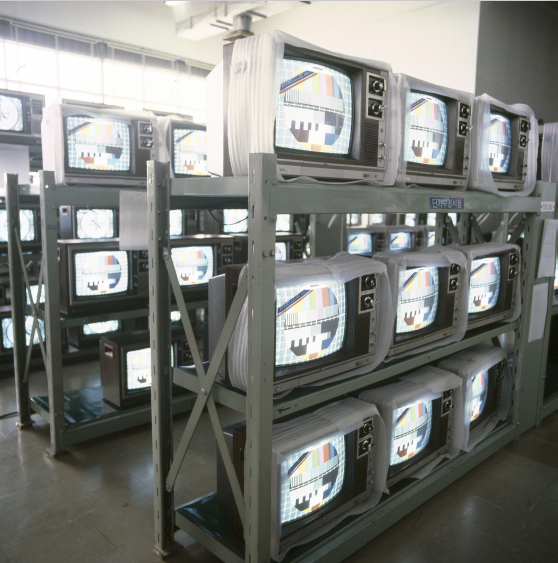
Korea’s electronics industry, famous worldwide for producing cutting-edge technology, was not always a global powerhouse. Today, this sector stands as Korea’s best-known industry, demonstrating world-class competitiveness and accounting for a massive 27.6% of the nation’s total exports in 2015. However, this high stature was the result of a half-century effort to catch up with world leaders.
We are going to dive into the crucial Formative Years (1966–1979), a foundational stage during which the industry shifted from basic assembly (low level of localization) to the production of sophisticated consumer products like B/W TV and Color TV. This strategic transformation, which propelled Korea's electronics industry to the 11th world rank by the end of this period, was driven by the powerful synergy created through the combination of effective government policy and corporate strategy, emphasizing an outward-looking approach focused on technology acquisition and adaptation.
#export orientation #export driven policy #localization #samsung #competition
Today, Korea's electronics industry is a dominant force in the global market, renowned for its world-leading competitiveness in semiconductors, mobile devices, and displays. In 2015, this sector accounted for a staggering 27.6% of the nation's total exports, far surpassing any other industry. This document explores the foundational strategies and policies from the industry's formative years that transformed a nation of assemblers into a global technology leader. The industry's journey can be understood through four distinct stages: the early years of import substitution (1959-1965), the formative years of export-oriented growth (1966-1979), a period of rapid rise into advanced technologies (1980-1992), and an era of sophistication and global leadership (1993-present).
The remarkable ascent of this sector was not an accident but the result of a deliberate and dynamic interplay between state and industry. Korea’s electronics industry was able to catch up with the world leaders through a combination of effective government policy and corporate strategy. This strategic partnership fueled a dramatic growth trajectory; for instance, the industry's share of manufacturing value added surged from just over 1% in 1970 to more than 30% by 2015, while its contribution to national GDP grew from a negligible 0.09% to 8.63% over the same period. This report delves into the developmental stages and policy choices that laid the groundwork for this unprecedented industrial transformation.
Understanding the phased development of Korea's electronics industry is crucial, as each stage methodically built upon the technological and strategic foundations of the last. This progression was marked by a steady climb in complexity, from simple assembly to the design and production of the world's most advanced components and consumer products.
The industry's origins during the Early Years (1959-1965) were humble and inward-looking. The production of Korea's first radio in 1959 by Goldstar (today's LG Electronics) typified this era, which was characterized by low levels of localization and a primary focus on import substitution for the domestic market. The subsequent Formative Years (1966-1979) marked a critical strategic pivot. The government and private sector shifted their focus outward, targeting export markets with consumer goods like black-and-white and, later, color televisions. Firms began localizing non-core components, taking the first steps toward building a domestic supply chain.
During the Rapid Rise (1980-1992), the industry's focus expanded from consumer electronics to the more complex Information and Communications Technology (ICT) sector. The government lifted its earlier anti-consumption bias, starting with its decision to allow color TV broadcasting in 1980, which generated synergy between domestic demand and exports. This era witnessed major technological milestones, including the development of the 64K DRAM memory chip. Private-sector firms, realizing that continued dependence on imported core components and materials would limit their potential for success, began to dramatically expand their own R&D. Finally, in the era of Sophistication (1993-present), Korean firms mastered a "fast follower-innovator" strategy. While American or Japanese firms were often first to market, Korean companies aggressively invested in R&D and mass production to catch up with and surpass the pioneers in products like mobile phones and flat-panel displays. In some cases, they launched innovative products ahead of incumbent leaders, as demonstrated by the success of the "phablet."
The foundation for this entire trajectory was laid during the pivotal 'Formative Years,' which established the strategic direction and competitive dynamics that would define the industry for decades to come.
The 'Formative Years' were critical because they represented the first concerted and comprehensive national effort to cultivate the electronics industry as a strategic pillar of the export-oriented economy. In December 1966, the government unveiled the ambitious Five-Year Electronics Industry Promotion Plan (1967-1971), which aimed to achieve an audacious goal of $100 million in electronics exports by 1971—a massive leap from the mere $3.6 million exported in 1966.
The plan's export targets served as crucial benchmarks for measuring progress. Since the targets were based on exports rather than domestic output, the plan emphasized international competitiveness from the outset. This outward-looking orientation was a defining feature of the strategy. A key intellectual architect of this vision was Dr. Kim Wan Hee, a Professor of Electrical Engineering at Columbia University, who briefed President Park Chung Hee in 1967. Dr. Kim made three influential policy recommendations:
Crucially, Dr. Kim advised that Korea must not settle for being a low-wage assembly hub. He argued that the nation needed to move beyond simple labor-intensive manufacturing and develop the capabilities required for activities demanding greater coordination and innovation. This strategic foresight set the stage for the specific laws and policy tools that would bring the national vision to life.
To execute its strategic vision, the Korean government deployed a unique blend of policy instruments. This approach combined strategic domestic market protection and targeted incentives with a deliberate and forceful promotion of competition among domestic firms. The enactment of the Electronics Industry Promotion Law in 1969, followed by the Basic Plan for Electronics Industry Promotion (1969-1976), codified this strategy.
The plans included several key promotion strategies:
The government's policies did not create winners; they created a competitive battlefield where winners would forge themselves. Intense corporate rivalry quickly became the primary engine for the industry's rapid innovation and growth. Samsung's entry into the electronics industry in 1969 serves as a prime example. As a latecomer but already Korea's largest business group, Samsung pursued a shrewd strategy of forming joint ventures with Japanese firms Sanyo and NEC. This approach allowed it to simultaneously secure market access, acquire advanced technology, and procure essential components. Samsung’s emphasis on vertical integration set it apart from incumbents.
Existing firms, led by Goldstar, reacted sharply, attempting to block Samsung's entry by citing the limited size of the domestic market. However, the government approved the new venture on the condition that it export 100% of its products for a set period, thereby ensuring its focus remained on global competitiveness. The impact was immediate and dramatic. By 1971, the competitive landscape had been completely redrawn. In the consumer electronics segment, Goldstar’s market share fell from 12.6% in 1969 to 7.1% in 1971. Meanwhile, Taihan Electric Wire’s market share grew from 2.9% to 4.6%, and by 1971, just over a year after beginning production, Samsung Sanyo Electric had already captured a 4.0% market share.
The success of Korea's electronics industry during its formative years offers a powerful and enduring model for developing nations seeking to cultivate high-value, globally competitive industries. The Korean blueprint provides several critical lessons in industrial policy.
First, the experience underscores the importance of selecting promising industries with high income elasticity and significant potential for productivity improvement. Korean policymakers used international benchmarking—specifically Japan's rapid success after enacting its own electronics promotion law in 1957—to validate that electronics was a realistically promising industry for a country with similar endowments.
Second, the model reveals the necessity of striking a critical balance between protection and discipline. The government provided temporary protection for the domestic market, but this was not a blank check. What proved critical was the performance-based reward and discipline system that was consistent with the notion that the policy objective was localization with international competitiveness, not localization per se. Support was tied to performance, particularly in export markets, forcing firms to build genuine capabilities rather than rely on indefinite protection. This experience also suggests that even successful policies must evolve; by the late 1970s, for instance, it might have been better for the government to remove its anti-consumption bias and allow companies to make investments based on market response rather than on state designation.
Third, from a political economy perspective, the government successfully designed an incentive system that aligned the pursuit of private interest with the public interest. By fostering a competitive environment where rewards were based on performance, the policy framework channeled corporate ambition into activities that benefited the national economy, such as R&D, quality improvement, and export growth, thereby avoiding the pitfalls of typical rent-seeking.
In sum, the government provided the initial "breathing space" through market protection but simultaneously created powerful incentives for firms to develop their own capabilities and compete on the world stage. The development of Korea's electronics industry shows that although it is necessary to provide protection and support in the early stages, far more important is the role of innovation and competition based on economic incentives.

Korea’s electronics industry, famous worldwide for producing cutting-edge technology, was not always a global powerhouse. Today, this sector stands as Korea’s best-known industry, demonstrating world-class competitiveness and accounting for a massive 27.6% of the nation’s total exports in 2015. However, this high stature was the result of a half-century effort to catch up with world leaders.
We are going to dive into the crucial Formative Years (1966–1979), a foundational stage during which the industry shifted from basic assembly (low level of localization) to the production of sophisticated consumer products like B/W TV and Color TV. This strategic transformation, which propelled Korea's electronics industry to the 11th world rank by the end of this period, was driven by the powerful synergy created through the combination of effective government policy and corporate strategy, emphasizing an outward-looking approach focused on technology acquisition and adaptation.
#export orientation #export driven policy #localization #samsung #competition
Today, Korea's electronics industry is a dominant force in the global market, renowned for its world-leading competitiveness in semiconductors, mobile devices, and displays. In 2015, this sector accounted for a staggering 27.6% of the nation's total exports, far surpassing any other industry. This document explores the foundational strategies and policies from the industry's formative years that transformed a nation of assemblers into a global technology leader. The industry's journey can be understood through four distinct stages: the early years of import substitution (1959-1965), the formative years of export-oriented growth (1966-1979), a period of rapid rise into advanced technologies (1980-1992), and an era of sophistication and global leadership (1993-present).
The remarkable ascent of this sector was not an accident but the result of a deliberate and dynamic interplay between state and industry. Korea’s electronics industry was able to catch up with the world leaders through a combination of effective government policy and corporate strategy. This strategic partnership fueled a dramatic growth trajectory; for instance, the industry's share of manufacturing value added surged from just over 1% in 1970 to more than 30% by 2015, while its contribution to national GDP grew from a negligible 0.09% to 8.63% over the same period. This report delves into the developmental stages and policy choices that laid the groundwork for this unprecedented industrial transformation.
Understanding the phased development of Korea's electronics industry is crucial, as each stage methodically built upon the technological and strategic foundations of the last. This progression was marked by a steady climb in complexity, from simple assembly to the design and production of the world's most advanced components and consumer products.
The industry's origins during the Early Years (1959-1965) were humble and inward-looking. The production of Korea's first radio in 1959 by Goldstar (today's LG Electronics) typified this era, which was characterized by low levels of localization and a primary focus on import substitution for the domestic market. The subsequent Formative Years (1966-1979) marked a critical strategic pivot. The government and private sector shifted their focus outward, targeting export markets with consumer goods like black-and-white and, later, color televisions. Firms began localizing non-core components, taking the first steps toward building a domestic supply chain.
During the Rapid Rise (1980-1992), the industry's focus expanded from consumer electronics to the more complex Information and Communications Technology (ICT) sector. The government lifted its earlier anti-consumption bias, starting with its decision to allow color TV broadcasting in 1980, which generated synergy between domestic demand and exports. This era witnessed major technological milestones, including the development of the 64K DRAM memory chip. Private-sector firms, realizing that continued dependence on imported core components and materials would limit their potential for success, began to dramatically expand their own R&D. Finally, in the era of Sophistication (1993-present), Korean firms mastered a "fast follower-innovator" strategy. While American or Japanese firms were often first to market, Korean companies aggressively invested in R&D and mass production to catch up with and surpass the pioneers in products like mobile phones and flat-panel displays. In some cases, they launched innovative products ahead of incumbent leaders, as demonstrated by the success of the "phablet."
The foundation for this entire trajectory was laid during the pivotal 'Formative Years,' which established the strategic direction and competitive dynamics that would define the industry for decades to come.
The 'Formative Years' were critical because they represented the first concerted and comprehensive national effort to cultivate the electronics industry as a strategic pillar of the export-oriented economy. In December 1966, the government unveiled the ambitious Five-Year Electronics Industry Promotion Plan (1967-1971), which aimed to achieve an audacious goal of $100 million in electronics exports by 1971—a massive leap from the mere $3.6 million exported in 1966.
The plan's export targets served as crucial benchmarks for measuring progress. Since the targets were based on exports rather than domestic output, the plan emphasized international competitiveness from the outset. This outward-looking orientation was a defining feature of the strategy. A key intellectual architect of this vision was Dr. Kim Wan Hee, a Professor of Electrical Engineering at Columbia University, who briefed President Park Chung Hee in 1967. Dr. Kim made three influential policy recommendations:
Crucially, Dr. Kim advised that Korea must not settle for being a low-wage assembly hub. He argued that the nation needed to move beyond simple labor-intensive manufacturing and develop the capabilities required for activities demanding greater coordination and innovation. This strategic foresight set the stage for the specific laws and policy tools that would bring the national vision to life.
To execute its strategic vision, the Korean government deployed a unique blend of policy instruments. This approach combined strategic domestic market protection and targeted incentives with a deliberate and forceful promotion of competition among domestic firms. The enactment of the Electronics Industry Promotion Law in 1969, followed by the Basic Plan for Electronics Industry Promotion (1969-1976), codified this strategy.
The plans included several key promotion strategies:
The government's policies did not create winners; they created a competitive battlefield where winners would forge themselves. Intense corporate rivalry quickly became the primary engine for the industry's rapid innovation and growth. Samsung's entry into the electronics industry in 1969 serves as a prime example. As a latecomer but already Korea's largest business group, Samsung pursued a shrewd strategy of forming joint ventures with Japanese firms Sanyo and NEC. This approach allowed it to simultaneously secure market access, acquire advanced technology, and procure essential components. Samsung’s emphasis on vertical integration set it apart from incumbents.
Existing firms, led by Goldstar, reacted sharply, attempting to block Samsung's entry by citing the limited size of the domestic market. However, the government approved the new venture on the condition that it export 100% of its products for a set period, thereby ensuring its focus remained on global competitiveness. The impact was immediate and dramatic. By 1971, the competitive landscape had been completely redrawn. In the consumer electronics segment, Goldstar’s market share fell from 12.6% in 1969 to 7.1% in 1971. Meanwhile, Taihan Electric Wire’s market share grew from 2.9% to 4.6%, and by 1971, just over a year after beginning production, Samsung Sanyo Electric had already captured a 4.0% market share.
The success of Korea's electronics industry during its formative years offers a powerful and enduring model for developing nations seeking to cultivate high-value, globally competitive industries. The Korean blueprint provides several critical lessons in industrial policy.
First, the experience underscores the importance of selecting promising industries with high income elasticity and significant potential for productivity improvement. Korean policymakers used international benchmarking—specifically Japan's rapid success after enacting its own electronics promotion law in 1957—to validate that electronics was a realistically promising industry for a country with similar endowments.
Second, the model reveals the necessity of striking a critical balance between protection and discipline. The government provided temporary protection for the domestic market, but this was not a blank check. What proved critical was the performance-based reward and discipline system that was consistent with the notion that the policy objective was localization with international competitiveness, not localization per se. Support was tied to performance, particularly in export markets, forcing firms to build genuine capabilities rather than rely on indefinite protection. This experience also suggests that even successful policies must evolve; by the late 1970s, for instance, it might have been better for the government to remove its anti-consumption bias and allow companies to make investments based on market response rather than on state designation.
Third, from a political economy perspective, the government successfully designed an incentive system that aligned the pursuit of private interest with the public interest. By fostering a competitive environment where rewards were based on performance, the policy framework channeled corporate ambition into activities that benefited the national economy, such as R&D, quality improvement, and export growth, thereby avoiding the pitfalls of typical rent-seeking.
In sum, the government provided the initial "breathing space" through market protection but simultaneously created powerful incentives for firms to develop their own capabilities and compete on the world stage. The development of Korea's electronics industry shows that although it is necessary to provide protection and support in the early stages, far more important is the role of innovation and competition based on economic incentives.

Today, Korea's electronics industry is a dominant force in the global market, renowned for its world-leading competitiveness in semiconductors, mobile devices, and displays. In 2015, this sector accounted for a staggering 27.6% of the nation's total exports, far surpassing any other industry. This document explores the foundational strategies and policies from the industry's formative years that transformed a nation of assemblers into a global technology leader. The industry's journey can be understood through four distinct stages: the early years of import substitution (1959-1965), the formative years of export-oriented growth (1966-1979), a period of rapid rise into advanced technologies (1980-1992), and an era of sophistication and global leadership (1993-present).
The remarkable ascent of this sector was not an accident but the result of a deliberate and dynamic interplay between state and industry. Korea’s electronics industry was able to catch up with the world leaders through a combination of effective government policy and corporate strategy. This strategic partnership fueled a dramatic growth trajectory; for instance, the industry's share of manufacturing value added surged from just over 1% in 1970 to more than 30% by 2015, while its contribution to national GDP grew from a negligible 0.09% to 8.63% over the same period. This report delves into the developmental stages and policy choices that laid the groundwork for this unprecedented industrial transformation.
Understanding the phased development of Korea's electronics industry is crucial, as each stage methodically built upon the technological and strategic foundations of the last. This progression was marked by a steady climb in complexity, from simple assembly to the design and production of the world's most advanced components and consumer products.
The industry's origins during the Early Years (1959-1965) were humble and inward-looking. The production of Korea's first radio in 1959 by Goldstar (today's LG Electronics) typified this era, which was characterized by low levels of localization and a primary focus on import substitution for the domestic market. The subsequent Formative Years (1966-1979) marked a critical strategic pivot. The government and private sector shifted their focus outward, targeting export markets with consumer goods like black-and-white and, later, color televisions. Firms began localizing non-core components, taking the first steps toward building a domestic supply chain.
During the Rapid Rise (1980-1992), the industry's focus expanded from consumer electronics to the more complex Information and Communications Technology (ICT) sector. The government lifted its earlier anti-consumption bias, starting with its decision to allow color TV broadcasting in 1980, which generated synergy between domestic demand and exports. This era witnessed major technological milestones, including the development of the 64K DRAM memory chip. Private-sector firms, realizing that continued dependence on imported core components and materials would limit their potential for success, began to dramatically expand their own R&D. Finally, in the era of Sophistication (1993-present), Korean firms mastered a "fast follower-innovator" strategy. While American or Japanese firms were often first to market, Korean companies aggressively invested in R&D and mass production to catch up with and surpass the pioneers in products like mobile phones and flat-panel displays. In some cases, they launched innovative products ahead of incumbent leaders, as demonstrated by the success of the "phablet."
The foundation for this entire trajectory was laid during the pivotal 'Formative Years,' which established the strategic direction and competitive dynamics that would define the industry for decades to come.
The 'Formative Years' were critical because they represented the first concerted and comprehensive national effort to cultivate the electronics industry as a strategic pillar of the export-oriented economy. In December 1966, the government unveiled the ambitious Five-Year Electronics Industry Promotion Plan (1967-1971), which aimed to achieve an audacious goal of $100 million in electronics exports by 1971—a massive leap from the mere $3.6 million exported in 1966.
The plan's export targets served as crucial benchmarks for measuring progress. Since the targets were based on exports rather than domestic output, the plan emphasized international competitiveness from the outset. This outward-looking orientation was a defining feature of the strategy. A key intellectual architect of this vision was Dr. Kim Wan Hee, a Professor of Electrical Engineering at Columbia University, who briefed President Park Chung Hee in 1967. Dr. Kim made three influential policy recommendations:
Crucially, Dr. Kim advised that Korea must not settle for being a low-wage assembly hub. He argued that the nation needed to move beyond simple labor-intensive manufacturing and develop the capabilities required for activities demanding greater coordination and innovation. This strategic foresight set the stage for the specific laws and policy tools that would bring the national vision to life.
To execute its strategic vision, the Korean government deployed a unique blend of policy instruments. This approach combined strategic domestic market protection and targeted incentives with a deliberate and forceful promotion of competition among domestic firms. The enactment of the Electronics Industry Promotion Law in 1969, followed by the Basic Plan for Electronics Industry Promotion (1969-1976), codified this strategy.
The plans included several key promotion strategies:
The government's policies did not create winners; they created a competitive battlefield where winners would forge themselves. Intense corporate rivalry quickly became the primary engine for the industry's rapid innovation and growth. Samsung's entry into the electronics industry in 1969 serves as a prime example. As a latecomer but already Korea's largest business group, Samsung pursued a shrewd strategy of forming joint ventures with Japanese firms Sanyo and NEC. This approach allowed it to simultaneously secure market access, acquire advanced technology, and procure essential components. Samsung’s emphasis on vertical integration set it apart from incumbents.
Existing firms, led by Goldstar, reacted sharply, attempting to block Samsung's entry by citing the limited size of the domestic market. However, the government approved the new venture on the condition that it export 100% of its products for a set period, thereby ensuring its focus remained on global competitiveness. The impact was immediate and dramatic. By 1971, the competitive landscape had been completely redrawn. In the consumer electronics segment, Goldstar’s market share fell from 12.6% in 1969 to 7.1% in 1971. Meanwhile, Taihan Electric Wire’s market share grew from 2.9% to 4.6%, and by 1971, just over a year after beginning production, Samsung Sanyo Electric had already captured a 4.0% market share.
The success of Korea's electronics industry during its formative years offers a powerful and enduring model for developing nations seeking to cultivate high-value, globally competitive industries. The Korean blueprint provides several critical lessons in industrial policy.
First, the experience underscores the importance of selecting promising industries with high income elasticity and significant potential for productivity improvement. Korean policymakers used international benchmarking—specifically Japan's rapid success after enacting its own electronics promotion law in 1957—to validate that electronics was a realistically promising industry for a country with similar endowments.
Second, the model reveals the necessity of striking a critical balance between protection and discipline. The government provided temporary protection for the domestic market, but this was not a blank check. What proved critical was the performance-based reward and discipline system that was consistent with the notion that the policy objective was localization with international competitiveness, not localization per se. Support was tied to performance, particularly in export markets, forcing firms to build genuine capabilities rather than rely on indefinite protection. This experience also suggests that even successful policies must evolve; by the late 1970s, for instance, it might have been better for the government to remove its anti-consumption bias and allow companies to make investments based on market response rather than on state designation.
Third, from a political economy perspective, the government successfully designed an incentive system that aligned the pursuit of private interest with the public interest. By fostering a competitive environment where rewards were based on performance, the policy framework channeled corporate ambition into activities that benefited the national economy, such as R&D, quality improvement, and export growth, thereby avoiding the pitfalls of typical rent-seeking.
In sum, the government provided the initial "breathing space" through market protection but simultaneously created powerful incentives for firms to develop their own capabilities and compete on the world stage. The development of Korea's electronics industry shows that although it is necessary to provide protection and support in the early stages, far more important is the role of innovation and competition based on economic incentives.