

Back to List
K-Dev Original

Forging a Nation: South Korea's Strategic Industrial Development (1960s-1980s)

Summary

South Korea’s remarkable economic rise in the late 20th century was driven by deliberate, state-led industrial strategy. At the core of this effort was the systematic development of industrial parks, which became pivotal engines of growth. This report examines two decisive phases of this transformation: the 1960s foundation of labor-intensive export industries centered in the capital region, and the 1970s–1980s strategic pivot toward large-scale heavy and chemical industries along the southeast coast. Together, these targeted industrialization waves reshaped the nation’s economic geography and propelled South Korea from a post-war agrarian society to a global industrial powerhouse.

Key Questions

  • How did South Korea strategically use industrial parks to accelerate national development from the 1960s to the 1980s?
  • Why did the government shift from labor-intensive export industries in the capital region to heavy and chemical industries along the southeast coast?
  • How can South Korea balance national economic competitiveness with regional equity in the era of globalization?

#industrialization #HCI #industrial park #urban plan

The 1960s: Laying the Foundation in the Capital Region

The launch of the first Five-Year Economic Development Plan in 1962 signaled the start of South Korea's state-driven industrialization. Faced with limited financial resources, the government adopted a strategy of concentrated investment, channeling funds into regions with the highest growth potential rather than dispersing them thinly nationwide. The Seoul-Incheon area, with its existing infrastructure, urban services, and large population, was identified as a primary development hub, setting the stage for a decade of capital-centric growth.

The Guro Export Industrial Park

In the early 1960s, cheap labor was nearly the country’s sole development resource, focusing the industrial policy on labor-intensive exports. This reality shaped the initial phase of industrial park development. Under the Export Industrial Park Formation Act of 1964, the government established the first Korea Export Industrial Park in Guro-dong, Seoul. The location was chosen for its strategic advantages, including a vast and accessible workforce and reliable access to transportation networks, electricity, and water. The park was an immediate success; demand from businesses far outstripped the available space, prompting the government to quickly plan for second and third parks in the area. This initial success also spurred a boom in the creation of industrial parks by local governments, but the export industry parks located in the heart of the capital boasted considerable advantages that other industrial parks outside Seoul could not copy.

Consequences of Concentration

This Seoul-centric industrial strategy had a profound effect on the national economy. The concentration of manufacturing in the capital led to a significant increase in its economic dominance; Seoul's share of the nation's secondary industries (manufacturing and mining) rose from 23 percent in 1960 to 31 percent in 1970. This industrial shift drove major changes in the country's economic and employment structure. Between 1962 and 1972, the primary industry's share of GDP fell from 37 percent to 29 percent, while the secondary industry's share climbed from 16 percent to 24 percent. This was mirrored in the workforce, as the percentage of workers in primary industries fell from 63 percent to 51 percent, while those employed in secondary industries increased from 9 percent to 14 percent.

Urbanization and Infrastructure Demands

Industrialization acted as a powerful magnet for population, fueling rapid urbanization. The national urbanization rate climbed from 37 percent in 1960 to 51 percent just ten years later. Seoul's population, which stood at just 1 million in 1945, soared to 5.54 million by 1970, creating immense demand for large-scale housing and urban infrastructure. This explosive growth placed enormous strain on existing systems. By 1966, the strain on railroads, which handled 84 percent of the nation’s transport capacity in 1962, was severe. Recognizing that infrastructure was a critical bottleneck, the government responded by constructing the nation's first expressways. The Seoul-Incheon Expressway (1968) and the Seoul-Busan Expressway (1970) were built to increase the transportation of goods and support the rapidly industrializing capital region.

The completion of the Seoul-Busan Expressway would form the backbone for a new, more ambitious development strategy in the following decade.

The 1970s Pivot: The Rise of the Southeast Coastal Industrial Belt

The 1970s marked a significant strategic pivot in South Korea's industrial policy. Under the leadership of President Park Chung-hee, the nation moved away from its reliance on light, labor-intensive manufacturing toward the systematic development of Heavy and Chemical Industries (HCIs). This top-down initiative was designed to elevate the country's economic capacity and secure its position in higher-value global markets, sparking a new wave of industrial development on an unprecedented scale.

A Systematic HCI Drive

The government's approach to promoting HCIs was highly organized and centrally controlled. In February 1973, it established the HCI Drive Committee, a high-level body composed of relevant ministers and experts, to oversee the national effort. This was followed in February 1974 by the creation of the Industrial Complex Development Corporation, an entity specifically charged with constructing the required industrial sites. This corporation was endowed with significant power and resources, including a capital investment of 100 billion won, tax exemptions, the authority to appropriate land, and the right to borrow from overseas, ensuring it had the means to execute its ambitious mandate.

Rationale for Coastal Complexes

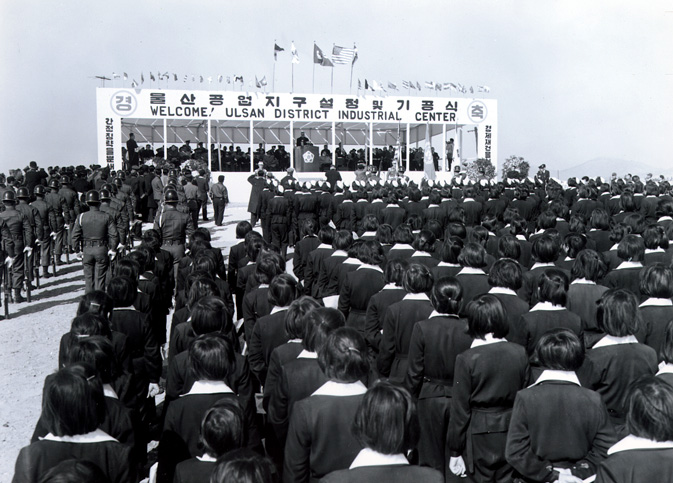
The creation of giant coastal industrial complexes was governed by three key strategic factors. First, these large-scale facilities were intended to promote economies of scale in capital-intensive industries such as iron and steel production and oil refining. Second, the coastal locations were chosen to ensure the efficient use of limited natural resources, selecting sites that could accommodate large port facilities and had sufficient water access. Third, and most ambitiously, these complexes were designed to evolve into entirely new industrial cities. This vision was realized as small towns like Ulsan and Pohang grew into major industrial centers, and entirely new cities like Changwon were planned and developed from the ground up to support the industrial drive.

A New Scale of Development

The new coastal industrial complexes were vastly different in scale compared to the interior parks developed in the 1960s. As shown in the table below, the difference in scale was immense.

An analysis of this data reveals the government's overwhelming focus on coastal HCI development. While the number of designated parks was similar (14 coastal versus 15 interior), the area dedicated to them was not. The 14 coastal complexes covered 315.0 km² of industrial park land, whereas the 15 interior parks covered a mere 16.8 km²—just 5% of the coastal area. This demonstrates a clear and dramatic shift in national development priorities.

This monumental planning effort would soon translate into tangible impacts on the nation's employment patterns and regional economic balance.

Reshaping the Nation's Economic Geography

The shift to Heavy and Chemical Industries in the 1970s did more than grow the economy; it deliberately re-engineered the nation's industrial center of gravity away from the capital. This state-led transformation not only created new industrial heartlands but also altered regional employment patterns and growth dynamics. The development strategy during this period was a complex interplay of grand economic vision, practical resource management, and pointed political calculation.

Regional Employment Shifts

The coastal complex policy had a profound impact on regional employment, shifting the country's industrial center of gravity. The changes in regional employment in the mining and manufacturing sectors are detailed in the table below.

The data reveals a dramatic shift. While Gyeonggi province, surrounding Seoul, continued its strong growth, South Gyeongsang Province emerged as a main industrial region, with its manufacturing job growth rate slightly exceeding even Gyeonggi's between 1975 and 1980. The success and concentration of this two-phase strategy are starkly illustrated by one fact: over the entire 1966-1980 period, only two provinces—Gyeonggi and South Gyeongsang—recorded manufacturing employment growth rates higher than the national average of 9 percent. This demonstrates the creation of a new, powerful industrial hub in the southeast that successfully counterbalanced the capital region.

Economic and Political Considerations

Industrial planning was not solely driven by economic logic; political factors also played a crucial role, particularly during the Chun Doo-hwan administration in the 1980s. The decision to build POSCO's new Gwangyang Steelworks is a prime example. When the existing Pohang steelworks reached capacity, a debate emerged over whether to build the new plant in Asan Bay, near the capital, or in Gwangyang Bay, on the less-developed southern coast. The final decision in favor of Gwangyang was influenced by political considerations. There was a perceived need to promote industrialization in the Jeolla region, partly to appease the region which had opposed the Chun administration with an urban uprising in 1980, and also to create a strategic counter-magnet to the overpopulated capital region. President Chun's decision framed the choice in strategic terms, declaring that Gwangyang Bay would represent the "westward extension of the Southeast Coastal Industrial Belt."

South Korea's journey to becoming an industrial nation was guided by a strategic, two-phased approach to developing industrial parks. The 1960s saw the initial concentration of labor-intensive export industries in the capital region, leveraging the area's existing workforce and infrastructure to build a foundational manufacturing base. This was followed in the 1970s and 1980s by a bold and large-scale pivot to heavy and chemical industries, centered on massive coastal complexes that reshaped the nation's southeastern coast into a new industrial heartland. This deliberate, state-led strategy fundamentally transformed South Korea's economic structure, rebalanced its regional geography, and laid the essential groundwork for its emergence as a global economic leader.

Further Readings

  • Kim, K. (2008). Industrial parks in Korea: Outline and recent policy. Korea Institute for Industrial Economics & Trade.
Author
Il SaKong
Korea Development Institute
Youngsun Koh
Korea Development Institute
cite this work

Forging a Nation: South Korea's Strategic Industrial Development (1960s-1980s)

K-Dev Original
March 12, 2026
This is some text inside of a div block.

Summary

South Korea’s remarkable economic rise in the late 20th century was driven by deliberate, state-led industrial strategy. At the core of this effort was the systematic development of industrial parks, which became pivotal engines of growth. This report examines two decisive phases of this transformation: the 1960s foundation of labor-intensive export industries centered in the capital region, and the 1970s–1980s strategic pivot toward large-scale heavy and chemical industries along the southeast coast. Together, these targeted industrialization waves reshaped the nation’s economic geography and propelled South Korea from a post-war agrarian society to a global industrial powerhouse.

Key Questions

  • How did South Korea strategically use industrial parks to accelerate national development from the 1960s to the 1980s?
  • Why did the government shift from labor-intensive export industries in the capital region to heavy and chemical industries along the southeast coast?
  • How can South Korea balance national economic competitiveness with regional equity in the era of globalization?

#industrialization #HCI #industrial park #urban plan

The 1960s: Laying the Foundation in the Capital Region

The launch of the first Five-Year Economic Development Plan in 1962 signaled the start of South Korea's state-driven industrialization. Faced with limited financial resources, the government adopted a strategy of concentrated investment, channeling funds into regions with the highest growth potential rather than dispersing them thinly nationwide. The Seoul-Incheon area, with its existing infrastructure, urban services, and large population, was identified as a primary development hub, setting the stage for a decade of capital-centric growth.

The Guro Export Industrial Park

In the early 1960s, cheap labor was nearly the country’s sole development resource, focusing the industrial policy on labor-intensive exports. This reality shaped the initial phase of industrial park development. Under the Export Industrial Park Formation Act of 1964, the government established the first Korea Export Industrial Park in Guro-dong, Seoul. The location was chosen for its strategic advantages, including a vast and accessible workforce and reliable access to transportation networks, electricity, and water. The park was an immediate success; demand from businesses far outstripped the available space, prompting the government to quickly plan for second and third parks in the area. This initial success also spurred a boom in the creation of industrial parks by local governments, but the export industry parks located in the heart of the capital boasted considerable advantages that other industrial parks outside Seoul could not copy.

Consequences of Concentration

This Seoul-centric industrial strategy had a profound effect on the national economy. The concentration of manufacturing in the capital led to a significant increase in its economic dominance; Seoul's share of the nation's secondary industries (manufacturing and mining) rose from 23 percent in 1960 to 31 percent in 1970. This industrial shift drove major changes in the country's economic and employment structure. Between 1962 and 1972, the primary industry's share of GDP fell from 37 percent to 29 percent, while the secondary industry's share climbed from 16 percent to 24 percent. This was mirrored in the workforce, as the percentage of workers in primary industries fell from 63 percent to 51 percent, while those employed in secondary industries increased from 9 percent to 14 percent.

Urbanization and Infrastructure Demands

Industrialization acted as a powerful magnet for population, fueling rapid urbanization. The national urbanization rate climbed from 37 percent in 1960 to 51 percent just ten years later. Seoul's population, which stood at just 1 million in 1945, soared to 5.54 million by 1970, creating immense demand for large-scale housing and urban infrastructure. This explosive growth placed enormous strain on existing systems. By 1966, the strain on railroads, which handled 84 percent of the nation’s transport capacity in 1962, was severe. Recognizing that infrastructure was a critical bottleneck, the government responded by constructing the nation's first expressways. The Seoul-Incheon Expressway (1968) and the Seoul-Busan Expressway (1970) were built to increase the transportation of goods and support the rapidly industrializing capital region.

The completion of the Seoul-Busan Expressway would form the backbone for a new, more ambitious development strategy in the following decade.

The 1970s Pivot: The Rise of the Southeast Coastal Industrial Belt

The 1970s marked a significant strategic pivot in South Korea's industrial policy. Under the leadership of President Park Chung-hee, the nation moved away from its reliance on light, labor-intensive manufacturing toward the systematic development of Heavy and Chemical Industries (HCIs). This top-down initiative was designed to elevate the country's economic capacity and secure its position in higher-value global markets, sparking a new wave of industrial development on an unprecedented scale.

A Systematic HCI Drive

The government's approach to promoting HCIs was highly organized and centrally controlled. In February 1973, it established the HCI Drive Committee, a high-level body composed of relevant ministers and experts, to oversee the national effort. This was followed in February 1974 by the creation of the Industrial Complex Development Corporation, an entity specifically charged with constructing the required industrial sites. This corporation was endowed with significant power and resources, including a capital investment of 100 billion won, tax exemptions, the authority to appropriate land, and the right to borrow from overseas, ensuring it had the means to execute its ambitious mandate.

Rationale for Coastal Complexes

The creation of giant coastal industrial complexes was governed by three key strategic factors. First, these large-scale facilities were intended to promote economies of scale in capital-intensive industries such as iron and steel production and oil refining. Second, the coastal locations were chosen to ensure the efficient use of limited natural resources, selecting sites that could accommodate large port facilities and had sufficient water access. Third, and most ambitiously, these complexes were designed to evolve into entirely new industrial cities. This vision was realized as small towns like Ulsan and Pohang grew into major industrial centers, and entirely new cities like Changwon were planned and developed from the ground up to support the industrial drive.

A New Scale of Development

The new coastal industrial complexes were vastly different in scale compared to the interior parks developed in the 1960s. As shown in the table below, the difference in scale was immense.

An analysis of this data reveals the government's overwhelming focus on coastal HCI development. While the number of designated parks was similar (14 coastal versus 15 interior), the area dedicated to them was not. The 14 coastal complexes covered 315.0 km² of industrial park land, whereas the 15 interior parks covered a mere 16.8 km²—just 5% of the coastal area. This demonstrates a clear and dramatic shift in national development priorities.

This monumental planning effort would soon translate into tangible impacts on the nation's employment patterns and regional economic balance.

Reshaping the Nation's Economic Geography

The shift to Heavy and Chemical Industries in the 1970s did more than grow the economy; it deliberately re-engineered the nation's industrial center of gravity away from the capital. This state-led transformation not only created new industrial heartlands but also altered regional employment patterns and growth dynamics. The development strategy during this period was a complex interplay of grand economic vision, practical resource management, and pointed political calculation.

Regional Employment Shifts

The coastal complex policy had a profound impact on regional employment, shifting the country's industrial center of gravity. The changes in regional employment in the mining and manufacturing sectors are detailed in the table below.

The data reveals a dramatic shift. While Gyeonggi province, surrounding Seoul, continued its strong growth, South Gyeongsang Province emerged as a main industrial region, with its manufacturing job growth rate slightly exceeding even Gyeonggi's between 1975 and 1980. The success and concentration of this two-phase strategy are starkly illustrated by one fact: over the entire 1966-1980 period, only two provinces—Gyeonggi and South Gyeongsang—recorded manufacturing employment growth rates higher than the national average of 9 percent. This demonstrates the creation of a new, powerful industrial hub in the southeast that successfully counterbalanced the capital region.

Economic and Political Considerations

Industrial planning was not solely driven by economic logic; political factors also played a crucial role, particularly during the Chun Doo-hwan administration in the 1980s. The decision to build POSCO's new Gwangyang Steelworks is a prime example. When the existing Pohang steelworks reached capacity, a debate emerged over whether to build the new plant in Asan Bay, near the capital, or in Gwangyang Bay, on the less-developed southern coast. The final decision in favor of Gwangyang was influenced by political considerations. There was a perceived need to promote industrialization in the Jeolla region, partly to appease the region which had opposed the Chun administration with an urban uprising in 1980, and also to create a strategic counter-magnet to the overpopulated capital region. President Chun's decision framed the choice in strategic terms, declaring that Gwangyang Bay would represent the "westward extension of the Southeast Coastal Industrial Belt."

South Korea's journey to becoming an industrial nation was guided by a strategic, two-phased approach to developing industrial parks. The 1960s saw the initial concentration of labor-intensive export industries in the capital region, leveraging the area's existing workforce and infrastructure to build a foundational manufacturing base. This was followed in the 1970s and 1980s by a bold and large-scale pivot to heavy and chemical industries, centered on massive coastal complexes that reshaped the nation's southeastern coast into a new industrial heartland. This deliberate, state-led strategy fundamentally transformed South Korea's economic structure, rebalanced its regional geography, and laid the essential groundwork for its emergence as a global economic leader.

Further Readings

  • Kim, K. (2008). Industrial parks in Korea: Outline and recent policy. Korea Institute for Industrial Economics & Trade.
References
Cite this work
.

More to explore from
In Perspective

Forging a Nation: South Korea's Strategic Industrial Development (1960s-1980s)

K-Dev Original
March 12, 2026

I am the text that will be copied.

The 1960s: Laying the Foundation in the Capital Region

The launch of the first Five-Year Economic Development Plan in 1962 signaled the start of South Korea's state-driven industrialization. Faced with limited financial resources, the government adopted a strategy of concentrated investment, channeling funds into regions with the highest growth potential rather than dispersing them thinly nationwide. The Seoul-Incheon area, with its existing infrastructure, urban services, and large population, was identified as a primary development hub, setting the stage for a decade of capital-centric growth.

The Guro Export Industrial Park

In the early 1960s, cheap labor was nearly the country’s sole development resource, focusing the industrial policy on labor-intensive exports. This reality shaped the initial phase of industrial park development. Under the Export Industrial Park Formation Act of 1964, the government established the first Korea Export Industrial Park in Guro-dong, Seoul. The location was chosen for its strategic advantages, including a vast and accessible workforce and reliable access to transportation networks, electricity, and water. The park was an immediate success; demand from businesses far outstripped the available space, prompting the government to quickly plan for second and third parks in the area. This initial success also spurred a boom in the creation of industrial parks by local governments, but the export industry parks located in the heart of the capital boasted considerable advantages that other industrial parks outside Seoul could not copy.

Consequences of Concentration

This Seoul-centric industrial strategy had a profound effect on the national economy. The concentration of manufacturing in the capital led to a significant increase in its economic dominance; Seoul's share of the nation's secondary industries (manufacturing and mining) rose from 23 percent in 1960 to 31 percent in 1970. This industrial shift drove major changes in the country's economic and employment structure. Between 1962 and 1972, the primary industry's share of GDP fell from 37 percent to 29 percent, while the secondary industry's share climbed from 16 percent to 24 percent. This was mirrored in the workforce, as the percentage of workers in primary industries fell from 63 percent to 51 percent, while those employed in secondary industries increased from 9 percent to 14 percent.

Urbanization and Infrastructure Demands

Industrialization acted as a powerful magnet for population, fueling rapid urbanization. The national urbanization rate climbed from 37 percent in 1960 to 51 percent just ten years later. Seoul's population, which stood at just 1 million in 1945, soared to 5.54 million by 1970, creating immense demand for large-scale housing and urban infrastructure. This explosive growth placed enormous strain on existing systems. By 1966, the strain on railroads, which handled 84 percent of the nation’s transport capacity in 1962, was severe. Recognizing that infrastructure was a critical bottleneck, the government responded by constructing the nation's first expressways. The Seoul-Incheon Expressway (1968) and the Seoul-Busan Expressway (1970) were built to increase the transportation of goods and support the rapidly industrializing capital region.

The completion of the Seoul-Busan Expressway would form the backbone for a new, more ambitious development strategy in the following decade.

The 1970s Pivot: The Rise of the Southeast Coastal Industrial Belt

The 1970s marked a significant strategic pivot in South Korea's industrial policy. Under the leadership of President Park Chung-hee, the nation moved away from its reliance on light, labor-intensive manufacturing toward the systematic development of Heavy and Chemical Industries (HCIs). This top-down initiative was designed to elevate the country's economic capacity and secure its position in higher-value global markets, sparking a new wave of industrial development on an unprecedented scale.

A Systematic HCI Drive

The government's approach to promoting HCIs was highly organized and centrally controlled. In February 1973, it established the HCI Drive Committee, a high-level body composed of relevant ministers and experts, to oversee the national effort. This was followed in February 1974 by the creation of the Industrial Complex Development Corporation, an entity specifically charged with constructing the required industrial sites. This corporation was endowed with significant power and resources, including a capital investment of 100 billion won, tax exemptions, the authority to appropriate land, and the right to borrow from overseas, ensuring it had the means to execute its ambitious mandate.

Rationale for Coastal Complexes

The creation of giant coastal industrial complexes was governed by three key strategic factors. First, these large-scale facilities were intended to promote economies of scale in capital-intensive industries such as iron and steel production and oil refining. Second, the coastal locations were chosen to ensure the efficient use of limited natural resources, selecting sites that could accommodate large port facilities and had sufficient water access. Third, and most ambitiously, these complexes were designed to evolve into entirely new industrial cities. This vision was realized as small towns like Ulsan and Pohang grew into major industrial centers, and entirely new cities like Changwon were planned and developed from the ground up to support the industrial drive.

A New Scale of Development

The new coastal industrial complexes were vastly different in scale compared to the interior parks developed in the 1960s. As shown in the table below, the difference in scale was immense.

An analysis of this data reveals the government's overwhelming focus on coastal HCI development. While the number of designated parks was similar (14 coastal versus 15 interior), the area dedicated to them was not. The 14 coastal complexes covered 315.0 km² of industrial park land, whereas the 15 interior parks covered a mere 16.8 km²—just 5% of the coastal area. This demonstrates a clear and dramatic shift in national development priorities.

This monumental planning effort would soon translate into tangible impacts on the nation's employment patterns and regional economic balance.

Reshaping the Nation's Economic Geography

The shift to Heavy and Chemical Industries in the 1970s did more than grow the economy; it deliberately re-engineered the nation's industrial center of gravity away from the capital. This state-led transformation not only created new industrial heartlands but also altered regional employment patterns and growth dynamics. The development strategy during this period was a complex interplay of grand economic vision, practical resource management, and pointed political calculation.

Regional Employment Shifts

The coastal complex policy had a profound impact on regional employment, shifting the country's industrial center of gravity. The changes in regional employment in the mining and manufacturing sectors are detailed in the table below.

The data reveals a dramatic shift. While Gyeonggi province, surrounding Seoul, continued its strong growth, South Gyeongsang Province emerged as a main industrial region, with its manufacturing job growth rate slightly exceeding even Gyeonggi's between 1975 and 1980. The success and concentration of this two-phase strategy are starkly illustrated by one fact: over the entire 1966-1980 period, only two provinces—Gyeonggi and South Gyeongsang—recorded manufacturing employment growth rates higher than the national average of 9 percent. This demonstrates the creation of a new, powerful industrial hub in the southeast that successfully counterbalanced the capital region.

Economic and Political Considerations

Industrial planning was not solely driven by economic logic; political factors also played a crucial role, particularly during the Chun Doo-hwan administration in the 1980s. The decision to build POSCO's new Gwangyang Steelworks is a prime example. When the existing Pohang steelworks reached capacity, a debate emerged over whether to build the new plant in Asan Bay, near the capital, or in Gwangyang Bay, on the less-developed southern coast. The final decision in favor of Gwangyang was influenced by political considerations. There was a perceived need to promote industrialization in the Jeolla region, partly to appease the region which had opposed the Chun administration with an urban uprising in 1980, and also to create a strategic counter-magnet to the overpopulated capital region. President Chun's decision framed the choice in strategic terms, declaring that Gwangyang Bay would represent the "westward extension of the Southeast Coastal Industrial Belt."

South Korea's journey to becoming an industrial nation was guided by a strategic, two-phased approach to developing industrial parks. The 1960s saw the initial concentration of labor-intensive export industries in the capital region, leveraging the area's existing workforce and infrastructure to build a foundational manufacturing base. This was followed in the 1970s and 1980s by a bold and large-scale pivot to heavy and chemical industries, centered on massive coastal complexes that reshaped the nation's southeastern coast into a new industrial heartland. This deliberate, state-led strategy fundamentally transformed South Korea's economic structure, rebalanced its regional geography, and laid the essential groundwork for its emergence as a global economic leader.

Further Readings

  • Kim, K. (2008). Industrial parks in Korea: Outline and recent policy. Korea Institute for Industrial Economics & Trade.
References
Cite this work
.

More to explore from
In Perspective