

.png)
Korea’s rapid industrialization transformed the country into a global economic powerhouse, but rural areas were left behind, facing aging, depopulation, and economic stagnation. This manuscript traces Korea’s rural policy evolution from early community development and the Saemaul Undong to recent revitalization efforts and smart-farm initiatives. It explains why these policies have struggled to reverse long-term decline. It argues that modern policies fall short because they do not adequately address structural demographic shifts, fragmented governance, and place-specific needs. The key takeaway is that Korea must shift toward people-centered, locally tailored, and long-term strategies for meaningful rural revitalization.
#rural development #rural policy #SFIV
The Republic of Korea’s transformation over the past half-century is one of the most remarkable stories of economic development in modern history. In the 1960s, Korea was still a largely rural, agriculture-based society; by the 2000s, it had become an advanced industrial economy with a global profile in manufacturing, technology, and services.
Yet this transformation, while generating world-class cities and industries, has left a quieter crisis in its wake: persistent rural decline.
Aging populations, youth outmigration, agricultural decline, and regional inequality.
Following the Korean War, South Korea’s rural population peaked at 19,6 million in 1966. However, this number declined sharply over the following decades, just 18% of the total population by 2010. The most significant drop occurred between 1975 and 1995, during the country’s industrialization, when large-scale migration from rural to urban areas took place.
Alongside large-scale migration, the age distribution between urban and rural populations shifted significantly. In 1960, the difference in age composition was minimal. By 2000, this gap had widened, with rural areas having a noticeably larger proportion of elderly people. This change occurred as younger, working-age individuals moved to cities in search of better employment and income opportunities. As a result, Korea’s population has been aging overall, with elderly individuals making up more than 14% of the rural population, compared to less than 7% in urban areas, indicating the country’s transition toward an aging society.
In 2019, the population structures of farm households by region showed that persons aged 65 years or over outnumbered other age groups. A mushroom-shaped population structure of farm households reflects that farm households are aging rapidly.
By the late 20th century, with the continuation of export-driven industrialization centered on heavy and chemical industries, agriculture's role in the national economy has began to decline. This shift led to a widening income gap between urban and rural households. Growing concerns over uneven regional development began to emerge. As farm household debt rose and rural depopulation accelerated, dissatisfaction with agricultural policies became increasingly pronounced (Seong et al., 2011).
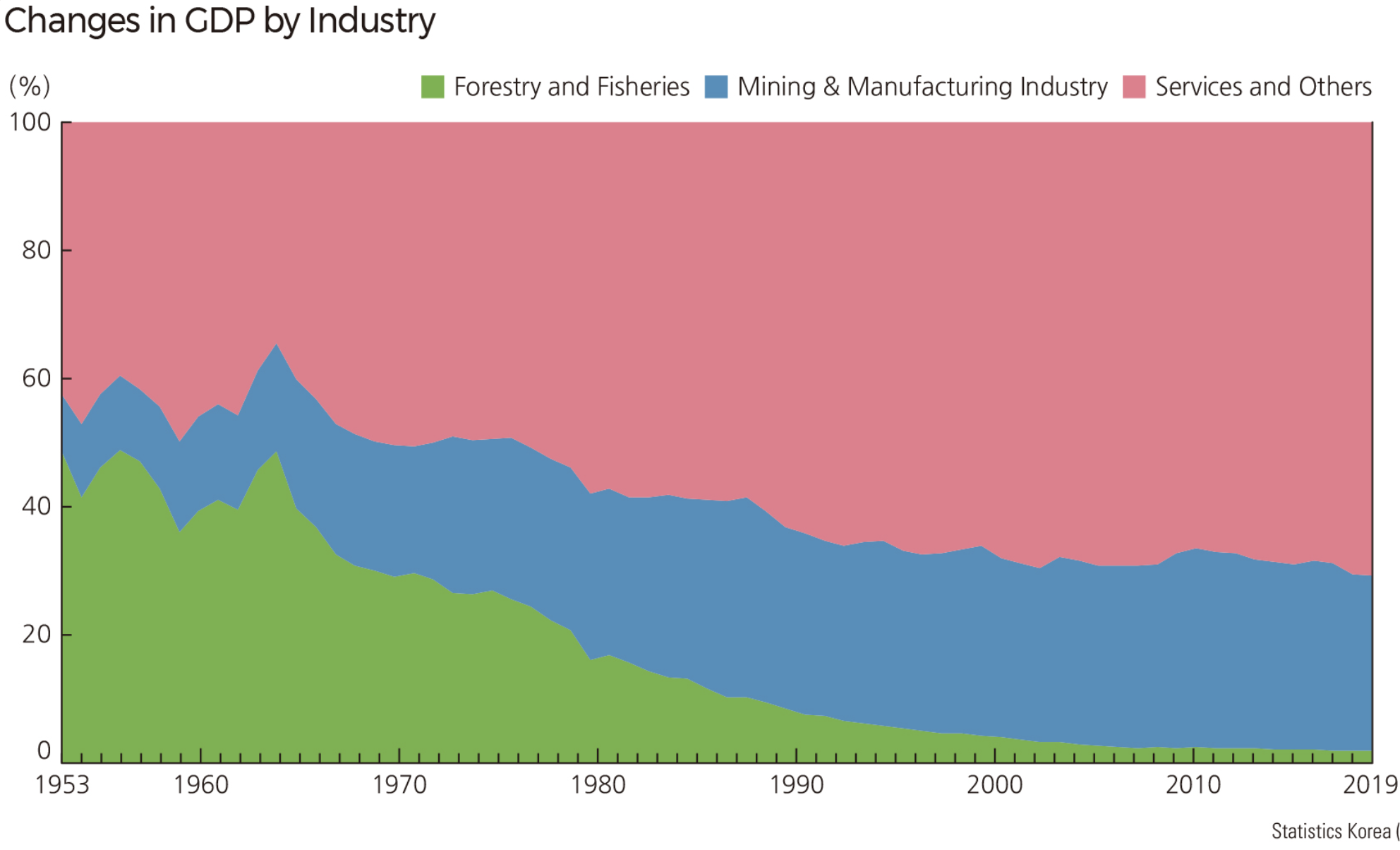
The proportion of the gross domestic product accounted for by the agriculture, forestry, and fishing industries declined sharply from 48.2% in 1953 to 28.9% in 1970, 8.4% in 1990, 2.4% in 2010, and only 2.0% in 2020. (National Atlas of Korea)
Between 1970 and 2020, employment in the agriculture, forestry, and fishing sectors declined sharply from approximately 4.85 million to 1.45 million workers. Over the same period, the share of these sectors in the total workforce fell significantly, dropping from around 50% to just 5.4%. From 2010 to 2019, the population in the agriculture, forestry, and fishing sectors was aging rapidly. The proportion of the population aged 65 years or over in the agriculture, forestry, and fishing sectors increased from about 31% in 2010 to about 46% in 2019.
Farmland owned by aging farmers can easily become abandoned after their retirement, as it often cannot be transferred to the next generation of farmers due to legal, economic, or social constraints (Lee, Oh, Yoo, & Suh, 2021). This structural labor decline reflects decades of migration and sectoral shifts.
Rural poverty in South Korea remains a persistent and complex issue. Despite decades of rapid development and modernization, stark disparities between urban and rural populations continue to widen. According to Statistics Korea, the relative poverty rate for rural households stood at approximately 23.1% in 2020, compared to 13.6% in urban areas, highlighting a consistent gap in living standards and income security. In addition, elderly poverty is disproportionately concentrated in rural regions, where over 45% of residents are aged 65 or older, many of whom rely on small-scale farming with limited pensions or financial support. The average income of rural households in 2022 was reported to be around KRW 40 million, significantly lower than the urban household average of KRW 65 million, revealing a structural income gap that remains difficult to close. These figures underscore the ongoing economic marginalization of rural areas, where job opportunities are scarce, educational and healthcare services are limited, and infrastructure investment is inconsistent. Moreover, as the agricultural sector contributes less than 2% to the national GDP, the economic power and political attention directed toward rural issues have diminished. This trend is exacerbated by demographic changes; rural depopulation and aging have led to what some experts refer to as "rural extinction zones," where basic services are no longer viable due to a critical mass of residents leaving. In contrast, urban centers like Seoul, Busan, and Incheon have experienced steady population inflows, investment in innovation and infrastructure, and increasing international connectivity, further deepening the urban–rural divide. While policies such as rural tourism, smart farming, and local revitalization funds have been introduced to address these challenges, the structural nature of rural poverty requires more than fragmented initiatives. A comprehensive, long-term strategy that integrates social welfare, job creation, land-use reform, and generational sustainability is essential if Korea is to ensure balanced national development and safeguard the well-being of its rural citizens.
Rural development strategies and policies in Korea for the past fifty years have been diverse in their objectives, promotion system, policy targets and beneficiaries, method of scaling up, etc. Korea’s rural development policies evolved through five landmark strategies, each responding to a distinct stage of national growth.
1960s – Early Community Development and Agricultural Reform:Korea’s rural development began with donor-supported community development projects under U.S. and UN guidance. These initiatives focused on agricultural modernization, infrastructure, and basic welfare (Lee, 2021).
1970s – Saemaul Undong (New Village Movement):President Park Chung-hee launched the Saemaul Undong in 1970 to foster self-reliance, modernization, and rural industrialization. It succeeded in improving roads, housing, and irrigation, and mobilized villages into collective action (Heo & Kim, 2016).
1980s–1990s – Post-Saemaul Institutional Expansion:After Saemaul's momentum slowed, the government introduced Comprehensive Rural Area Development and Settlement Zone Development programs. These targeted larger administrative areas but often lacked grassroots participation and financial sustainability (Lee, 2021). The comprehensive rural area development was the first development strategy which established the development plan on a systematic and comprehensive basis targeting the unit of gun.
2000s–Present – Welfare, Revitalization, and Decentralization:
The major rural development policies emerging since 2000 included the green village development project, the rural traditional theme village development project, the urban dwellers’ rural attraction support project, the rural village development project, the farming/fishing village theme park development project, and the farming/fishing village new-town development project. The project’s core components were organized into several categories: enhancing the village environment (such as creating small parks, developing village forests, and clearing abandoned land or long-vacant homes); building essential infrastructure (including village roads, parking areas, water and sewage systems, and construction or renovation of housing); establishing income-generating facilities (like communal seedling nurseries and shared storage or collection centers); preparing the village for the resettlement of retired urban residents (through redevelopment and spatial reorganization); and boosting village capacity (with consulting for village planning, promotional and marketing efforts, and programs aimed at attracting new residents).
Recent decades have emphasized quality-of-life improvements through decentralization and welfare-focused rural development. Projects include:
As Korea entered the 2010s, rural development policy faced a new reality: traditional tools, infrastructure upgrades, village beautification, tourism projects, and return-to-farm subsidies were no longer enough to counter aging, depopulation, and declining agricultural productivity. Earlier strategies had improved living conditions, but few created sustainable economic engines capable of retaining young people.
This policy gap set the stage for Korea’s latest rural development approach: technology-driven agriculture.
Launched in 2018 by the Ministry of Agriculture, Food and Rural Affairs, the Smart Farm Innovation Valley represents the most ambitious attempt to reshape rural Korea not through construction, but through economic and technological transformation. It is the clearest example of Korea’s shift toward innovation-based rural revitalization, following decades of infrastructure-heavy policies.
Each SFIV hub integrates:
These elements show that SFIV is not just an agricultural project; it is designed as a regional rural-revitalization ecosystem, aligning economic, demographic, and spatial strategies.
Thus, the Smart Farm initiative is not isolated, it is the logical continuation of Korea’s evolving rural policy:
CD → Saemaul Undong → Integrated regional plans → Lifestyle/welfare improvement → Innovation & high-tech agriculture
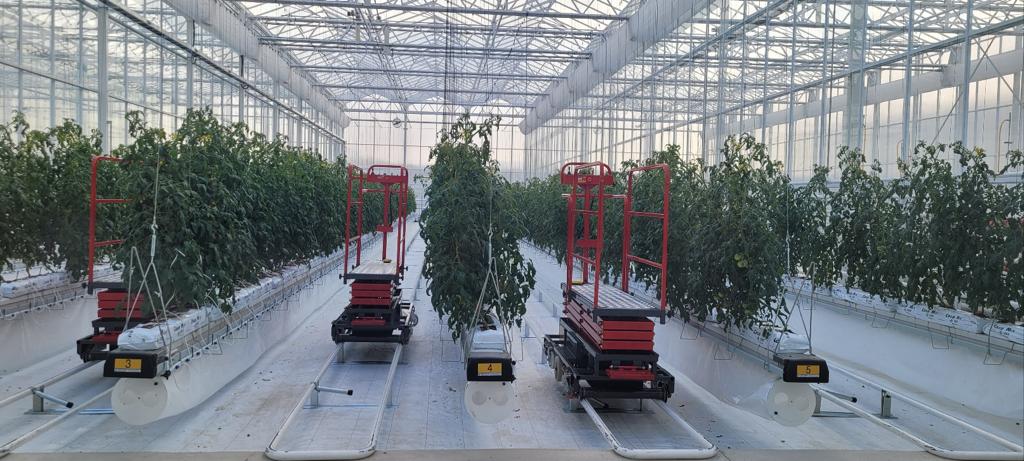
Despite its promise, SFIV faces constraints rooted in earlier demographic and structural patterns:
This reflects a key insight of Korea’s rural policy evolution: technological upgrades cannot compensate for long-term demographic decline or fragmented governance.
Smart farms represent a forward-looking adaptation of rural policy, but their success depends on integrating technology with broader reforms in land use, welfare, education, and rural governance.
Despite limitations, the Smart Farm Innovation Valley initiative is crucial because it signals a major shift:
In this sense, smart farms are not the solution to rural decline, but they may become a core component of a more adaptive, technologically capable rural economy.
Despite the variety of rural initiatives implemented over the past two decades, several structural and strategic weaknesses persist, limiting the effectiveness of Korea’s modern rural policy.
Fragmentation & Bureaucratic Silos: Ministries and agencies continue to operate independently, often duplicating efforts or failing to coordinate effectively. According to KREI (2020), this fragmentation results in poor policy cohesion, diluted outcomes, and local governments struggling with overcomplex procedures.
Demographic Inertia: Aging in rural areas is a deep-rooted structural issue. Even with youth-return incentives, many regions cannot overcome the accumulated effects of decades-long outmigration. KREI (2020) highlights that, from 2010 to 2019, the proportion of the elderly in the agriculture, forestry, and fishing sectors rose from 31% to 46%, reinforcing the difficulty of reversing these trends.
Mismatch Between Investment and Impact: Large financial inputs are not necessarily yielding lasting impact. KREI’s evaluation of flagship projects shows that infrastructure-focused investments often produce short-term results, such as renovated buildings or tourism zones, without improving actual rural living conditions or economic viability.
Placeless Design: Policy templates are often applied uniformly, regardless of each region’s social, cultural, and economic characteristics. KREI (2020) critiques this “one-size-fits-all” model for undermining local identity and missing opportunities to build on unique regional strengths.
Short-Term Thinking & Evaluation Gaps: The typical 3–5 year funding cycle encourages local actors to prioritize visible, quick results rather than long-term sustainability. KREI (2020) also found that post-project evaluation is weak, and knowledge sharing between regions remains limited, preventing adaptation and scaling of successful models.
“Rural development strategies should be aligned with the socio-economic stages of a country, not just its geography.”Heo & Kim (2016)
Korea’s rural decline underscores a central paradox: even as the nation has emerged as an economic powerhouse, its countryside continues to fall behind. The erosion of the agricultural workforce, accelerated aging, and youth migration reflect deep structural challenges. Despite bold policy interventions, such as smart farming clusters, rural tourism initiatives, and targeted revitalization funds the root of the problem lies not in a lack of effort, but in the misalignment between policy design and rural realities.
Fragmented governance, short-term funding cycles, and "placeless" one-size-fits-all approaches have diluted the effectiveness of even well-intentioned programs. Korea's rural strategy, to date, has too often prioritized infrastructure over identity, reinvention over sustainability, and quick fixes over rooted change.
As this report has shown, reversing rural decline will require a fundamental policy shift toward people-centered, place-based renewal. This entails training and empowering local leaders, fostering economic innovation that draws from regional strengths, and expanding incentives for youth return and community-led development.
Rural vitality in a developed society is not just about survival, it’s about creating places that sustain meaningful lives. For Korea to build an inclusive and resilient future, it must reimagine its rural policy not as an addendum to national growth, but as a core pillar of its social and economic identity.
.png)
Korea’s rapid industrialization transformed the country into a global economic powerhouse, but rural areas were left behind, facing aging, depopulation, and economic stagnation. This manuscript traces Korea’s rural policy evolution from early community development and the Saemaul Undong to recent revitalization efforts and smart-farm initiatives. It explains why these policies have struggled to reverse long-term decline. It argues that modern policies fall short because they do not adequately address structural demographic shifts, fragmented governance, and place-specific needs. The key takeaway is that Korea must shift toward people-centered, locally tailored, and long-term strategies for meaningful rural revitalization.
#rural development #rural policy #SFIV
The Republic of Korea’s transformation over the past half-century is one of the most remarkable stories of economic development in modern history. In the 1960s, Korea was still a largely rural, agriculture-based society; by the 2000s, it had become an advanced industrial economy with a global profile in manufacturing, technology, and services.
Yet this transformation, while generating world-class cities and industries, has left a quieter crisis in its wake: persistent rural decline.
Aging populations, youth outmigration, agricultural decline, and regional inequality.
Following the Korean War, South Korea’s rural population peaked at 19,6 million in 1966. However, this number declined sharply over the following decades, just 18% of the total population by 2010. The most significant drop occurred between 1975 and 1995, during the country’s industrialization, when large-scale migration from rural to urban areas took place.
Alongside large-scale migration, the age distribution between urban and rural populations shifted significantly. In 1960, the difference in age composition was minimal. By 2000, this gap had widened, with rural areas having a noticeably larger proportion of elderly people. This change occurred as younger, working-age individuals moved to cities in search of better employment and income opportunities. As a result, Korea’s population has been aging overall, with elderly individuals making up more than 14% of the rural population, compared to less than 7% in urban areas, indicating the country’s transition toward an aging society.
In 2019, the population structures of farm households by region showed that persons aged 65 years or over outnumbered other age groups. A mushroom-shaped population structure of farm households reflects that farm households are aging rapidly.
By the late 20th century, with the continuation of export-driven industrialization centered on heavy and chemical industries, agriculture's role in the national economy has began to decline. This shift led to a widening income gap between urban and rural households. Growing concerns over uneven regional development began to emerge. As farm household debt rose and rural depopulation accelerated, dissatisfaction with agricultural policies became increasingly pronounced (Seong et al., 2011).

The proportion of the gross domestic product accounted for by the agriculture, forestry, and fishing industries declined sharply from 48.2% in 1953 to 28.9% in 1970, 8.4% in 1990, 2.4% in 2010, and only 2.0% in 2020. (National Atlas of Korea)
Between 1970 and 2020, employment in the agriculture, forestry, and fishing sectors declined sharply from approximately 4.85 million to 1.45 million workers. Over the same period, the share of these sectors in the total workforce fell significantly, dropping from around 50% to just 5.4%. From 2010 to 2019, the population in the agriculture, forestry, and fishing sectors was aging rapidly. The proportion of the population aged 65 years or over in the agriculture, forestry, and fishing sectors increased from about 31% in 2010 to about 46% in 2019.
Farmland owned by aging farmers can easily become abandoned after their retirement, as it often cannot be transferred to the next generation of farmers due to legal, economic, or social constraints (Lee, Oh, Yoo, & Suh, 2021). This structural labor decline reflects decades of migration and sectoral shifts.
Rural poverty in South Korea remains a persistent and complex issue. Despite decades of rapid development and modernization, stark disparities between urban and rural populations continue to widen. According to Statistics Korea, the relative poverty rate for rural households stood at approximately 23.1% in 2020, compared to 13.6% in urban areas, highlighting a consistent gap in living standards and income security. In addition, elderly poverty is disproportionately concentrated in rural regions, where over 45% of residents are aged 65 or older, many of whom rely on small-scale farming with limited pensions or financial support. The average income of rural households in 2022 was reported to be around KRW 40 million, significantly lower than the urban household average of KRW 65 million, revealing a structural income gap that remains difficult to close. These figures underscore the ongoing economic marginalization of rural areas, where job opportunities are scarce, educational and healthcare services are limited, and infrastructure investment is inconsistent. Moreover, as the agricultural sector contributes less than 2% to the national GDP, the economic power and political attention directed toward rural issues have diminished. This trend is exacerbated by demographic changes; rural depopulation and aging have led to what some experts refer to as "rural extinction zones," where basic services are no longer viable due to a critical mass of residents leaving. In contrast, urban centers like Seoul, Busan, and Incheon have experienced steady population inflows, investment in innovation and infrastructure, and increasing international connectivity, further deepening the urban–rural divide. While policies such as rural tourism, smart farming, and local revitalization funds have been introduced to address these challenges, the structural nature of rural poverty requires more than fragmented initiatives. A comprehensive, long-term strategy that integrates social welfare, job creation, land-use reform, and generational sustainability is essential if Korea is to ensure balanced national development and safeguard the well-being of its rural citizens.
Rural development strategies and policies in Korea for the past fifty years have been diverse in their objectives, promotion system, policy targets and beneficiaries, method of scaling up, etc. Korea’s rural development policies evolved through five landmark strategies, each responding to a distinct stage of national growth.
1960s – Early Community Development and Agricultural Reform:Korea’s rural development began with donor-supported community development projects under U.S. and UN guidance. These initiatives focused on agricultural modernization, infrastructure, and basic welfare (Lee, 2021).
1970s – Saemaul Undong (New Village Movement):President Park Chung-hee launched the Saemaul Undong in 1970 to foster self-reliance, modernization, and rural industrialization. It succeeded in improving roads, housing, and irrigation, and mobilized villages into collective action (Heo & Kim, 2016).
1980s–1990s – Post-Saemaul Institutional Expansion:After Saemaul's momentum slowed, the government introduced Comprehensive Rural Area Development and Settlement Zone Development programs. These targeted larger administrative areas but often lacked grassroots participation and financial sustainability (Lee, 2021). The comprehensive rural area development was the first development strategy which established the development plan on a systematic and comprehensive basis targeting the unit of gun.
2000s–Present – Welfare, Revitalization, and Decentralization:
The major rural development policies emerging since 2000 included the green village development project, the rural traditional theme village development project, the urban dwellers’ rural attraction support project, the rural village development project, the farming/fishing village theme park development project, and the farming/fishing village new-town development project. The project’s core components were organized into several categories: enhancing the village environment (such as creating small parks, developing village forests, and clearing abandoned land or long-vacant homes); building essential infrastructure (including village roads, parking areas, water and sewage systems, and construction or renovation of housing); establishing income-generating facilities (like communal seedling nurseries and shared storage or collection centers); preparing the village for the resettlement of retired urban residents (through redevelopment and spatial reorganization); and boosting village capacity (with consulting for village planning, promotional and marketing efforts, and programs aimed at attracting new residents).
Recent decades have emphasized quality-of-life improvements through decentralization and welfare-focused rural development. Projects include:
As Korea entered the 2010s, rural development policy faced a new reality: traditional tools, infrastructure upgrades, village beautification, tourism projects, and return-to-farm subsidies were no longer enough to counter aging, depopulation, and declining agricultural productivity. Earlier strategies had improved living conditions, but few created sustainable economic engines capable of retaining young people.
This policy gap set the stage for Korea’s latest rural development approach: technology-driven agriculture.
Launched in 2018 by the Ministry of Agriculture, Food and Rural Affairs, the Smart Farm Innovation Valley represents the most ambitious attempt to reshape rural Korea not through construction, but through economic and technological transformation. It is the clearest example of Korea’s shift toward innovation-based rural revitalization, following decades of infrastructure-heavy policies.
Each SFIV hub integrates:
These elements show that SFIV is not just an agricultural project; it is designed as a regional rural-revitalization ecosystem, aligning economic, demographic, and spatial strategies.
Thus, the Smart Farm initiative is not isolated, it is the logical continuation of Korea’s evolving rural policy:
CD → Saemaul Undong → Integrated regional plans → Lifestyle/welfare improvement → Innovation & high-tech agriculture

Despite its promise, SFIV faces constraints rooted in earlier demographic and structural patterns:
This reflects a key insight of Korea’s rural policy evolution: technological upgrades cannot compensate for long-term demographic decline or fragmented governance.
Smart farms represent a forward-looking adaptation of rural policy, but their success depends on integrating technology with broader reforms in land use, welfare, education, and rural governance.
Despite limitations, the Smart Farm Innovation Valley initiative is crucial because it signals a major shift:
In this sense, smart farms are not the solution to rural decline, but they may become a core component of a more adaptive, technologically capable rural economy.
Despite the variety of rural initiatives implemented over the past two decades, several structural and strategic weaknesses persist, limiting the effectiveness of Korea’s modern rural policy.
Fragmentation & Bureaucratic Silos: Ministries and agencies continue to operate independently, often duplicating efforts or failing to coordinate effectively. According to KREI (2020), this fragmentation results in poor policy cohesion, diluted outcomes, and local governments struggling with overcomplex procedures.
Demographic Inertia: Aging in rural areas is a deep-rooted structural issue. Even with youth-return incentives, many regions cannot overcome the accumulated effects of decades-long outmigration. KREI (2020) highlights that, from 2010 to 2019, the proportion of the elderly in the agriculture, forestry, and fishing sectors rose from 31% to 46%, reinforcing the difficulty of reversing these trends.
Mismatch Between Investment and Impact: Large financial inputs are not necessarily yielding lasting impact. KREI’s evaluation of flagship projects shows that infrastructure-focused investments often produce short-term results, such as renovated buildings or tourism zones, without improving actual rural living conditions or economic viability.
Placeless Design: Policy templates are often applied uniformly, regardless of each region’s social, cultural, and economic characteristics. KREI (2020) critiques this “one-size-fits-all” model for undermining local identity and missing opportunities to build on unique regional strengths.
Short-Term Thinking & Evaluation Gaps: The typical 3–5 year funding cycle encourages local actors to prioritize visible, quick results rather than long-term sustainability. KREI (2020) also found that post-project evaluation is weak, and knowledge sharing between regions remains limited, preventing adaptation and scaling of successful models.
“Rural development strategies should be aligned with the socio-economic stages of a country, not just its geography.”Heo & Kim (2016)
Korea’s rural decline underscores a central paradox: even as the nation has emerged as an economic powerhouse, its countryside continues to fall behind. The erosion of the agricultural workforce, accelerated aging, and youth migration reflect deep structural challenges. Despite bold policy interventions, such as smart farming clusters, rural tourism initiatives, and targeted revitalization funds the root of the problem lies not in a lack of effort, but in the misalignment between policy design and rural realities.
Fragmented governance, short-term funding cycles, and "placeless" one-size-fits-all approaches have diluted the effectiveness of even well-intentioned programs. Korea's rural strategy, to date, has too often prioritized infrastructure over identity, reinvention over sustainability, and quick fixes over rooted change.
As this report has shown, reversing rural decline will require a fundamental policy shift toward people-centered, place-based renewal. This entails training and empowering local leaders, fostering economic innovation that draws from regional strengths, and expanding incentives for youth return and community-led development.
Rural vitality in a developed society is not just about survival, it’s about creating places that sustain meaningful lives. For Korea to build an inclusive and resilient future, it must reimagine its rural policy not as an addendum to national growth, but as a core pillar of its social and economic identity.
.png)
The Republic of Korea’s transformation over the past half-century is one of the most remarkable stories of economic development in modern history. In the 1960s, Korea was still a largely rural, agriculture-based society; by the 2000s, it had become an advanced industrial economy with a global profile in manufacturing, technology, and services.
Yet this transformation, while generating world-class cities and industries, has left a quieter crisis in its wake: persistent rural decline.
Aging populations, youth outmigration, agricultural decline, and regional inequality.
Following the Korean War, South Korea’s rural population peaked at 19,6 million in 1966. However, this number declined sharply over the following decades, just 18% of the total population by 2010. The most significant drop occurred between 1975 and 1995, during the country’s industrialization, when large-scale migration from rural to urban areas took place.
Alongside large-scale migration, the age distribution between urban and rural populations shifted significantly. In 1960, the difference in age composition was minimal. By 2000, this gap had widened, with rural areas having a noticeably larger proportion of elderly people. This change occurred as younger, working-age individuals moved to cities in search of better employment and income opportunities. As a result, Korea’s population has been aging overall, with elderly individuals making up more than 14% of the rural population, compared to less than 7% in urban areas, indicating the country’s transition toward an aging society.
In 2019, the population structures of farm households by region showed that persons aged 65 years or over outnumbered other age groups. A mushroom-shaped population structure of farm households reflects that farm households are aging rapidly.
By the late 20th century, with the continuation of export-driven industrialization centered on heavy and chemical industries, agriculture's role in the national economy has began to decline. This shift led to a widening income gap between urban and rural households. Growing concerns over uneven regional development began to emerge. As farm household debt rose and rural depopulation accelerated, dissatisfaction with agricultural policies became increasingly pronounced (Seong et al., 2011).

The proportion of the gross domestic product accounted for by the agriculture, forestry, and fishing industries declined sharply from 48.2% in 1953 to 28.9% in 1970, 8.4% in 1990, 2.4% in 2010, and only 2.0% in 2020. (National Atlas of Korea)
Between 1970 and 2020, employment in the agriculture, forestry, and fishing sectors declined sharply from approximately 4.85 million to 1.45 million workers. Over the same period, the share of these sectors in the total workforce fell significantly, dropping from around 50% to just 5.4%. From 2010 to 2019, the population in the agriculture, forestry, and fishing sectors was aging rapidly. The proportion of the population aged 65 years or over in the agriculture, forestry, and fishing sectors increased from about 31% in 2010 to about 46% in 2019.
Farmland owned by aging farmers can easily become abandoned after their retirement, as it often cannot be transferred to the next generation of farmers due to legal, economic, or social constraints (Lee, Oh, Yoo, & Suh, 2021). This structural labor decline reflects decades of migration and sectoral shifts.
Rural poverty in South Korea remains a persistent and complex issue. Despite decades of rapid development and modernization, stark disparities between urban and rural populations continue to widen. According to Statistics Korea, the relative poverty rate for rural households stood at approximately 23.1% in 2020, compared to 13.6% in urban areas, highlighting a consistent gap in living standards and income security. In addition, elderly poverty is disproportionately concentrated in rural regions, where over 45% of residents are aged 65 or older, many of whom rely on small-scale farming with limited pensions or financial support. The average income of rural households in 2022 was reported to be around KRW 40 million, significantly lower than the urban household average of KRW 65 million, revealing a structural income gap that remains difficult to close. These figures underscore the ongoing economic marginalization of rural areas, where job opportunities are scarce, educational and healthcare services are limited, and infrastructure investment is inconsistent. Moreover, as the agricultural sector contributes less than 2% to the national GDP, the economic power and political attention directed toward rural issues have diminished. This trend is exacerbated by demographic changes; rural depopulation and aging have led to what some experts refer to as "rural extinction zones," where basic services are no longer viable due to a critical mass of residents leaving. In contrast, urban centers like Seoul, Busan, and Incheon have experienced steady population inflows, investment in innovation and infrastructure, and increasing international connectivity, further deepening the urban–rural divide. While policies such as rural tourism, smart farming, and local revitalization funds have been introduced to address these challenges, the structural nature of rural poverty requires more than fragmented initiatives. A comprehensive, long-term strategy that integrates social welfare, job creation, land-use reform, and generational sustainability is essential if Korea is to ensure balanced national development and safeguard the well-being of its rural citizens.
Rural development strategies and policies in Korea for the past fifty years have been diverse in their objectives, promotion system, policy targets and beneficiaries, method of scaling up, etc. Korea’s rural development policies evolved through five landmark strategies, each responding to a distinct stage of national growth.
1960s – Early Community Development and Agricultural Reform:Korea’s rural development began with donor-supported community development projects under U.S. and UN guidance. These initiatives focused on agricultural modernization, infrastructure, and basic welfare (Lee, 2021).
1970s – Saemaul Undong (New Village Movement):President Park Chung-hee launched the Saemaul Undong in 1970 to foster self-reliance, modernization, and rural industrialization. It succeeded in improving roads, housing, and irrigation, and mobilized villages into collective action (Heo & Kim, 2016).
1980s–1990s – Post-Saemaul Institutional Expansion:After Saemaul's momentum slowed, the government introduced Comprehensive Rural Area Development and Settlement Zone Development programs. These targeted larger administrative areas but often lacked grassroots participation and financial sustainability (Lee, 2021). The comprehensive rural area development was the first development strategy which established the development plan on a systematic and comprehensive basis targeting the unit of gun.
2000s–Present – Welfare, Revitalization, and Decentralization:
The major rural development policies emerging since 2000 included the green village development project, the rural traditional theme village development project, the urban dwellers’ rural attraction support project, the rural village development project, the farming/fishing village theme park development project, and the farming/fishing village new-town development project. The project’s core components were organized into several categories: enhancing the village environment (such as creating small parks, developing village forests, and clearing abandoned land or long-vacant homes); building essential infrastructure (including village roads, parking areas, water and sewage systems, and construction or renovation of housing); establishing income-generating facilities (like communal seedling nurseries and shared storage or collection centers); preparing the village for the resettlement of retired urban residents (through redevelopment and spatial reorganization); and boosting village capacity (with consulting for village planning, promotional and marketing efforts, and programs aimed at attracting new residents).
Recent decades have emphasized quality-of-life improvements through decentralization and welfare-focused rural development. Projects include:
As Korea entered the 2010s, rural development policy faced a new reality: traditional tools, infrastructure upgrades, village beautification, tourism projects, and return-to-farm subsidies were no longer enough to counter aging, depopulation, and declining agricultural productivity. Earlier strategies had improved living conditions, but few created sustainable economic engines capable of retaining young people.
This policy gap set the stage for Korea’s latest rural development approach: technology-driven agriculture.
Launched in 2018 by the Ministry of Agriculture, Food and Rural Affairs, the Smart Farm Innovation Valley represents the most ambitious attempt to reshape rural Korea not through construction, but through economic and technological transformation. It is the clearest example of Korea’s shift toward innovation-based rural revitalization, following decades of infrastructure-heavy policies.
Each SFIV hub integrates:
These elements show that SFIV is not just an agricultural project; it is designed as a regional rural-revitalization ecosystem, aligning economic, demographic, and spatial strategies.
Thus, the Smart Farm initiative is not isolated, it is the logical continuation of Korea’s evolving rural policy:
CD → Saemaul Undong → Integrated regional plans → Lifestyle/welfare improvement → Innovation & high-tech agriculture

Despite its promise, SFIV faces constraints rooted in earlier demographic and structural patterns:
This reflects a key insight of Korea’s rural policy evolution: technological upgrades cannot compensate for long-term demographic decline or fragmented governance.
Smart farms represent a forward-looking adaptation of rural policy, but their success depends on integrating technology with broader reforms in land use, welfare, education, and rural governance.
Despite limitations, the Smart Farm Innovation Valley initiative is crucial because it signals a major shift:
In this sense, smart farms are not the solution to rural decline, but they may become a core component of a more adaptive, technologically capable rural economy.
Despite the variety of rural initiatives implemented over the past two decades, several structural and strategic weaknesses persist, limiting the effectiveness of Korea’s modern rural policy.
Fragmentation & Bureaucratic Silos: Ministries and agencies continue to operate independently, often duplicating efforts or failing to coordinate effectively. According to KREI (2020), this fragmentation results in poor policy cohesion, diluted outcomes, and local governments struggling with overcomplex procedures.
Demographic Inertia: Aging in rural areas is a deep-rooted structural issue. Even with youth-return incentives, many regions cannot overcome the accumulated effects of decades-long outmigration. KREI (2020) highlights that, from 2010 to 2019, the proportion of the elderly in the agriculture, forestry, and fishing sectors rose from 31% to 46%, reinforcing the difficulty of reversing these trends.
Mismatch Between Investment and Impact: Large financial inputs are not necessarily yielding lasting impact. KREI’s evaluation of flagship projects shows that infrastructure-focused investments often produce short-term results, such as renovated buildings or tourism zones, without improving actual rural living conditions or economic viability.
Placeless Design: Policy templates are often applied uniformly, regardless of each region’s social, cultural, and economic characteristics. KREI (2020) critiques this “one-size-fits-all” model for undermining local identity and missing opportunities to build on unique regional strengths.
Short-Term Thinking & Evaluation Gaps: The typical 3–5 year funding cycle encourages local actors to prioritize visible, quick results rather than long-term sustainability. KREI (2020) also found that post-project evaluation is weak, and knowledge sharing between regions remains limited, preventing adaptation and scaling of successful models.
“Rural development strategies should be aligned with the socio-economic stages of a country, not just its geography.”Heo & Kim (2016)
Korea’s rural decline underscores a central paradox: even as the nation has emerged as an economic powerhouse, its countryside continues to fall behind. The erosion of the agricultural workforce, accelerated aging, and youth migration reflect deep structural challenges. Despite bold policy interventions, such as smart farming clusters, rural tourism initiatives, and targeted revitalization funds the root of the problem lies not in a lack of effort, but in the misalignment between policy design and rural realities.
Fragmented governance, short-term funding cycles, and "placeless" one-size-fits-all approaches have diluted the effectiveness of even well-intentioned programs. Korea's rural strategy, to date, has too often prioritized infrastructure over identity, reinvention over sustainability, and quick fixes over rooted change.
As this report has shown, reversing rural decline will require a fundamental policy shift toward people-centered, place-based renewal. This entails training and empowering local leaders, fostering economic innovation that draws from regional strengths, and expanding incentives for youth return and community-led development.
Rural vitality in a developed society is not just about survival, it’s about creating places that sustain meaningful lives. For Korea to build an inclusive and resilient future, it must reimagine its rural policy not as an addendum to national growth, but as a core pillar of its social and economic identity.