

Back to List
K-Dev Original

Korea’s Expressway Evolution: Development Path and Financing

Summary

Korea’s expressway system’s development and financing evolution started since the post-war era. Early expressways in the 1960s and 1970s, the Seoul-Busan route, were built under the Five-Year Economic Development Plan (FYEDP) to support the nation's export-oriented economy, despite initial opposition and high costs. In the 1990s, to address road congestions caused by rapid economic growth and soaring use of vehicles, further significant expansion was made by the massive investment from central government and the Korea Expressway Corporation (KEC), using mechanism transport taxes and Public-Private Partnership (PPPs). The economic evaluation system for transport projects changes to a more rigorous preliminary feasibility study (PFS) system implemented after 1999 to ensure efficient public spending and reduce fiscal risk

Key Questions

  • How did the state's prioritization of rapid transport to support the export-oriented economy compromise crucial expressway standards?
  • How did the fundamental shift in financing mechanisms to Public-Private Partnerships (PPPs) impact the long-term fiscal health of the sector?
  • How effective were the 1999 PFS* system and the 2005 PPP FS** system in reducing asymmetric information and improving the efficient allocation of public funds?
    * PFS: Preliminary Feasibility Study, * FS: Feasibility Study\

#expressway #expressway construction #expressway financing #feasibility #PPP

Post-War: Building ‘Concrete Arteries’ For Nation to Thrive On

In the aftermath of the Korean War in the 1950s, South Korea was a nation in ruins. With a GDP per capita under USD 100 and 97% of its roads unpaved, the country faced a monumental task of reconstruction. Yet, from this state of devastation, Korea engineered one of the most rapid economic transformations in modern history. A central pillar of this "economic miracle" was the ambitious and systematic development of a national expressway system. These were not merely roads; they were the arteries of a new, export-oriented economy, designed to move goods, people, and a nation forward. This report charts the four distinct phases of the expressway system's evolution: from a high-risk economic catalyst in an impoverished nation, to a sprawling network combating the congestion of its own success, to a model of innovative financing, and finally, to a mature system guided by rigorous fiscal accountability.

Expressways Foundation: a Catalyst for Economic Growth (1960s-1970s)

In the 1960s, the South Korean government's primary goal was national revitalization through an export-oriented economy. To achieve this, leaders recognized that a modern infrastructure network was not a luxury but an absolute necessity. Expressways were identified as the critical arteries that would connect industrial centers to ports, fueling the nation's economic engine. This vision was formalized within the first Five-Year Economic Development Plan (FYEDP), which began in 1962 and delivered unexpectedly high economic growth, surging from 3.5% in its first year to a remarkable 13.4% by 1966.

The first step was the Seoul-Incheon expressway. Its purpose was strategically clear: to relieve serious traffic congestion between the capital city and the major port of Incheon. At just 23.5km and crossing flat terrain with no major mountains or rivers, its construction was relatively straightforward and its financing was readily supported by a loan from the Asian Development Bank.

Seoul-Incheon Expressway: https://www.koreatimes.co.kr/southkorea/globalcommunity/20210223/korea-encounters-korea-enters-highway-age-50-years-ago

In stark contrast was the next project: the ambitious and highly controversial Seoul-Busan expressway. Spurred by the success of the first FYEDP, the government planned to develop large-scale industrial complexes in the southeast near the port city of Busan. A high-speed road connecting the capital to this industrial heartland was deemed essential. However, the project faced strong opposition from both domestic experts and international institutions. The International Bank of Reconstruction and Development (IBRD) concluded it was simply too early for Korea to build such an expressway, given its economic situation.

Seoul-Busan Expressway in 1970. Source: https://www.hyundai.com/worldwide/en/newsroom/detail/driven-to-distinction-the-modern-miracle-of-south-korea-0000000310

The financial and technical challenges were immense. The expressway would stretch 428km across mountainous terrain, requiring engineering techniques that domestic contractors did not yet possess. The final cost ballooned to KRW 43 billion—an astonishing sum that represented nearly one-fourth of the entire 1967 national budget. To fund this high-risk mega-project, the government took drastic measures, including doubling the gasoline tax.

The construction itself was a testament to the government's resolve, carried out with extreme urgency and at a great human cost. To reduce expenses and meet a punishing deadline, design criteria were set low, construction work continued day and night, and some military personnel were forced to work for free. The engineering challenges were brutal; while constructing one of the most difficult tunnels, it collapsed 13 times. Safety concerns were often ignored, leading to the tragic deaths of 77 workers. The low design criteria created a long-term legacy of problems, causing a high number of traffic accidents during the expressway’s operation and requiring costly redesigns and lane expansions in the 1990s and 2000s.

Despite the controversy and hardship, the Seoul-Busan expressway was completed in just two years and five months—a feat considered a miracle in infrastructure history. Its impact was immediate and profound. The travel time between the nation's two largest cities was dramatically reduced from 15 hours to 5 hours. This directly boosted the productivity of Korea's export-driven industries by saving enormous amounts of time for both passengers and freight, creating a powerful multiplier effect that further fueled economic growth. The success of the Seoul-Busan expressway proved the government's vision correct, but this very success would soon create a new set of challenges for the burgeoning network.

Expressway Expansion: Combating the Congestion (1980s-1990s)

The economic success catalyzed by the early expressways created a new and unforeseen problem. By the 1980s and 1990s, rapid development and rising incomes led to an explosion in vehicle ownership that threatened to choke the very arteries built to support the economy. The strategic focus shifted from building a foundational network to aggressively expanding it to relieve crippling congestion.

The statistics on vehicle growth illustrate the scale of the impending crisis. The number of vehicles in South Korea surged from 528 thousand in 1980 to over 3.3 million by 1990, and then more than tripled again to 12 million by 2000, with a particularly conspicuous increase in private cars. During the 1980s, government policy focused on rehabilitating existing general, un-tolled roads rather than building new high-capacity expressways. This strategic misallocation created a critical imbalance where "the road supply could not have matched the road demand."

In response to this crisis, the government in the early 1990s prioritized a massive expressway expansion, recognizing that expressways offered higher efficiency in terms of vehicle capacity per investment cost. The scale of this new construction phase was enormous, with annual investment jumping from KRW 342 billion in 1990 to KRW 4,223 billion in 2000. By 2015, the national network reached 4,193km, making it one of the longest in the world by per capita, per vehicle, and per-land-area metrics.

The length of expressways in 2015 is 4,193km, which has expanded so rapidly during the last 50 years. In terms of the network length, Korea has the 7th longest expressway in the world. US, Canada, Germany, France, Japan, and China have the expressway network longer than Korea. In terms of per capita network length, Korea has the 5th longest expressway, if the Benelux countries with small land areas are excluded. Even in terms of per vehicle network length, Korea has the 6th longest expressway, if the Benelux countries are also excluded. Particularly in terms of per km2 land network length, Korea has the highest expressway as 41.3km/km2, apart from the Benelux countries.

This era also saw a significant technological modernization of the network. Beginning in 1993, Integrated Transport Systems (ITS) were introduced, primarily focusing on a Traffic Management System (TMS) to monitor and control traffic flow and an Electronic Toll Collection System (ETCS) to reduce delays at toll gates. These systems were supported by a vast network of fiber-optic communications and thousands of pieces of hardware, including over 2,100 vehicle detectors and nearly 1,800 CCTVs as of 2016, transforming the expressways into a modern, responsive infrastructure system. This massive and technologically advanced expansion, however, raised a critical question: how could a nation continue to fund such growth?

Expressway during the 1990s. Source: https://arca.live/b/city/148590965

Expressway’s Financing: Innovative Funding for a Growing Nation

By the 1990s, the sheer scale of the required infrastructure investment outstripped the capacity of traditional government budgets. This challenge forced the development of new, sustainable funding mechanisms to support the nation's continued growth. South Korea's response was a two-pronged strategy combining dedicated tax revenues and private sector partnerships.

First, the government introduced an ear-marked transport tax system. To fund the expansion and overcome strong public opposition to tax hikes, the government doubled taxes on gasoline and diesel in 1994. Crucially, it enacted a policy stipulating that all transport tax revenues should be used only for transport infrastructure investment. This created a dedicated and predictable revenue stream that grew from KRW 3.4 trillion in 1995 to KRW 14.1 trillion by 2015, providing the stable financial foundation for long-term planning and construction. This financing tool was later adapted to meet broader national goals; in 2007, the tax was changed to the transport, energy, and environment tax, allowing revenues to be invested in those related sectors as well.


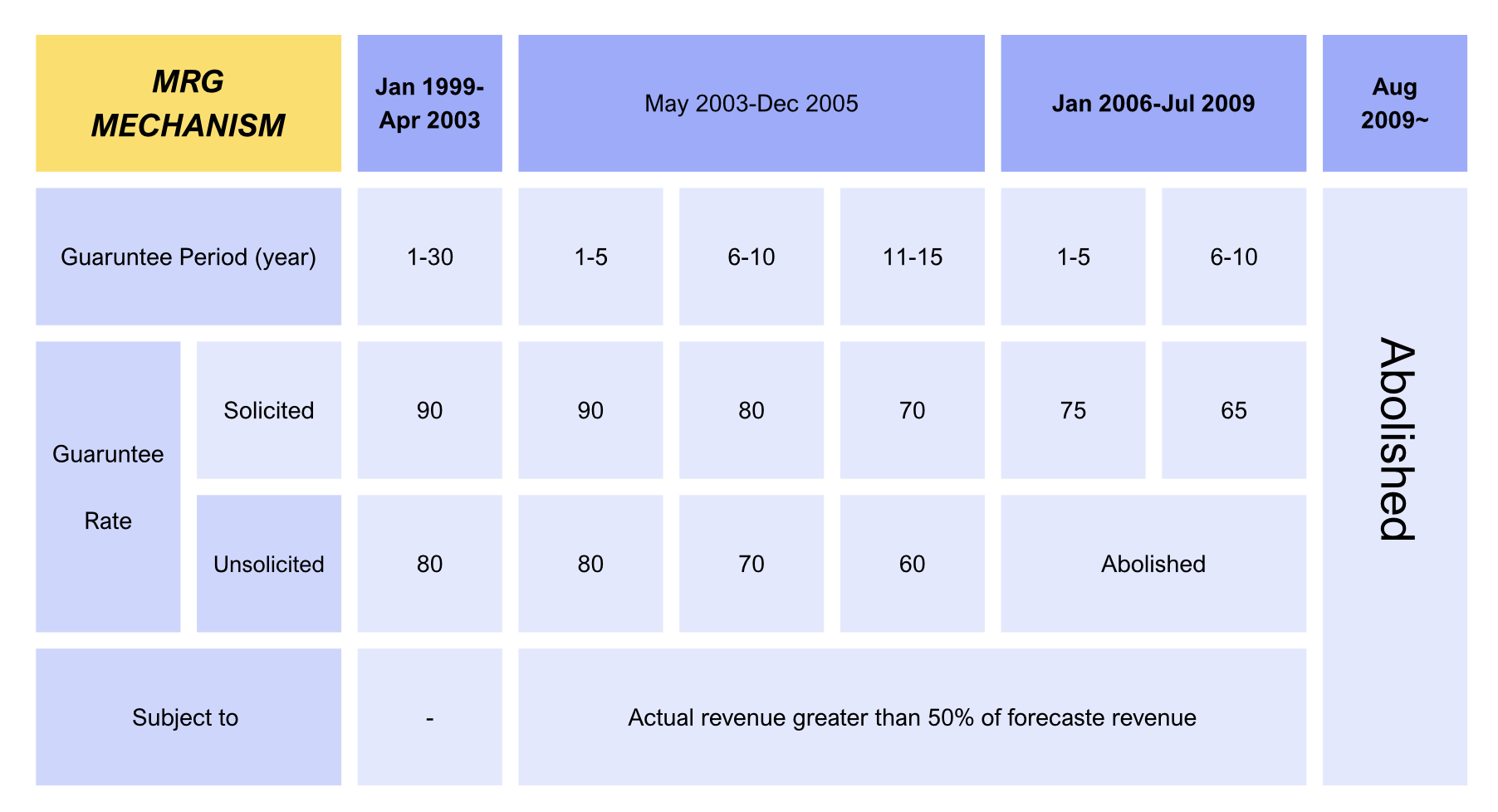
Second, the government turned to Public-Private Partnerships (PPPs) as another key funding pillar. An initial PPP law passed in 1994 proved largely unsuccessful, as it placed most of the financial risk on the private sector. The breakthrough came with a critical amendment to the law in 1999. This revision introduced the Minimum Revenue Guarantee (MRG) mechanism, which mitigated the demand forecast risk for private investors by guaranteeing a large proportion of their projected revenue. This single change unlocked a wave of private investment, spurring the procurement of numerous PPP expressway projects, particularly around the congested Seoul metropolitan area. These innovative financing tools were highly effective, but the massive flows of capital soon highlighted a growing need for greater oversight and fiscal discipline.

Minimum Revenue Guarantee (MRG) mechanism

soure: MRG Mechanism; adapted from: https://www.kdevelopedia.org/Development-Topics/themes/Expressway-Construction-and-Management--21 open edit access through: https://www.canva.com/design/DAG48sw2ojc/MbXEm-dNl17xxQel3TFrUw/edit?utm_content=DAG48sw2ojc&utm_campaign=designshare&utm_medium=link2&utm_source=sharebutton

Expressway’s Accountability: The Shift to Rigorous Project Evaluation

The fourth and final phase of the expressway's evolution was shaped by a new imperative for fiscal responsibility and objective evaluation. This shift was driven by a combination of factors: the 1997 Asian financial crisis which strained government budgets, the near-completion of the core national network, and a growing recognition that past project proposals had often been based on overly optimistic assumptions.

Previously, project evaluations were conducted through Feasibility Studies (FS) managed by the Ministry of Transport (MOT). This system had a significant flaw: it was common for these studies to overestimate traffic demand and underestimate costs, resulting in nearly all proposed projects being deemed economically feasible. The primary challenge was simply finding the money, which placed a heavy burden on the Ministry of Strategy and Finance (MOSF).

This changed dramatically with the introduction of the Preliminary Feasibility Study (PFS) system in 1999. The key reform was that the PFS was supervised by the MOSF, not the MOT, to ensure objectivity. The new system utilized standardized national transport databases and clear guidelines for estimating costs and benefits. The impact was immediate: this new, rigorous process resulted in the rejection of about half of the projects submitted by the MOT, leading to a vast improvement in the efficiency of government budget spending.

Preliminary Feasible System; adapted from: https://www.kdevelopedia.org/Development-Topics/themes/Expressway-Construction-and-Management--21

A similar evolution occurred in the oversight of unsolicited PPP projects. Between 1999 and 2005, the government approved nearly all private proposals. This created a situation of "asymmetric information" where private proposers held all the proprietary data and models for their traffic forecasts, leaving the government with no independent means to verify their optimistic claims and exposing the treasury to immense fiscal risk from MRG payouts.

Solicited PPP project selection and development ;adapted from: https://www.kdevelopedia.org/Development-Topics/themes/Expressway-Construction-and-Management--21 open access edit: https://www.canva.com/design/DAG48om6q84/MVVPnN5rAdwxSg-Cll3dQg/edit?utm_content=DAG48om6q84&utm_campaign=designshare&utm_medium=link2&utm_source=sharebutton

To correct this, a crucial policy shift occurred in 2005. The government introduced a rigorous and independent PPP Feasibility Study, conducted by an impartial body like the Korea Development Institute (KDI), to validate all private sector proposals. This independent review process revealed that in most cases, demand had been significantly overestimated by private proposers. As a result, more than half of unsolicited projects were rejected as economically infeasible, protecting the public from unsustainable financial commitments.

From its origins as a bold gamble to kickstart a shattered economy, South Korea's expressway system evolved through four distinct eras. It began as a foundational catalystfor growth, underwent massive expansion to cope with its success, pioneered innovative financing to sustain its development, and ultimately matured into a system governed by strict accountability. This journey from rubble to superhighway offers a powerful narrative of how strategic infrastructure, coupled with adaptive policy, can build and sustain a nation.

References

Author
Eui-young Shon
University of Seoul
cite this work

Korea’s Expressway Evolution: Development Path and Financing

K-Dev Original
February 2, 2026
This is some text inside of a div block.

Summary

Korea’s expressway system’s development and financing evolution started since the post-war era. Early expressways in the 1960s and 1970s, the Seoul-Busan route, were built under the Five-Year Economic Development Plan (FYEDP) to support the nation's export-oriented economy, despite initial opposition and high costs. In the 1990s, to address road congestions caused by rapid economic growth and soaring use of vehicles, further significant expansion was made by the massive investment from central government and the Korea Expressway Corporation (KEC), using mechanism transport taxes and Public-Private Partnership (PPPs). The economic evaluation system for transport projects changes to a more rigorous preliminary feasibility study (PFS) system implemented after 1999 to ensure efficient public spending and reduce fiscal risk

Key Questions

  • How did the state's prioritization of rapid transport to support the export-oriented economy compromise crucial expressway standards?
  • How did the fundamental shift in financing mechanisms to Public-Private Partnerships (PPPs) impact the long-term fiscal health of the sector?
  • How effective were the 1999 PFS* system and the 2005 PPP FS** system in reducing asymmetric information and improving the efficient allocation of public funds?
    * PFS: Preliminary Feasibility Study, * FS: Feasibility Study\

#expressway #expressway construction #expressway financing #feasibility #PPP

Post-War: Building ‘Concrete Arteries’ For Nation to Thrive On

In the aftermath of the Korean War in the 1950s, South Korea was a nation in ruins. With a GDP per capita under USD 100 and 97% of its roads unpaved, the country faced a monumental task of reconstruction. Yet, from this state of devastation, Korea engineered one of the most rapid economic transformations in modern history. A central pillar of this "economic miracle" was the ambitious and systematic development of a national expressway system. These were not merely roads; they were the arteries of a new, export-oriented economy, designed to move goods, people, and a nation forward. This report charts the four distinct phases of the expressway system's evolution: from a high-risk economic catalyst in an impoverished nation, to a sprawling network combating the congestion of its own success, to a model of innovative financing, and finally, to a mature system guided by rigorous fiscal accountability.

Expressways Foundation: a Catalyst for Economic Growth (1960s-1970s)

In the 1960s, the South Korean government's primary goal was national revitalization through an export-oriented economy. To achieve this, leaders recognized that a modern infrastructure network was not a luxury but an absolute necessity. Expressways were identified as the critical arteries that would connect industrial centers to ports, fueling the nation's economic engine. This vision was formalized within the first Five-Year Economic Development Plan (FYEDP), which began in 1962 and delivered unexpectedly high economic growth, surging from 3.5% in its first year to a remarkable 13.4% by 1966.

The first step was the Seoul-Incheon expressway. Its purpose was strategically clear: to relieve serious traffic congestion between the capital city and the major port of Incheon. At just 23.5km and crossing flat terrain with no major mountains or rivers, its construction was relatively straightforward and its financing was readily supported by a loan from the Asian Development Bank.

Seoul-Incheon Expressway: https://www.koreatimes.co.kr/southkorea/globalcommunity/20210223/korea-encounters-korea-enters-highway-age-50-years-ago

In stark contrast was the next project: the ambitious and highly controversial Seoul-Busan expressway. Spurred by the success of the first FYEDP, the government planned to develop large-scale industrial complexes in the southeast near the port city of Busan. A high-speed road connecting the capital to this industrial heartland was deemed essential. However, the project faced strong opposition from both domestic experts and international institutions. The International Bank of Reconstruction and Development (IBRD) concluded it was simply too early for Korea to build such an expressway, given its economic situation.

Seoul-Busan Expressway in 1970. Source: https://www.hyundai.com/worldwide/en/newsroom/detail/driven-to-distinction-the-modern-miracle-of-south-korea-0000000310

The financial and technical challenges were immense. The expressway would stretch 428km across mountainous terrain, requiring engineering techniques that domestic contractors did not yet possess. The final cost ballooned to KRW 43 billion—an astonishing sum that represented nearly one-fourth of the entire 1967 national budget. To fund this high-risk mega-project, the government took drastic measures, including doubling the gasoline tax.

The construction itself was a testament to the government's resolve, carried out with extreme urgency and at a great human cost. To reduce expenses and meet a punishing deadline, design criteria were set low, construction work continued day and night, and some military personnel were forced to work for free. The engineering challenges were brutal; while constructing one of the most difficult tunnels, it collapsed 13 times. Safety concerns were often ignored, leading to the tragic deaths of 77 workers. The low design criteria created a long-term legacy of problems, causing a high number of traffic accidents during the expressway’s operation and requiring costly redesigns and lane expansions in the 1990s and 2000s.

Despite the controversy and hardship, the Seoul-Busan expressway was completed in just two years and five months—a feat considered a miracle in infrastructure history. Its impact was immediate and profound. The travel time between the nation's two largest cities was dramatically reduced from 15 hours to 5 hours. This directly boosted the productivity of Korea's export-driven industries by saving enormous amounts of time for both passengers and freight, creating a powerful multiplier effect that further fueled economic growth. The success of the Seoul-Busan expressway proved the government's vision correct, but this very success would soon create a new set of challenges for the burgeoning network.

Expressway Expansion: Combating the Congestion (1980s-1990s)

The economic success catalyzed by the early expressways created a new and unforeseen problem. By the 1980s and 1990s, rapid development and rising incomes led to an explosion in vehicle ownership that threatened to choke the very arteries built to support the economy. The strategic focus shifted from building a foundational network to aggressively expanding it to relieve crippling congestion.

The statistics on vehicle growth illustrate the scale of the impending crisis. The number of vehicles in South Korea surged from 528 thousand in 1980 to over 3.3 million by 1990, and then more than tripled again to 12 million by 2000, with a particularly conspicuous increase in private cars. During the 1980s, government policy focused on rehabilitating existing general, un-tolled roads rather than building new high-capacity expressways. This strategic misallocation created a critical imbalance where "the road supply could not have matched the road demand."

In response to this crisis, the government in the early 1990s prioritized a massive expressway expansion, recognizing that expressways offered higher efficiency in terms of vehicle capacity per investment cost. The scale of this new construction phase was enormous, with annual investment jumping from KRW 342 billion in 1990 to KRW 4,223 billion in 2000. By 2015, the national network reached 4,193km, making it one of the longest in the world by per capita, per vehicle, and per-land-area metrics.

The length of expressways in 2015 is 4,193km, which has expanded so rapidly during the last 50 years. In terms of the network length, Korea has the 7th longest expressway in the world. US, Canada, Germany, France, Japan, and China have the expressway network longer than Korea. In terms of per capita network length, Korea has the 5th longest expressway, if the Benelux countries with small land areas are excluded. Even in terms of per vehicle network length, Korea has the 6th longest expressway, if the Benelux countries are also excluded. Particularly in terms of per km2 land network length, Korea has the highest expressway as 41.3km/km2, apart from the Benelux countries.

This era also saw a significant technological modernization of the network. Beginning in 1993, Integrated Transport Systems (ITS) were introduced, primarily focusing on a Traffic Management System (TMS) to monitor and control traffic flow and an Electronic Toll Collection System (ETCS) to reduce delays at toll gates. These systems were supported by a vast network of fiber-optic communications and thousands of pieces of hardware, including over 2,100 vehicle detectors and nearly 1,800 CCTVs as of 2016, transforming the expressways into a modern, responsive infrastructure system. This massive and technologically advanced expansion, however, raised a critical question: how could a nation continue to fund such growth?

Expressway during the 1990s. Source: https://arca.live/b/city/148590965

Expressway’s Financing: Innovative Funding for a Growing Nation

By the 1990s, the sheer scale of the required infrastructure investment outstripped the capacity of traditional government budgets. This challenge forced the development of new, sustainable funding mechanisms to support the nation's continued growth. South Korea's response was a two-pronged strategy combining dedicated tax revenues and private sector partnerships.

First, the government introduced an ear-marked transport tax system. To fund the expansion and overcome strong public opposition to tax hikes, the government doubled taxes on gasoline and diesel in 1994. Crucially, it enacted a policy stipulating that all transport tax revenues should be used only for transport infrastructure investment. This created a dedicated and predictable revenue stream that grew from KRW 3.4 trillion in 1995 to KRW 14.1 trillion by 2015, providing the stable financial foundation for long-term planning and construction. This financing tool was later adapted to meet broader national goals; in 2007, the tax was changed to the transport, energy, and environment tax, allowing revenues to be invested in those related sectors as well.


Second, the government turned to Public-Private Partnerships (PPPs) as another key funding pillar. An initial PPP law passed in 1994 proved largely unsuccessful, as it placed most of the financial risk on the private sector. The breakthrough came with a critical amendment to the law in 1999. This revision introduced the Minimum Revenue Guarantee (MRG) mechanism, which mitigated the demand forecast risk for private investors by guaranteeing a large proportion of their projected revenue. This single change unlocked a wave of private investment, spurring the procurement of numerous PPP expressway projects, particularly around the congested Seoul metropolitan area. These innovative financing tools were highly effective, but the massive flows of capital soon highlighted a growing need for greater oversight and fiscal discipline.
Minimum Revenue Guarantee (MRG) mechanism

soure: MRG Mechanism; adapted from: https://www.kdevelopedia.org/Development-Topics/themes/Expressway-Construction-and-Management--21 open edit access through: https://www.canva.com/design/DAG48sw2ojc/MbXEm-dNl17xxQel3TFrUw/edit?utm_content=DAG48sw2ojc&utm_campaign=designshare&utm_medium=link2&utm_source=sharebutton

Expressway’s Accountability: The Shift to Rigorous Project Evaluation

The fourth and final phase of the expressway's evolution was shaped by a new imperative for fiscal responsibility and objective evaluation. This shift was driven by a combination of factors: the 1997 Asian financial crisis which strained government budgets, the near-completion of the core national network, and a growing recognition that past project proposals had often been based on overly optimistic assumptions.

Previously, project evaluations were conducted through Feasibility Studies (FS) managed by the Ministry of Transport (MOT). This system had a significant flaw: it was common for these studies to overestimate traffic demand and underestimate costs, resulting in nearly all proposed projects being deemed economically feasible. The primary challenge was simply finding the money, which placed a heavy burden on the Ministry of Strategy and Finance (MOSF).

This changed dramatically with the introduction of the Preliminary Feasibility Study (PFS) system in 1999. The key reform was that the PFS was supervised by the MOSF, not the MOT, to ensure objectivity. The new system utilized standardized national transport databases and clear guidelines for estimating costs and benefits. The impact was immediate: this new, rigorous process resulted in the rejection of about half of the projects submitted by the MOT, leading to a vast improvement in the efficiency of government budget spending.

Preliminary Feasible System; adapted from: https://www.kdevelopedia.org/Development-Topics/themes/Expressway-Construction-and-Management--21

A similar evolution occurred in the oversight of unsolicited PPP projects. Between 1999 and 2005, the government approved nearly all private proposals. This created a situation of "asymmetric information" where private proposers held all the proprietary data and models for their traffic forecasts, leaving the government with no independent means to verify their optimistic claims and exposing the treasury to immense fiscal risk from MRG payouts.

Solicited PPP project selection and development ;adapted from: https://www.kdevelopedia.org/Development-Topics/themes/Expressway-Construction-and-Management--21 open access edit: https://www.canva.com/design/DAG48om6q84/MVVPnN5rAdwxSg-Cll3dQg/edit?utm_content=DAG48om6q84&utm_campaign=designshare&utm_medium=link2&utm_source=sharebutton

To correct this, a crucial policy shift occurred in 2005. The government introduced a rigorous and independent PPP Feasibility Study, conducted by an impartial body like the Korea Development Institute (KDI), to validate all private sector proposals. This independent review process revealed that in most cases, demand had been significantly overestimated by private proposers. As a result, more than half of unsolicited projects were rejected as economically infeasible, protecting the public from unsustainable financial commitments.

From its origins as a bold gamble to kickstart a shattered economy, South Korea's expressway system evolved through four distinct eras. It began as a foundational catalystfor growth, underwent massive expansion to cope with its success, pioneered innovative financing to sustain its development, and ultimately matured into a system governed by strict accountability. This journey from rubble to superhighway offers a powerful narrative of how strategic infrastructure, coupled with adaptive policy, can build and sustain a nation.

References

References
Cite this work
.

More to explore from
In Perspective

Korea’s Expressway Evolution: Development Path and Financing

K-Dev Original
February 2, 2026

I am the text that will be copied.

Post-War: Building ‘Concrete Arteries’ For Nation to Thrive On

In the aftermath of the Korean War in the 1950s, South Korea was a nation in ruins. With a GDP per capita under USD 100 and 97% of its roads unpaved, the country faced a monumental task of reconstruction. Yet, from this state of devastation, Korea engineered one of the most rapid economic transformations in modern history. A central pillar of this "economic miracle" was the ambitious and systematic development of a national expressway system. These were not merely roads; they were the arteries of a new, export-oriented economy, designed to move goods, people, and a nation forward. This report charts the four distinct phases of the expressway system's evolution: from a high-risk economic catalyst in an impoverished nation, to a sprawling network combating the congestion of its own success, to a model of innovative financing, and finally, to a mature system guided by rigorous fiscal accountability.

Expressways Foundation: a Catalyst for Economic Growth (1960s-1970s)

In the 1960s, the South Korean government's primary goal was national revitalization through an export-oriented economy. To achieve this, leaders recognized that a modern infrastructure network was not a luxury but an absolute necessity. Expressways were identified as the critical arteries that would connect industrial centers to ports, fueling the nation's economic engine. This vision was formalized within the first Five-Year Economic Development Plan (FYEDP), which began in 1962 and delivered unexpectedly high economic growth, surging from 3.5% in its first year to a remarkable 13.4% by 1966.

The first step was the Seoul-Incheon expressway. Its purpose was strategically clear: to relieve serious traffic congestion between the capital city and the major port of Incheon. At just 23.5km and crossing flat terrain with no major mountains or rivers, its construction was relatively straightforward and its financing was readily supported by a loan from the Asian Development Bank.

Seoul-Incheon Expressway: https://www.koreatimes.co.kr/southkorea/globalcommunity/20210223/korea-encounters-korea-enters-highway-age-50-years-ago

In stark contrast was the next project: the ambitious and highly controversial Seoul-Busan expressway. Spurred by the success of the first FYEDP, the government planned to develop large-scale industrial complexes in the southeast near the port city of Busan. A high-speed road connecting the capital to this industrial heartland was deemed essential. However, the project faced strong opposition from both domestic experts and international institutions. The International Bank of Reconstruction and Development (IBRD) concluded it was simply too early for Korea to build such an expressway, given its economic situation.

Seoul-Busan Expressway in 1970. Source: https://www.hyundai.com/worldwide/en/newsroom/detail/driven-to-distinction-the-modern-miracle-of-south-korea-0000000310

The financial and technical challenges were immense. The expressway would stretch 428km across mountainous terrain, requiring engineering techniques that domestic contractors did not yet possess. The final cost ballooned to KRW 43 billion—an astonishing sum that represented nearly one-fourth of the entire 1967 national budget. To fund this high-risk mega-project, the government took drastic measures, including doubling the gasoline tax.

The construction itself was a testament to the government's resolve, carried out with extreme urgency and at a great human cost. To reduce expenses and meet a punishing deadline, design criteria were set low, construction work continued day and night, and some military personnel were forced to work for free. The engineering challenges were brutal; while constructing one of the most difficult tunnels, it collapsed 13 times. Safety concerns were often ignored, leading to the tragic deaths of 77 workers. The low design criteria created a long-term legacy of problems, causing a high number of traffic accidents during the expressway’s operation and requiring costly redesigns and lane expansions in the 1990s and 2000s.

Despite the controversy and hardship, the Seoul-Busan expressway was completed in just two years and five months—a feat considered a miracle in infrastructure history. Its impact was immediate and profound. The travel time between the nation's two largest cities was dramatically reduced from 15 hours to 5 hours. This directly boosted the productivity of Korea's export-driven industries by saving enormous amounts of time for both passengers and freight, creating a powerful multiplier effect that further fueled economic growth. The success of the Seoul-Busan expressway proved the government's vision correct, but this very success would soon create a new set of challenges for the burgeoning network.

Expressway Expansion: Combating the Congestion (1980s-1990s)

The economic success catalyzed by the early expressways created a new and unforeseen problem. By the 1980s and 1990s, rapid development and rising incomes led to an explosion in vehicle ownership that threatened to choke the very arteries built to support the economy. The strategic focus shifted from building a foundational network to aggressively expanding it to relieve crippling congestion.

The statistics on vehicle growth illustrate the scale of the impending crisis. The number of vehicles in South Korea surged from 528 thousand in 1980 to over 3.3 million by 1990, and then more than tripled again to 12 million by 2000, with a particularly conspicuous increase in private cars. During the 1980s, government policy focused on rehabilitating existing general, un-tolled roads rather than building new high-capacity expressways. This strategic misallocation created a critical imbalance where "the road supply could not have matched the road demand."

In response to this crisis, the government in the early 1990s prioritized a massive expressway expansion, recognizing that expressways offered higher efficiency in terms of vehicle capacity per investment cost. The scale of this new construction phase was enormous, with annual investment jumping from KRW 342 billion in 1990 to KRW 4,223 billion in 2000. By 2015, the national network reached 4,193km, making it one of the longest in the world by per capita, per vehicle, and per-land-area metrics.

The length of expressways in 2015 is 4,193km, which has expanded so rapidly during the last 50 years. In terms of the network length, Korea has the 7th longest expressway in the world. US, Canada, Germany, France, Japan, and China have the expressway network longer than Korea. In terms of per capita network length, Korea has the 5th longest expressway, if the Benelux countries with small land areas are excluded. Even in terms of per vehicle network length, Korea has the 6th longest expressway, if the Benelux countries are also excluded. Particularly in terms of per km2 land network length, Korea has the highest expressway as 41.3km/km2, apart from the Benelux countries.

This era also saw a significant technological modernization of the network. Beginning in 1993, Integrated Transport Systems (ITS) were introduced, primarily focusing on a Traffic Management System (TMS) to monitor and control traffic flow and an Electronic Toll Collection System (ETCS) to reduce delays at toll gates. These systems were supported by a vast network of fiber-optic communications and thousands of pieces of hardware, including over 2,100 vehicle detectors and nearly 1,800 CCTVs as of 2016, transforming the expressways into a modern, responsive infrastructure system. This massive and technologically advanced expansion, however, raised a critical question: how could a nation continue to fund such growth?

Expressway during the 1990s. Source: https://arca.live/b/city/148590965

Expressway’s Financing: Innovative Funding for a Growing Nation

By the 1990s, the sheer scale of the required infrastructure investment outstripped the capacity of traditional government budgets. This challenge forced the development of new, sustainable funding mechanisms to support the nation's continued growth. South Korea's response was a two-pronged strategy combining dedicated tax revenues and private sector partnerships.

First, the government introduced an ear-marked transport tax system. To fund the expansion and overcome strong public opposition to tax hikes, the government doubled taxes on gasoline and diesel in 1994. Crucially, it enacted a policy stipulating that all transport tax revenues should be used only for transport infrastructure investment. This created a dedicated and predictable revenue stream that grew from KRW 3.4 trillion in 1995 to KRW 14.1 trillion by 2015, providing the stable financial foundation for long-term planning and construction. This financing tool was later adapted to meet broader national goals; in 2007, the tax was changed to the transport, energy, and environment tax, allowing revenues to be invested in those related sectors as well.


Second, the government turned to Public-Private Partnerships (PPPs) as another key funding pillar. An initial PPP law passed in 1994 proved largely unsuccessful, as it placed most of the financial risk on the private sector. The breakthrough came with a critical amendment to the law in 1999. This revision introduced the Minimum Revenue Guarantee (MRG) mechanism, which mitigated the demand forecast risk for private investors by guaranteeing a large proportion of their projected revenue. This single change unlocked a wave of private investment, spurring the procurement of numerous PPP expressway projects, particularly around the congested Seoul metropolitan area. These innovative financing tools were highly effective, but the massive flows of capital soon highlighted a growing need for greater oversight and fiscal discipline.

Minimum Revenue Guarantee (MRG) mechanism

soure: MRG Mechanism; adapted from: https://www.kdevelopedia.org/Development-Topics/themes/Expressway-Construction-and-Management--21 open edit access through: https://www.canva.com/design/DAG48sw2ojc/MbXEm-dNl17xxQel3TFrUw/edit?utm_content=DAG48sw2ojc&utm_campaign=designshare&utm_medium=link2&utm_source=sharebutton

Expressway’s Accountability: The Shift to Rigorous Project Evaluation

The fourth and final phase of the expressway's evolution was shaped by a new imperative for fiscal responsibility and objective evaluation. This shift was driven by a combination of factors: the 1997 Asian financial crisis which strained government budgets, the near-completion of the core national network, and a growing recognition that past project proposals had often been based on overly optimistic assumptions.

Previously, project evaluations were conducted through Feasibility Studies (FS) managed by the Ministry of Transport (MOT). This system had a significant flaw: it was common for these studies to overestimate traffic demand and underestimate costs, resulting in nearly all proposed projects being deemed economically feasible. The primary challenge was simply finding the money, which placed a heavy burden on the Ministry of Strategy and Finance (MOSF).

This changed dramatically with the introduction of the Preliminary Feasibility Study (PFS) system in 1999. The key reform was that the PFS was supervised by the MOSF, not the MOT, to ensure objectivity. The new system utilized standardized national transport databases and clear guidelines for estimating costs and benefits. The impact was immediate: this new, rigorous process resulted in the rejection of about half of the projects submitted by the MOT, leading to a vast improvement in the efficiency of government budget spending.

Preliminary Feasible System; adapted from: https://www.kdevelopedia.org/Development-Topics/themes/Expressway-Construction-and-Management--21

A similar evolution occurred in the oversight of unsolicited PPP projects. Between 1999 and 2005, the government approved nearly all private proposals. This created a situation of "asymmetric information" where private proposers held all the proprietary data and models for their traffic forecasts, leaving the government with no independent means to verify their optimistic claims and exposing the treasury to immense fiscal risk from MRG payouts.

Solicited PPP project selection and development ;adapted from: https://www.kdevelopedia.org/Development-Topics/themes/Expressway-Construction-and-Management--21 open access edit: https://www.canva.com/design/DAG48om6q84/MVVPnN5rAdwxSg-Cll3dQg/edit?utm_content=DAG48om6q84&utm_campaign=designshare&utm_medium=link2&utm_source=sharebutton

To correct this, a crucial policy shift occurred in 2005. The government introduced a rigorous and independent PPP Feasibility Study, conducted by an impartial body like the Korea Development Institute (KDI), to validate all private sector proposals. This independent review process revealed that in most cases, demand had been significantly overestimated by private proposers. As a result, more than half of unsolicited projects were rejected as economically infeasible, protecting the public from unsustainable financial commitments.

From its origins as a bold gamble to kickstart a shattered economy, South Korea's expressway system evolved through four distinct eras. It began as a foundational catalystfor growth, underwent massive expansion to cope with its success, pioneered innovative financing to sustain its development, and ultimately matured into a system governed by strict accountability. This journey from rubble to superhighway offers a powerful narrative of how strategic infrastructure, coupled with adaptive policy, can build and sustain a nation.

References

References
Cite this work
.

More to explore from
In Perspective